 Jobboy
Introduction to Equity Valuation in 2026
Equity compensation continues to play a pivotal role in attracting and retaining top talent, particularly in competitive fields like technology and finance. As we move through 2026, understanding the nuances of valuing restricted stock units (RSUs), employee stock options, and phantom stock plans has become essential for mid-career professionals negotiating offers or managing existing grants. These instruments can significantly impact long-term wealth, yet their true value often depends on complex factors including market volatility, company performance, vesting conditions, and external economic influences. This comprehensive guide breaks down proven valuation techniques, explores tax consequences in detail, examines real-world scenarios, and provides actionable checklists to help you maximize your compensation package. Whether you are evaluating a new role or refreshing an existing equity award, the strategies outlined here draw from industry benchmarks and practical applications across global markets.
Understanding RSU Valuation in Depth
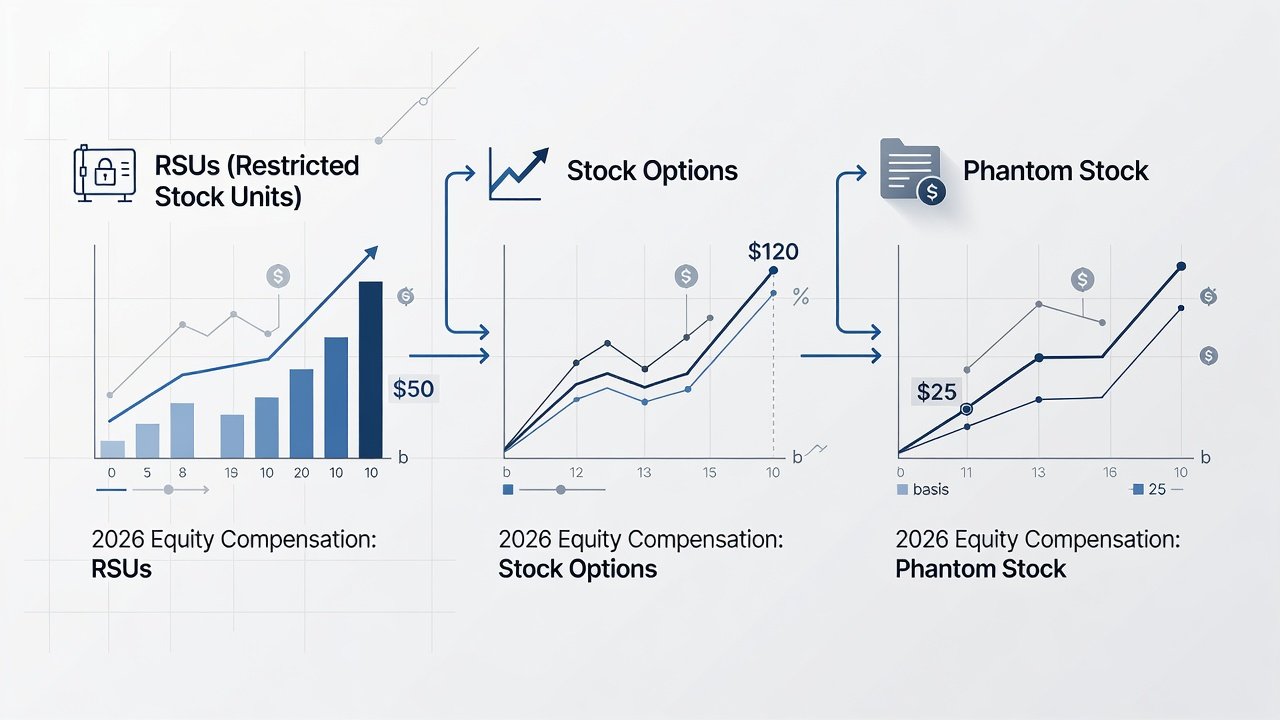
Restricted stock units represent a contractual right to receive company shares once specific vesting criteria are met. In 2026, accurate RSU valuation begins with determining the grant-date fair market value, which is typically the closing stock price on the grant date for public companies. For private firms, this requires independent appraisals that consider revenue multiples, comparable transactions, and projected growth rates. Professionals should apply a step-by-step process: first, identify the number of units granted and the vesting schedule; second, estimate the probability of meeting performance milestones if applicable; third, discount future expected values using risk-adjusted rates derived from the company's beta and prevailing interest rates. Additional considerations include forfeiture risk due to employment termination and potential dilution from future equity issuances. For example, a mid-level engineer at a Series C startup might receive 10,000 RSUs valued at an appraised $25 per share, but after applying a 20% forfeiture discount and liquidity adjustment, the effective present value could drop by 15-25% depending on the company's path to liquidity.
Practical Steps for Accurate RSU Modeling
- Review the grant agreement for exact vesting terms and acceleration clauses.
- Use company-provided 409A valuations as a baseline and cross-reference with public market data where available.
- Model multiple scenarios including best-case, base-case, and worst-case share price trajectories over the vesting period.
Stock Options: Advanced Valuation Techniques
Stock options provide the right to buy shares at a predetermined strike price, making their valuation more sensitive to time, volatility, and interest rates than RSUs. The 2026 standard incorporates sophisticated models such as the Black-Scholes-Merton framework for European-style options and binomial lattices for American options that allow early exercise. Monte Carlo simulations are increasingly used to account for path-dependent features like performance vesting. Begin by calculating intrinsic value as the difference between current fair market value and strike price, then layer on time value based on expected volatility over the option term. Industry comparisons reveal that technology companies often assume higher volatility inputs (around 40-60%) compared to financial services firms (25-40%), resulting in higher option values in growth-oriented sectors. Common pitfalls include ignoring early exercise windows or underestimating tax implications at exercise. A finance manager holding 5,000 options with a $50 strike price might see substantial upside if the stock reaches $120, but must factor in the cost of capital tied up in exercising.
Phantom Stock Plans and Their Unique Valuation
Phantom stock plans simulate equity ownership by tying payouts to increases in company valuation without issuing actual shares, making them ideal for private companies concerned about dilution or shareholder limits. Valuation typically relies on periodic internal or external appraisals using metrics such as EBITDA multiples, revenue growth, or discounted cash flow models. In 2026, these plans often incorporate caps or floors to manage risk. Professionals should track the underlying valuation formula closely and request transparency on appraisal methodologies. Compared to RSUs and options, phantom stock offers more predictable cash-like outcomes but may lack the upside potential of actual equity in a successful exit.
Tax Implications Across Equity Types
Tax treatment represents one of the most critical aspects of equity valuation and varies by instrument and jurisdiction. RSUs are generally taxed as ordinary income at vesting based on the fair market value of shares received, with subsequent gains or losses treated as capital gains. Non-qualified stock options trigger ordinary income at exercise, while incentive stock options may qualify for preferential capital gains treatment if holding periods are satisfied. Phantom stock payouts are almost always taxed as ordinary income upon settlement. Liquidity events such as IPOs, acquisitions, or tender offers can accelerate taxation, requiring proactive planning to manage cash flow for tax liabilities. Refer to authoritative resources from the IRS for current guidelines and the SEC for disclosure requirements that affect valuation transparency. Mistakes to avoid include failing to set aside funds for estimated taxes or overlooking state-level tax obligations in multi-jurisdiction roles.

Vesting Schedules, Liquidity Events, and Scenario Planning
Vesting schedules in 2026 commonly follow a four-year timeline with one-year cliffs, though many companies now incorporate monthly vesting after the initial period or performance-based accelerators. Liquidity events introduce additional complexity, as they can trigger immediate vesting or cash settlements. Professionals should build scenario models that incorporate probability-weighted outcomes for different exit timelines, such as a three-year IPO versus a five-year acquisition. This approach helps quantify the range of possible realized values and informs decisions around holding or selling post-liquidity.
Negotiation Scripts, Checklists, and Total Compensation Assessment
Effective negotiation begins with data-driven scripts such as: "Based on current market data for similar roles, I propose increasing the equity component by aligning the RSU grant with top-quartile benchmarks while maintaining the base salary." Follow up with questions about refresh grant policies and acceleration terms. Use a detailed checklist to evaluate offers: confirm strike prices and grant dates, calculate fully diluted share counts, assess currency conversion impacts for international roles, and factor in cost-of-living adjustments using regional indices. Compare equity value against base salary, bonuses, and benefits to determine the true total compensation picture. For global positions, adjust for foreign exchange rates and local tax treaties to avoid over- or under-estimating net worth.
Real-World Case Studies from Tech and Finance
Consider a 2025 tech case where a product manager at a late-stage startup negotiated an additional 8,000 RSUs by highlighting comparable offers from competitors, resulting in a 30% higher equity value upon the company's 2026 IPO. In finance, a vice president at a multinational bank used phantom stock modeling to secure a payout structure that accounted for currency fluctuations, preserving value across EUR and USD conversions. These examples underscore the importance of proactive valuation and negotiation.
Global Roles: Currency Adjustments and COL Factors
International assignments require careful adjustments for currency risk and cost-of-living differences. Convert equity values using forward exchange rates and apply localized purchasing power metrics to ensure apples-to-apples comparisons. Failure to do so can lead to significant discrepancies in perceived compensation value.
FAQs on Common Pitfalls and Refresh Strategies
- How do I handle unexpected vesting acceleration? Model tax impacts immediately and consult a tax advisor.
- What refresh strategies work best? Request performance-tied grants that vest over additional periods to maintain alignment with company growth.
- Which valuation mistakes are most costly? Overlooking forfeiture rates or using outdated volatility assumptions can distort decision-making.
- How often should I revalue my equity? Conduct quarterly reviews aligned with earnings reports or major company announcements.
By applying these principles consistently, professionals can navigate 2026 equity compensation with greater confidence and optimize their financial outcomes across diverse career paths.

No comments yet. Be the first!