 Jobboy

Introduction to Equity Refreshes in Private Companies
Professionals in private firms often rely on equity as a major component of long-term compensation beyond base salary. In 2026, effective equity refresh strategies help maximize value amid evolving market conditions in tech and finance sectors. This guide explores advanced negotiation tactics, valuation methods, and integration with benefits and bonuses. Equity refreshes are particularly critical for mid-career employees who have seen their initial grants vest partially while facing dilution from subsequent funding rounds. Understanding these dynamics allows individuals to secure packages that reflect both personal contributions and company trajectory without relying solely on base salary increases.
Understanding RSU Valuation in Private Firms
Restricted Stock Units (RSUs) remain a cornerstone of equity compensation. Valuation in private companies requires careful assessment of 409A valuations and recent funding rounds. Step-by-step, start by reviewing the latest independent appraisal, then compare against comparable public company multiples adjusted for illiquidity discounts. Next, factor in the company's revenue growth, burn rate, and path to liquidity events such as IPO or acquisition. Professionals should also request sensitivity analysis showing how different exit valuations would affect their personal holdings.
Step-by-Step Vesting Schedule Assessment
- Map out the original grant's vesting timeline against current performance milestones.
- Evaluate acceleration clauses triggered by change of control or termination.
- Model dilution impacts from new funding rounds on your ownership percentage.
- Assess the probability of future refreshes based on company retention policies.
- Calculate the net present value of unvested equity using conservative discount rates.
Real-world examples from tech startups show how mid-level engineers negotiated refreshed grants with four-year vesting plus one-year cliffs to align with company growth phases. In one finance sector case, a senior analyst at a Series C company secured an RSU refresh that included performance-based accelerators tied to ARR targets, resulting in a 40 percent increase in effective ownership over three years.
Phantom Stock and Profit-Sharing Alternatives
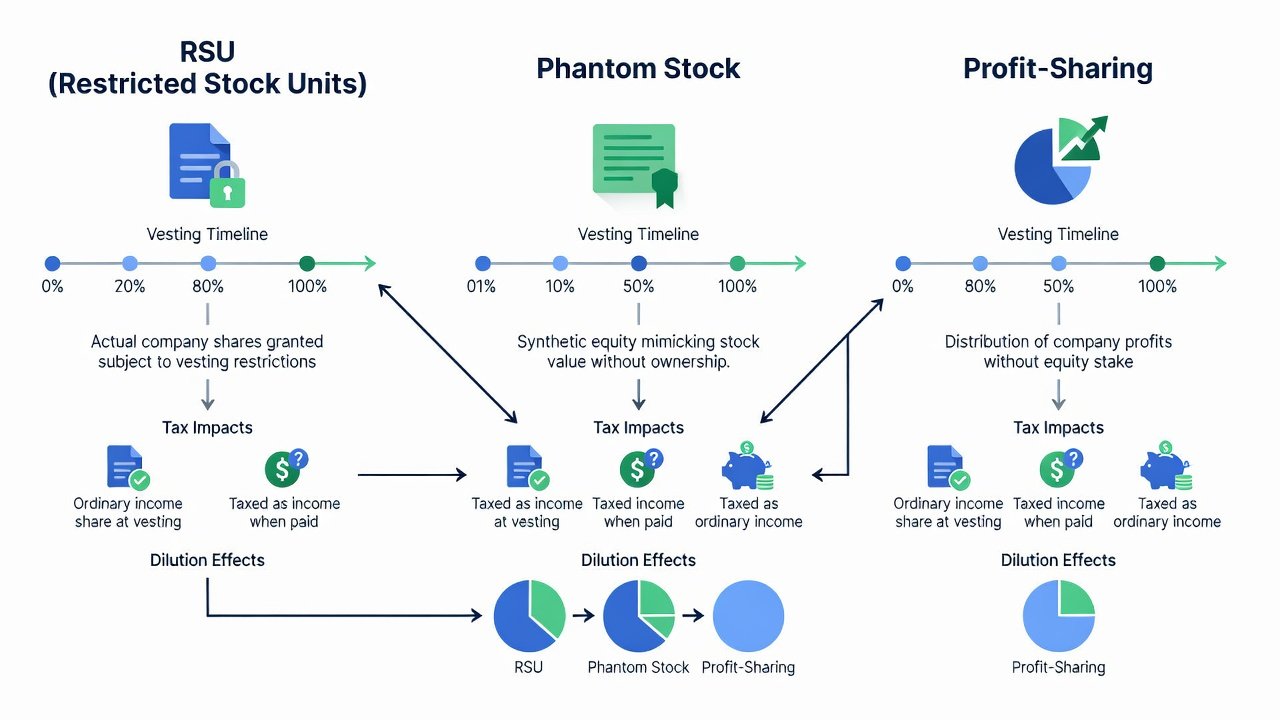
When RSUs face valuation challenges, phantom stock plans offer cash-settled equivalents tied to company value. Profit-sharing structures provide annual payouts based on performance metrics. These alternatives reduce dilution risks while delivering similar upside. Phantom stock can be structured with deferred payouts to manage company cash flow, and profit-sharing often includes caps or floors to balance employee and investor interests. Companies in the finance sector frequently use these vehicles during pre-IPO stages to retain talent without issuing additional common stock.
IRS guidelines detail tax treatment differences between these vehicles. Another useful reference is the SEC resources on private company disclosures, which help employees understand reporting requirements around material events that could affect equity value.
Tax Impacts and Dilution Risk Management
Tax implications vary significantly by equity type. RSUs trigger ordinary income at vesting, while phantom stock may qualify for capital gains treatment under specific conditions. Always model after-tax proceeds using current federal and state rates. Dilution risk management involves negotiating protective provisions such as weighted average anti-dilution or participating preferred rights in refresh agreements. Employees should also consider the timing of liquidity events, as early exercises or sales can optimize tax outcomes in certain scenarios.
Real-World Examples from Tech and Finance
- A Series B fintech firm refreshed equity for finance roles using phantom stock to avoid 409A complexities, resulting in improved retention rates above 85 percent.
- Tech professionals at late-stage startups mitigated dilution by securing anti-dilution protections in refresh agreements, preserving ownership percentages even after two additional funding rounds.
- In the finance sector, a private equity firm implemented profit-sharing refreshes tied to fund performance, allowing mid-career associates to receive annual cash distributions while building long-term value.
Integrating Equity with Total Compensation
Combine equity refreshes with benefits like health stipends and performance bonuses for holistic packages. Compare offers by calculating fully loaded compensation including expected equity value over five years. Consider how benefits such as 401(k) matching, wellness programs, and professional development stipends complement equity upside. Total compensation modeling should include scenario analysis for best-case, base-case, and worst-case liquidity outcomes to set realistic expectations.
Scripts for Mid-Career Equity Discussions
Prepare for performance reviews with these sample scripts: "Based on my contributions to the recent product launch and market data on comparable roles, I'd like to discuss an equity refresh aligned with current benchmarks to reflect my impact and ensure continued alignment with company goals." Another effective approach: "I've reviewed the latest 409A valuation and would propose a refresh that includes both time-based and performance-based components to balance risk and reward." Follow up by asking about vesting schedules, tax gross-ups, and potential for future adjustments during subsequent reviews.
Comparisons of Equity Types
| Equity Type | Pros | Cons | Best For |
|---|---|---|---|
| RSUs | Direct ownership potential, clear path to liquidity | Tax at vesting, dilution risk | Companies nearing IPO |
| Phantom Stock | No dilution, flexible payouts, easier administration | Cash flow dependency, limited upside in some structures | Private firms focused on retention |
| Profit Sharing | Annual liquidity, performance alignment | Less upside in exits, variable payouts | Stable revenue companies |
Further comparison reveals that RSUs suit high-growth environments, while phantom stock excels in cash-rich but equity-constrained firms. Profit-sharing works well for roles with measurable annual contributions.
FAQs on Timing Equity Refreshes
When should I request a refresh? Align requests with annual performance reviews or after major milestones like funding rounds or key product launches to demonstrate value.
How do market benchmarks influence negotiations? Reference recent private company data from reliable compensation surveys to support your ask with objective evidence.
What if the company pushes back on valuation? Request a joint review of the 409A appraisal and propose alternative structures like phantom stock to bridge gaps.
Can I negotiate multiple refreshes? Yes, many firms allow periodic refreshes every 12 to 24 months for high performers, especially in competitive talent markets.
Conclusion
Strategic equity refreshes in 2026 private firms demand proactive analysis of valuation, taxes, dilution risks, and total rewards integration. By applying these tactics—including detailed vesting assessments, alternative structures like phantom stock, and well-prepared discussion scripts—professionals can enhance long-term earnings potential while aligning personal incentives with company success. Regular review of these elements ensures compensation remains competitive and rewarding over time.
No comments yet. Be the first!