 Jobboy

Introduction: Why Professional Memberships Matter on Modern Resumes
In 2026, recruiters and applicant tracking systems (ATS) continue to prioritize evidence of ongoing professional development. Listing memberships in associations demonstrates commitment to your field, networking capabilities, and access to industry resources. When done strategically, these entries can differentiate your application from competitors, especially in competitive sectors like technology, healthcare, and finance. This guide provides a complete, ATS-optimized approach to showcasing professional memberships on your resume, helping you stand out while avoiding common mistakes that could harm your chances.
Strategic Placement Options for Professional Memberships
Deciding where to position memberships depends on your career stage and the relevance of the associations. Two primary approaches exist: creating a dedicated section or integrating entries into your professional experience. Understanding when to use each method ensures your resume flows logically and highlights your strengths effectively.
Dedicated Memberships Section
A standalone section titled "Professional Memberships" or "Affiliations" works best when you hold multiple relevant memberships. Place this section after your work experience or education, depending on which is more prominent. This format allows quick scanning by recruiters and ATS software that looks for keyword matches. For mid-level professionals with three or more active affiliations, this dedicated area creates visual balance and emphasizes continuous learning without interrupting the narrative of your career progression.
Integration into Experience or Skills Sections
For career changers or those with limited space, weave memberships into your experience bullets. For example, under a role description, note "Maintained active membership in the Project Management Institute, applying PMBOK standards to deliver 12 projects on time." This method reinforces skills without creating a separate section and helps tie your affiliations directly to measurable accomplishments. Senior professionals often benefit from this approach when space is tight, allowing them to embed leadership roles within existing job entries.
Examples Tailored for Career Changers and Senior Professionals
Career changers benefit from highlighting transferable memberships that bridge their past and target roles. A software engineer transitioning to data science might list: "Member, Association for Computing Machinery (ACM) since 2023 – Attended workshops on machine learning ethics and contributed to open-source projects that improved model accuracy by 15%." This shows adaptability and relevant skill-building.
Senior professionals should emphasize leadership roles within associations to showcase influence: "Board Member, American Marketing Association, 2024–2026 – Led committee that increased membership by 25% through targeted outreach campaigns." Always quantify impact where possible to show value beyond mere participation. Additional examples include healthcare professionals listing "Fellow, American College of Healthcare Executives" with details on policy contributions, or finance experts noting "Chartered Financial Analyst (CFA) Society Member" alongside mentorship programs they led.
Quantification Tips and Citation Styles
Quantify achievements tied to memberships using metrics such as events attended, certifications earned, or contributions made. Use consistent citation styles like: "Member, IEEE (Institute of Electrical and Electronics Engineers), 2021–Present." Include dates and any leadership positions for added credibility. Avoid vague entries; instead, connect memberships directly to job requirements by describing specific outcomes, such as "Organized annual conference for 500+ attendees resulting in three new industry partnerships." This level of detail transforms passive listings into active proof of engagement and results.
Before-and-After Comparisons Demonstrating Impact
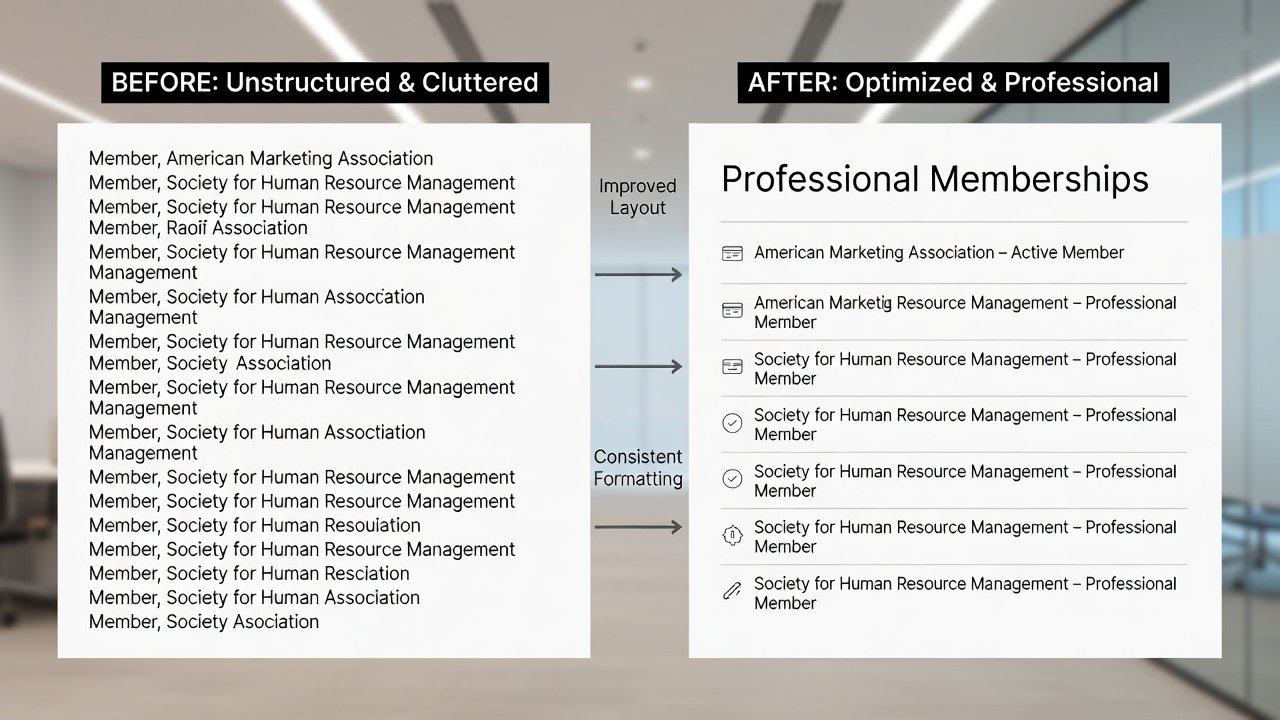
Before: "Member of several professional groups."
After: "Active Member, Society for Human Resource Management (SHRM) – Completed certification program resulting in updated compliance protocols that reduced audit findings by 40%." The revised version provides concrete evidence that resonates with both ATS algorithms and human readers. Another comparison: A generic entry like "Member, Marketing Association" becomes "Vice President, Local Chapter of American Marketing Association – Spearheaded digital campaign that boosted chapter engagement by 60% and generated 20 new member referrals." These transformations illustrate how specificity and metrics elevate your resume from ordinary to compelling.
Common Pitfalls to Avoid
- Over-listing: Limit entries to 3–5 highly relevant associations to prevent diluting your resume and overwhelming recruiters.
- Keyword stuffing: Only include terms that genuinely apply; ATS can detect unnatural repetition and penalize your application.
- Outdated information: Remove memberships from more than five years ago unless they remain highly prestigious and directly relevant to the target role.
- Irrelevant groups: Focus on industry-specific organizations rather than general networking clubs that do not align with the job description.
- Inconsistent formatting: Ensure all entries follow the same style for dates, abbreviations, and descriptions to maintain a polished appearance.
- Neglecting leadership: Failing to highlight roles like committee chair or event organizer misses opportunities to demonstrate initiative.
Formatting Best Practices and Research Strategies
Research relevant memberships by reviewing job postings for required skills and cross-referencing with association websites. Use full organization names on first mention, followed by acronyms. Format entries with consistent bullet points or simple lines, and consider adding a one-line description only when it adds quantifiable value. For multi-page resumes, prioritize the most recent and impactful affiliations at the top of the section.
Industry-Specific Considerations in 2026
In technology fields, emphasize memberships like ACM or IEEE that align with emerging trends such as AI ethics. Healthcare resumes benefit from clinical associations that highlight compliance knowledge. Finance professionals should focus on CFA or similar groups to signal regulatory expertise. Tailoring ensures ATS compatibility while appealing to niche recruiters.
Impact on Recruiter Perception and ATS Scoring
Recruiters view professional memberships as signals of dedication and currency in your field. Well-placed entries can increase callback rates by demonstrating proactive career management. ATS systems often score resumes higher when keywords from job descriptions appear naturally within membership contexts, improving overall ranking in applicant pools.
Actionable Checklist for Listing Memberships
- Review the job description and select only matching associations.
- Choose placement based on career stage and resume length.
- Quantify contributions with specific numbers and results.
- Verify all dates and leadership roles are accurate.
- Proofread for consistent formatting and spelling.
- Test the resume through an ATS simulator before submission.
- Update memberships annually to reflect current status.
FAQ: Relevance for ATS and Recruiter Scanning
Do professional memberships improve ATS scores?
Yes, when they contain keywords from the job posting. Relevant memberships signal domain expertise that many ATS systems are programmed to flag positively, especially when paired with action-oriented descriptions.
How many memberships should I include?
Three to five targeted entries are ideal. Prioritize quality and relevance over quantity to maintain a focused, professional impression that does not overwhelm the reader.
Should I list expired memberships?
Only if they are still prestigious and directly related to the role. Otherwise, focus on current, active affiliations to reflect ongoing engagement and avoid appearing stagnant.
Can memberships replace work experience gaps?
They can help bridge gaps when described with active involvement, such as volunteer leadership roles, but they should supplement rather than replace core employment history.
For additional guidance on resume best practices, consult resources from CareerOneStop and LinkedIn.

No comments yet. Be the first!