 Jobboy

Introduction
In 2026, professional affiliations continue to serve as a critical differentiator on resumes, helping candidates showcase ongoing commitment to their field and active engagement with industry networks. As applicant tracking systems evolve with more sophisticated natural language processing, recruiters rely on these sections to quickly identify candidates who demonstrate leadership, specialized knowledge, and peer recognition. This comprehensive guide explores every aspect of listing professional affiliations effectively, from strategic placement and ATS-friendly formatting to impact quantification and relevance filtering. Whether you are a mid-career professional or a career changer, understanding how to present these credentials can significantly improve your resume's performance in both automated scans and human reviews.
Why Professional Affiliations Matter in 2026
Professional memberships signal to employers that you invest in continuous learning and stay current with industry trends. In a job market where skills evolve rapidly, affiliations provide tangible proof of your dedication beyond basic employment history. They also offer networking opportunities that can lead to referrals and insider knowledge about open roles. For ATS compatibility, these entries often contain keywords that align directly with job descriptions, boosting match rates. Recruiters frequently note that candidates who actively participate in associations tend to adapt better to new challenges and bring fresh perspectives to teams.
Strategic Placement on Your Resume
The ideal location for your Professional Affiliations section depends on your career stage and resume format. In a standard chronological resume, position it after your Professional Experience section and before Education to maintain focus on achievements while highlighting credentials. For functional or skills-based resumes, integrate it earlier, perhaps immediately following a Summary or Core Competencies area, to emphasize transferable qualifications early. Mid-career professionals with 10+ years of experience may benefit from placing strong affiliations near the top if they directly support the target role. Career changers should consider merging the section with skills to create a unified narrative of expertise. Always ensure the section does not exceed one-quarter of the page to avoid diluting more critical content like work history.
Citation Formats for ATS Optimization
ATS software parses text linearly, so clarity and consistency are essential. Use this reliable format: Organization Name, Your Role or Membership Type, Start Year–End Year or Present. Examples include "Society for Human Resource Management, Certified Professional, 2021–Present" or "Institute of Electrical and Electronics Engineers, Senior Member, 2019–Present." Incorporate full organization names rather than acronyms on first mention, followed by the abbreviation in parentheses if space allows. Avoid decorative elements like bullets within the entry itself, and list entries in reverse chronological order. This approach ensures dates, roles, and organizations are extracted accurately during parsing.
Quantifying Impact and Relevance Filtering
Transform passive memberships into compelling statements by quantifying your contributions. Instead of simply naming the group, describe outcomes such as "Organized quarterly workshops for 150 members, resulting in improved certification pass rates." Relevance filtering requires reviewing each affiliation against the specific job posting. Retain only those that contain matching keywords or demonstrate skills listed in the description. Remove any groups unrelated to the role or inactive for more than five years. This selective approach keeps your resume concise while maximizing keyword density for ATS algorithms.
Before-and-After Examples
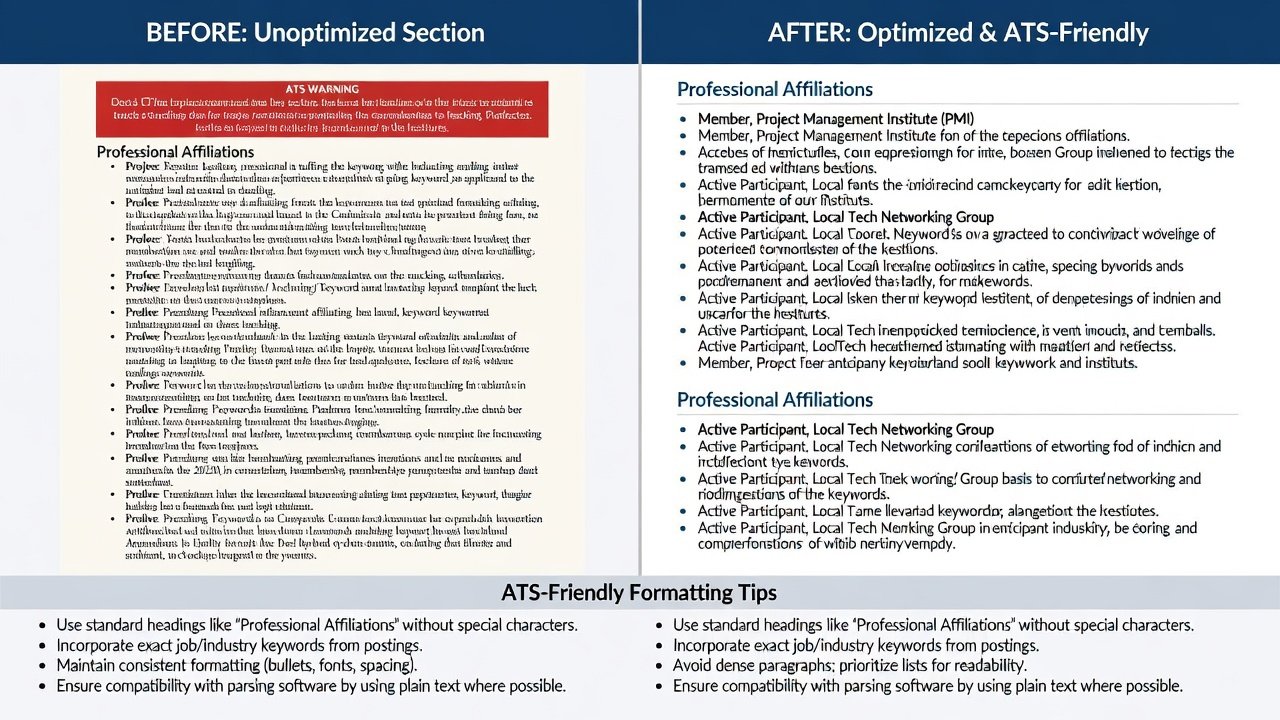
Before: "Member of professional organizations." After: "Project Management Institute, PMP Certified Member, 2022–Present: Facilitated monthly knowledge-sharing sessions attended by 80 professionals, contributing to a 25% increase in chapter engagement metrics." Another transformation: Before: "Various industry associations." After: "American Institute of Certified Public Accountants, Committee Chair, 2023–Present: Led regulatory update reviews that informed policy recommendations adopted by 12 regional firms."
Checklist for Selecting Affiliations
- Verify alignment with at least three keywords from the target job description
- Confirm active status and recent participation within the last two years
- Prioritize leadership positions or measurable contributions over basic membership
- Limit the list to four or five entries maximum for readability
- Exclude student or alumni groups unless transitioning directly into academia
- Cross-check spelling and official organization names for accuracy
Integrating with Skills Sections
Strengthen your resume by linking affiliations to specific skills. If you list "Data Analysis" as a core competency, reference your membership in the Data Science Association in the same area or nearby. This creates a cohesive story that reinforces expertise. Use parallel language where possible, such as repeating key phrases from the job posting across both sections. This technique improves ATS scoring while providing context for human readers scanning quickly.
Common Pitfalls to Avoid
Many candidates make the mistake of listing every affiliation they have ever joined, resulting in a cluttered section that appears unfocused. Another frequent error is using vague language without outcomes or dates. Including political or controversial groups can also introduce unintended bias. Overuse of acronyms without explanation confuses both ATS and recruiters unfamiliar with niche organizations. Finally, failing to update the section when memberships lapse can damage credibility during background checks.
STAR-Style Examples
Mid-Career Professional: Situation: A marketing manager joined the American Marketing Association in 2020 amid industry shifts. Task: Increase local chapter visibility. Action: Developed a digital campaign that attracted 300 new members through targeted webinars and networking events. Result: The chapter received a national excellence award, and the manager advanced to regional board leadership within 18 months.
Career Changer: Situation: An educator transitioning to corporate training joined the Association for Talent Development. Task: Build relevant credentials quickly. Action: Completed two certification programs and volunteered as a session moderator at the annual conference. Result: Landed three interviews citing the affiliation and secured a role with a 30% salary increase by demonstrating practical training expertise.
Recruiter Insights on What Stands Out
Experienced recruiters emphasize that quantified achievements within affiliations create the strongest impressions. They recommend maintaining an updated profile on LinkedIn that mirrors resume entries for easy verification. Active involvement, such as speaking engagements or committee work, signals initiative more effectively than passive membership. Recruiters also advise tailoring the section for each application rather than using a generic list, as this demonstrates genuine interest in the specific opportunity.
Advanced ATS Techniques for 2026
Stay ahead by incorporating emerging best practices. Use standard section headings like "Professional Affiliations" exactly, as variations can reduce parsing accuracy. Include relevant certifications earned through the affiliation immediately below each entry. Test your resume against free ATS simulators available on career sites to identify any formatting issues before submission. Incorporate industry-specific terminology naturally within descriptions to align with evolving keyword databases.
Industry-Specific Strategies
In technology fields, highlight affiliations like the Association for Computing Machinery with details on open-source contributions. Healthcare professionals should emphasize groups such as the American Nurses Association and any patient safety initiatives led. Finance candidates benefit from detailing roles in the CFA Institute, including ethics training participation. Each sector values different aspects, so research target employers' preferred associations through their career pages on Indeed.
How to Maintain and Update Affiliations
Regularly review your memberships quarterly to ensure accuracy. When adding new affiliations, immediately document any leadership activities for future resume updates. Set calendar reminders for renewal dates to avoid lapses that could create gaps. For long-term members, periodically refresh older entries with recent activities to keep the section dynamic and relevant.
Downloadable Template
Access our professionally designed 2026 resume template featuring optimized sections for professional affiliations, complete with placeholder examples and formatting guides tailored for ATS compatibility.
Conclusion
Effectively listing professional affiliations on your 2026 resume requires thoughtful selection, precise formatting, and strategic integration with the rest of your document. By following the strategies outlined above, including checklists, quantified examples, and industry insights, you can create a compelling section that enhances both ATS performance and recruiter engagement. Consistent updates and tailoring will ensure your resume remains a powerful tool throughout your career journey.
FAQ
How do I list affiliations for niche industries like healthcare?
Focus on organizations such as the American Medical Association or specialty boards, quantifying any involvement in research, policy development, or continuing education programs that demonstrate patient care improvements.
Should I include expired memberships?
Include them only if they are recent, directly relevant to the role, and you held a leadership position; otherwise, omit them to maintain a current and focused professional narrative.
What if I have too many affiliations?
Select the four or five strongest matches to the job description and move the remainder to your LinkedIn profile, where space is less limited and additional context can be added.
Can student affiliations help during a career change?
Yes, when transitioning fields, recent student memberships in professional groups can bridge gaps by showing proactive skill-building and networking efforts in the new industry.
How often should I update the affiliations section?
Review and refresh the section every six months or whenever you achieve a new milestone, certification, or leadership role within an organization to keep information accurate and impactful.

No comments yet. Be the first!