 Jobboy

Introduction
Professional affiliations demonstrate your commitment to industry standards and ongoing development. In 2026, recruiters and applicant tracking systems (ATS) evaluate these sections for relevance and impact. This guide covers selection criteria, optimal formatting, quantified examples, and integration techniques tailored for career changers and tech professionals. Understanding how to present these memberships effectively can elevate your resume from standard to standout, especially in a job market where employers seek candidates who actively engage with their fields beyond daily work duties.
Why Professional Affiliations Matter in 2026
Affiliations signal expertise and networking prowess. They help differentiate candidates in competitive fields by showing active participation in associations like the Project Management Institute or IEEE. Recruiters note that well-chosen memberships can boost interview callbacks when tied to job requirements. In today's evolving workplace, where remote collaboration and continuous learning are emphasized, these entries highlight your dedication to staying current with trends, regulations, and best practices. For instance, membership in a data privacy association can underscore your awareness of evolving compliance issues, making you more attractive to tech firms handling sensitive information.
Selecting the Right Affiliations
Evaluate groups based on industry alignment, leadership roles held, and recent activity. Prioritize organizations offering certifications or events that match target roles. Avoid listing every membership; focus on those adding value rather than padding length. Consider factors such as the organization's reputation, the frequency of your involvement, and how it aligns with emerging 2026 priorities like sustainability or AI ethics. Research each group thoroughly by reviewing their websites and recent publications to ensure they reflect positively on your professional brand.
Criteria Checklist
- Relevance to the position applied for – Match the affiliation directly to keywords in the job posting.
- Active participation within the last two years – Include only current or recently active roles to avoid appearing disengaged.
- Opportunities for skill validation or awards – Highlight any leadership positions or recognitions received.
- International recognition for global roles – Essential for multinational applications where cross-border expertise is valued.
- Cost-benefit analysis – Weigh annual dues against tangible career benefits like access to exclusive job boards or conferences.
Strategic Placement on Your Resume
Position the affiliations section after experience or education for most applicants. For senior professionals, integrate it near the top if memberships highlight executive leadership. Career changers benefit from blending it with skills to bridge gaps. In a standard one-page resume, place it in the lower half to maintain focus on core achievements first. If you hold multiple high-profile roles, create a dedicated subsection under a broader "Professional Development" heading to keep the layout clean and scannable.
ATS-Friendly Formatting Techniques
Use standard headings like "Professional Affiliations" and bullet points for readability. Spell out acronyms on first mention, such as "American Marketing Association (AMA)." Avoid tables or graphics that confuse parsing software. Incorporate industry-specific keywords naturally within descriptions to improve matching algorithms. For example, if applying to a healthcare role, mention affiliations with terms like "HIPAA compliance" or "patient advocacy" if relevant to your involvement. Test your resume by pasting it into free ATS simulators to verify the section parses correctly without errors.
Quantifying Impact with Examples
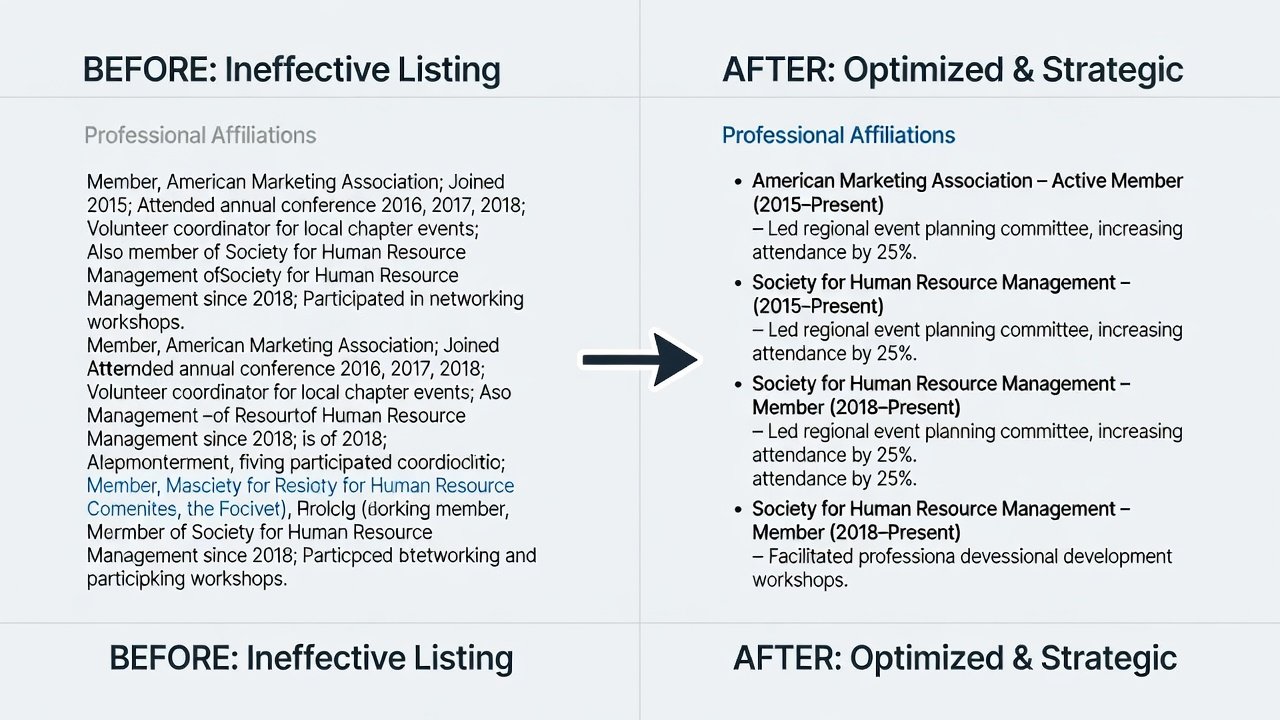
Transform basic listings into achievement-oriented entries. Instead of "Member, PMI," write "Active PMI member since 2023; contributed to 3 local chapter events attended by 150 professionals, resulting in two new project management methodologies adopted by attendees." This approach quantifies engagement for stronger impact. Always tie your involvement to measurable outcomes, such as increased membership numbers, event attendance growth, or skills gained that directly apply to the target job. In tech roles, quantify contributions like "Led virtual workshops on machine learning ethics for 200+ members, enhancing community knowledge on responsible AI deployment."
Before-and-After Samples
Before: Member, Society for Human Resource Management
After: Society for Human Resource Management (SHRM) – Chapter Volunteer, 2024-2026; organized 4 workshops improving member retention by 22% and facilitated networking sessions that connected 75 professionals with new opportunities.
Another example for a software engineer: Before: Member, Association for Computing Machinery. After: Association for Computing Machinery (ACM) – Special Interest Group Participant, 2023-2026; presented at two annual conferences on cloud computing advancements, influencing session content for over 500 attendees and earning recognition for innovative case studies.
Common Pitfalls and Avoidance Checklist
Recruiters warn against outdated entries or irrelevant groups that clutter pages. Use this checklist: verify expiration dates, limit to 3-5 entries, and ensure each aligns with the job description. Additional pitfalls include failing to update entries after role changes, using vague language without outcomes, and listing student or honorary memberships without context. To avoid these, review your resume quarterly and solicit feedback from mentors in your industry. Always proofread for consistency in date formats and terminology across the entire document.
Recruiter Insights on Credibility vs. Clutter
Industry experts from major platforms emphasize that affiliations enhance profiles when they reflect genuine involvement. Overloading with honorary or expired groups often leads to quick dismissals during initial screens. One common observation is that candidates who selectively highlight 2-4 key affiliations with action verbs and results stand out more than those with long, unprioritized lists. Recruiters appreciate when entries demonstrate progression, such as moving from member to committee chair, as this shows leadership growth over time.
Integration with Skills and Experience for Career Changers
Tech professionals and career switchers can merge affiliations into a "Professional Development" section. Link memberships to transferable skills, such as using an AI ethics group to support data science transitions. For example, a marketing professional shifting to tech might list an affiliation with a digital analytics association alongside skills like "data visualization" to create a cohesive narrative. This integration helps bridge experience gaps by showing proactive learning and network building in the new field.
Handling Expired Memberships and International Organizations: FAQs
How should I handle lapsed memberships?
List only active ones unless the expired role included notable leadership. Note the timeframe clearly if inclusion adds context, such as "Former Board Member, 2022-2024, during which membership grew 15%."
Are international organizations worth including?
Yes, for roles requiring global awareness. Reference bodies like the LinkedIn professional network guidelines for formatting worldwide credentials.
Should affiliations appear on every application?
Tailor per role. Research target companies via Indeed to match listed preferences and adjust accordingly.
What about student or entry-level memberships?
Include them if they provided substantial experience, like conference presentations or mentorship programs, but transition them to professional status as your career advances.
How do I verify if an organization is reputable in 2026?
Check for official accreditation, active online presence, and peer reviews on established career sites. Cross-reference with industry standards from sources like the CareerOneStop for validated professional development pathways.
Conclusion
Strategic listing of professional affiliations strengthens resumes when executed with precision. Apply these methods to create ATS-optimized, recruiter-friendly sections that highlight your professional growth in 2026. By focusing on relevance, quantification, and thoughtful placement, you position yourself as a dedicated and connected professional ready for new opportunities.
No comments yet. Be the first!