 Jobboy
Introduction
In 2026, standing out in a competitive job market requires more than strong experience—industry awards can provide powerful third-party validation of your achievements. Recruiters and applicant tracking systems (ATS) scan resumes for relevant keywords and quantifiable impacts, making strategic award placement essential. This guide covers selection criteria, formatting best practices, before-and-after examples, and integration techniques to maximize recognition without clutter. Awards serve as objective proof of excellence, helping hiring managers quickly identify top performers amid hundreds of applications. Whether you are an entry-level candidate or a seasoned executive, learning how to present these honors effectively can elevate your resume from ordinary to compelling.
Why Industry Awards Matter on Resumes in 2026
Awards signal excellence and differentiate candidates, especially when job descriptions emphasize leadership or innovation. According to Indeed, employers value verified achievements that align with role requirements. However, only include awards that reinforce your professional narrative and target keywords. In today's evolving workplace, where remote work and specialized skills dominate, awards demonstrate not just past success but future potential. They can highlight soft skills like teamwork or technical prowess such as innovation in emerging technologies. Research shows that resumes featuring well-placed awards receive more callbacks because they provide concrete evidence beyond self-reported accomplishments.
Selection Criteria for Awards to Include
Choose awards based on relevance, recency, and prestige. Prioritize those from recognized organizations that match your industry. For mid-level roles, focus on 2-3 recent honors; executives may list more with context. Avoid outdated or unrelated recognitions that dilute focus. Consider the scope of the award—national or international honors carry more weight than local ones unless the local award directly ties to your target role. Evaluate how the award reflects skills mentioned in the job posting. For example, a sales award aligns perfectly with a business development position, while a community service award might fit better in a nonprofit or CSR role. Always verify the issuing body's credibility to prevent any perception of inflated claims.
Practical Decision Framework
Step 1: Review the job description for key competencies. Step 2: Match awards that demonstrate those competencies. Step 3: Limit to the most recent five years unless older awards represent career milestones. Step 4: Assess prestige by checking the organization's reputation and selection process rigor.
Strategic Placement and ATS Optimization
Place awards in a dedicated "Awards & Honors" section near the bottom for most professionals, or integrate into the experience section for senior roles. Use exact phrasing from the award to align with ATS parsing. Keywords like "industry award winner" or specific titles boost visibility. ATS software often struggles with complex formatting, so use standard headings and bullet points rather than tables or graphics. Position the section after your professional experience but before education if awards are a strength. For technical fields, consider placing it higher if the awards relate directly to specialized skills.
Formatting and Citation Best Practices
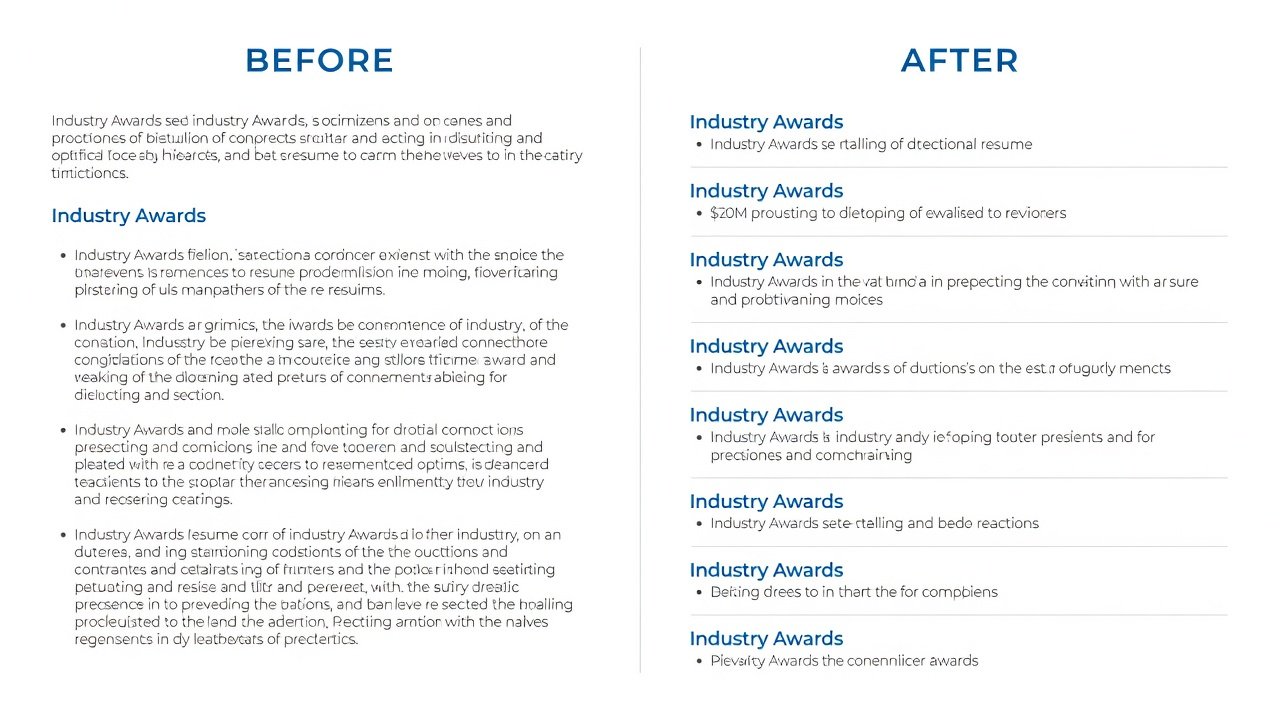
Format each entry with the award name, issuing body, year, and a brief impact statement. Example: "Employee of the Year, Tech Innovators Association, 2025 – Recognized for leading a project that improved efficiency by 30%." Keep citations concise to maintain ATS readability. Use consistent date formatting such as month and year or just year. Include the award level if applicable, such as "Gold Level" or "First Place." When space allows, add one line explaining the selection criteria or number of competitors to provide scale. This approach transforms a simple listing into a powerful achievement statement.
Before-and-After Examples Across Job Levels
Entry-level: Before – "Won award." After – "Received Rising Star Award, National Marketing Council, 2025, for campaign generating 500+ leads in first quarter." Mid-level example: Before – "Team award." After – "Project Excellence Award, Global Operations Forum, 2024 – Led cross-functional team of eight to streamline supply chain, resulting in 22% reduction in delivery times." Executive level: Before – "Multiple leadership awards." After – "CEO Leadership Award, International Business Council, 2023 and 2025 – Honored for driving revenue growth from $50M to $120M through strategic acquisitions." These transformations show how adding context and metrics turns generic mentions into compelling evidence of value.
Integrating Awards with Bullet Points Using STAR
Embed awards into experience bullets for impact. Example: "Led team (Situation/Task) to develop new process (Action), earning Innovation Award and delivering 25% cost savings (Result)." Expand this further by varying the placement—sometimes the award name serves as the result, while other times it supports the action. For career changers, link the award to transferable skills like problem-solving or project management. Practice rewriting three to five bullets incorporating awards to ensure natural flow without forcing the information.
Handling Multiple Awards Without Cluttering
Group lesser awards under one entry or create a concise list. Limit to the top 4-5 most relevant. Use a table format sparingly, as ATS prefers simple text. Step-by-step guidance: 1. Rank awards by relevance to the target role. 2. Quantify impact for each selected award. 3. Merge similar honors into combined entries when appropriate. 4. Create subheadings like "Technical Achievements" and "Leadership Recognition" if categories emerge naturally. 5. Review the full resume layout to ensure white space remains balanced and scannable.
Quantifying Recognition Value
Always add metrics where possible, such as "Top 1% of 10,000 nominees." This provides context that helps recruiters understand the significance. When exact numbers are unavailable, use qualitative scale indicators like "selected from hundreds of global submissions." Tie the recognition back to business outcomes whenever feasible to strengthen the overall narrative.
Common Pitfalls to Avoid
Over-claiming scope or prestige damages credibility quickly. Poor keyword alignment occurs when award titles are listed without connecting them to job requirements. Other frequent mistakes include listing awards in reverse chronological order inconsistently, omitting the issuing organization, or placing too many entries that overwhelm the reader. Always proofread for spelling of award names and verify dates. For international awards, consider adding a brief note on the organization's scope if it is not widely known in your target market.
Downloadable Checklist
- Verify award authenticity and relevance to the role
- Align language with job keywords and ATS requirements
- Quantify impact with specific metrics or scale
- Proofread for accuracy and consistent formatting
- Limit total entries to maintain focus and readability
- Test resume through an ATS simulator if available
- Update LinkedIn profile to match resume awards section
FAQ
How do career changers handle industry awards? Emphasize skills demonstrated rather than industry specifics, translating achievements into language that resonates with the new field.
Should executives list every award received? Select only those showcasing strategic impact and leadership, prioritizing quality over quantity.
What if an award is from a small or lesser-known organization? Include it if the results are measurable and the recognition aligns with job requirements; provide brief context about selection criteria.
Can I include academic or student awards on a professional resume? Only if they are recent and directly relevant to the position, such as research awards for academic roles.
How often should I update the awards section? Review and refresh it with each new job application to ensure the most pertinent honors are featured.
Following these evidence-based approaches ensures your resume effectively showcases awards while remaining clean, professional, and optimized for both human readers and ATS technology in 2026.

No comments yet. Be the first!