 Jobboy

Introduction: Why Conference Presentations Matter on Modern Resumes
In 2026, recruiters and hiring managers increasingly value demonstrated expertise through conference presentations, especially for mid-career professionals and those in academic or technical fields. These entries signal thought leadership, communication skills, and subject-matter depth that standard job descriptions may not capture. When formatted correctly, they enhance credibility without bloating your document. Conference presentations allow candidates to stand out in competitive applicant pools by showcasing real-world application of skills, networking reach, and the ability to distill complex ideas for varied audiences. For mid-career professionals transitioning roles or seeking promotions, these details often tip the scales in favor of an interview invitation. Academic professionals benefit even more, as presentations frequently tie directly to research output and grant success. This comprehensive guide explores strategic selection, ATS-friendly citation styles, integration with work experience, real-world examples across industries, and common pitfalls to avoid. By the end, you will have actionable steps to elevate your resume effectively.
Selecting the Right Presentations to Include
Not every talk belongs on your resume. Prioritize based on relevance, recency, and impact. Focus on presentations from the past 5–7 years that align with the target role. For academic professionals, include peer-reviewed or high-profile events; for industry roles, emphasize those tied to measurable business outcomes. Consider the conference's prestige, your specific role in the session, and any follow-on opportunities that arose, such as publications, collaborations, or media mentions. Avoid listing every minor workshop; instead, curate a focused list that reinforces your professional narrative. If you have dozens of presentations, group older or less relevant ones under a summary statement like “Additional presentations at regional symposia, 2018–2022.”
Key Selection Criteria
- Relevance to the job description keywords and required competencies
- Prestige of the conference or sponsoring organization
- Quantifiable outcomes, such as audience size, session ratings, or subsequent collaborations
- Recency—favor 2023–2026 events unless older work is foundational to your expertise
- Diversity of formats, including keynotes, panels, posters, and workshops
ATS-Optimized Formatting and Citation Styles
Applicant Tracking Systems parse resumes best with clean, standard structures. Use reverse chronological order under a dedicated “Presentations” or “Speaking Engagements” section, or integrate select entries into your work experience. Preferred citation style: Conference Name, Location (if applicable), Date, Presentation Title, Role (e.g., Keynote Speaker). Avoid graphics or tables that ATS cannot read. Compare styles for different fields: technical roles may prefer concise bullet points, while humanities fields often adapt MLA or APA formats adapted for resumes. Always use standard fonts like Arial or Calibri at 10–12 point size and include exact conference names verified from official programs.
Integrating Presentations with Work Experience
Blend presentations into existing roles when they directly resulted from your position. For example, under a Project Manager role at a tech firm, add a bullet: “Delivered keynote on agile methodologies at the 2025 Global Tech Summit, attended by 1,200 professionals, resulting in two new client contracts.” This approach keeps your resume concise while highlighting achievements. If presentations were independent of a single employer, maintain a separate section but reference them briefly in experience bullets where contextually relevant. Compare this to standalone sections: integration works best for career changers, while separate sections suit academics with extensive speaking histories.
Quantifying Impact for Stronger Entries
Recruiters respond to numbers. Instead of “Presented at conference,” write “Presented research on AI ethics to 850 attendees at the 2024 International Data Science Conference, leading to three follow-up industry partnerships and a featured article in industry media.” Track metrics such as attendance figures, media coverage, or post-presentation downloads where available. When exact numbers are unavailable, use qualitative but specific language like “invited speaker for sold-out session” or “highest-rated presentation in track.”
Real-World Examples Across Industries
Academic: “Keynote: ‘Climate Policy Innovations,’ Annual Environmental Science Conference, Chicago, IL, March 2025 – Attended by 600 researchers; led to two collaborative grant proposals totaling over $1.2 million.”
Marketing: “Panelist: ‘Content Strategies for 2026,’ Digital Marketing World, virtual, September 2025 – Generated 2,300 session views and 45 post-event inquiries.”
Healthcare: “Poster Presentation: ‘Telehealth Outcomes Study,’ American Medical Association Annual Meeting, Boston, MA, May 2024 – Recognized with best poster award; cited in three subsequent peer-reviewed papers.”
Technology: “Workshop Leader: ‘Machine Learning Deployment Best Practices,’ AI Summit 2025, San Francisco, CA, June 2025 – Trained 180 engineers; materials downloaded 4,500 times.”
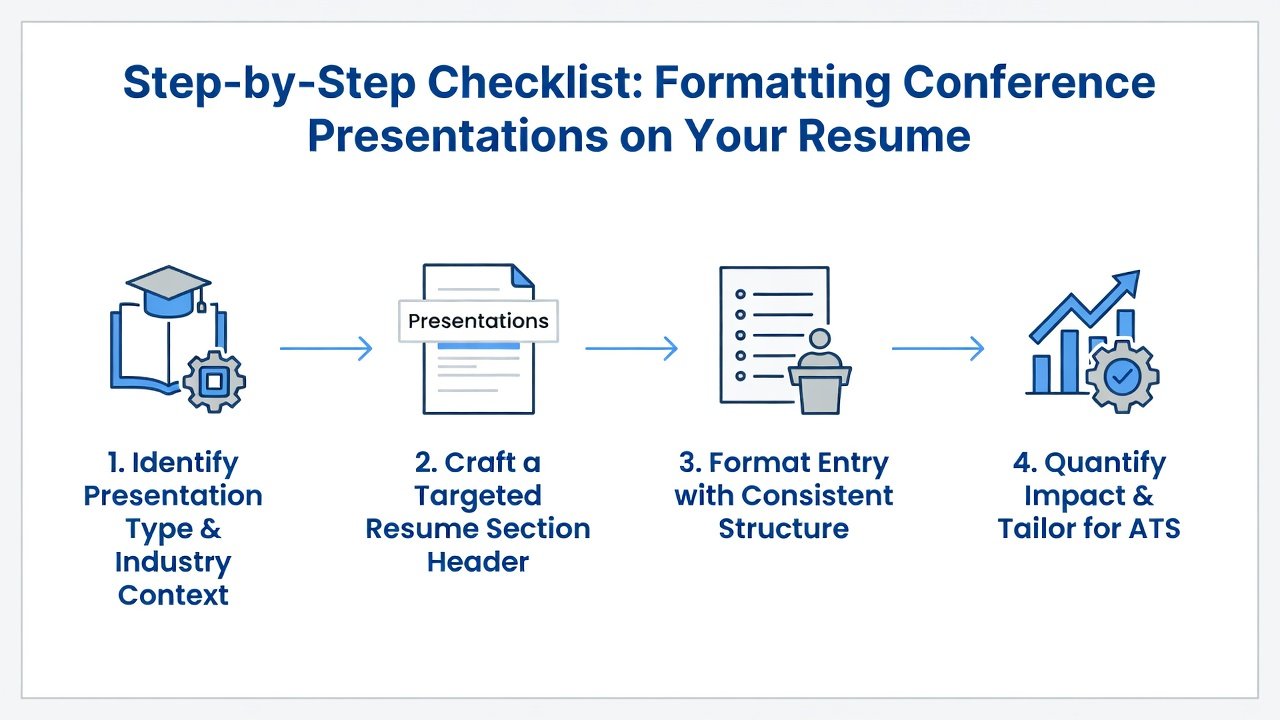
Step-by-Step Checklist for Formatting
Follow this process to ensure consistency and professionalism:
- List presentations in reverse chronological order under an appropriate heading.
- Use consistent date format (Month Year) throughout.
- Include your exact role (Presenter, Keynote Speaker, Panelist, Workshop Facilitator).
- Add 1–2 impact metrics when possible, focusing on audience reach or outcomes.
- Proofread for spelling of conference names and locations.
- Limit to 3–5 entries unless the role is highly academic or speaking-focused.
- Align language with industry norms—use formal citations for academia and action-oriented bullets for corporate roles.
- Review for ATS compatibility by copying text into a plain-text editor.
Recruiter Insights on Credibility Boost
Recruiters note that well-chosen presentations differentiate candidates in competitive fields. They demonstrate proactive professional development and the ability to synthesize complex information for diverse audiences—skills valued in both corporate and academic hiring. One common observation is that candidates who include presentations often receive more interview requests because the entries provide concrete talking points during interviews. For mid-career professionals, these details bridge gaps in traditional experience, while for academics they validate research impact beyond publications. Always tailor the level of detail to the employer; conservative industries prefer minimal entries, whereas innovative sectors appreciate bold metrics.
Common Pitfalls and How to Avoid Them
Over-listing dilutes impact; stick to the most relevant. Never include canceled or low-attendance events. Balance length by merging older presentations into a summary line if space is tight. Always verify conference names against official records. Another frequent mistake is using inconsistent formatting across entries, which signals poor attention to detail. Avoid vague titles or omitting your role. For virtual events, clearly note the format to prevent confusion. Finally, do not repeat the same presentation multiple times across sections; consolidate where appropriate.
Frequently Asked Questions
How many presentations should I list? Aim for three to five high-impact entries unless your career centers on public speaking.
Should I include student conference presentations? Only if they are recent and highly relevant to the target position; otherwise, focus on professional events.
What if the conference was virtual? Note “Virtual” after the location and emphasize engagement metrics like live attendees or recordings viewed.
Conclusion
Listing conference presentations effectively in 2026 requires strategic selection, precise formatting, and impact-focused language. When done right, these entries elevate your resume and open doors to advanced opportunities. Review your list against the checklist above before submitting applications. For additional career resources, visit LinkedIn, Indeed Career Advice, and CareerOneStop.
No comments yet. Be the first!