 Jobboy

Introduction: Why Targeted Cover Letters Matter in Career Transitions
Career switches are increasingly common in 2026 as industries evolve rapidly due to technological advancements and shifting market demands. A generic cover letter often fails to connect your past experience to a new role, but a targeted one bridges that gap effectively by demonstrating clear relevance and enthusiasm. This comprehensive guide provides step-by-step strategies, customizable templates, detailed examples, and actionable checklists to help you craft compelling letters that highlight transferable skills while aligning perfectly with job descriptions.
Employers receive hundreds of applications for each opening, making it essential for your cover letter to quickly demonstrate why you are the ideal candidate despite lacking direct industry experience. By focusing on keyword alignment, reframing your professional narrative through storytelling, and sidestepping common pitfalls, you significantly increase your chances of passing applicant tracking systems (ATS) and capturing the attention of human recruiters who value adaptability and proven problem-solving abilities.
Understanding ATS Optimization for Career Switch Cover Letters
Applicant tracking systems scan documents for specific keywords, phrases, and formatting cues pulled directly from the job posting. For career changers, this requires strategically incorporating industry-specific terminology without unnatural repetition or keyword stuffing that could flag your application as inauthentic. Begin by thoroughly analyzing the job description and copying key phrases into your letter in a natural, contextual manner that flows with your story.
Use standard section headings such as "Professional Summary," "Relevant Experience," and "Skills" to ensure compatibility. Avoid tables, columns, images, or special characters that many ATS platforms cannot parse correctly. Resources from major job platforms like Indeed offer free compatibility checkers that can help validate your document before submission.
Keyword Alignment Strategies
Identify between five and eight primary keywords from the posting, including terms like "project management," "data analysis," "customer experience," or "agile methodologies." Integrate these naturally into your opening paragraph, achievement statements, and closing remarks. For instance, when transitioning from education to corporate training, emphasize phrases such as "curriculum development" and "adult learning principles" to create immediate resonance with hiring managers.
Maintain balance by repeating keywords contextually rather than listing them in isolation. This satisfies both automated systems and recruiters seeking evidence of genuine role fit, while also allowing you to showcase how your background uniquely positions you for success in the new field.
Storytelling Techniques to Reframe Transferable Skills
Effective cover letters function as concise narratives that connect your professional journey to the target role. Start with a compelling motivation statement for the switch, then link specific past achievements to the contributions you will make. Employ the CAR method—Challenge, Action, Result—to structure each example with clarity and impact.
Consider this expanded example: A former retail manager applying for a supply chain analyst position could write, "While overseeing high-volume inventory operations during seasonal peaks, I identified inefficiencies in stock tracking processes that led to a 25% reduction in discrepancies. These analytical and process-improvement skills translate directly to optimizing logistics workflows and reducing operational costs within your dynamic supply chain environment." Such reframing transforms seemingly unrelated experience into compelling, relevant proof points that demonstrate immediate value.
Step-by-Step Templates for Different Switch Scenarios
Template 1: Full Industry Switch (e.g., Hospitality to Tech Sales)
Opening paragraph: Clearly state your transition goal and highlight one overarching transferable skill, such as client relationship management. Body paragraphs: Provide two detailed examples linking past accomplishments to the new industry's needs, incorporating keywords. Closing: Reaffirm enthusiasm and include a specific call to action, such as requesting an informational interview.
Template 2: Role Switch Within a Similar Field
Emphasize skill evolution and continuous learning. Detail any certifications, online courses, or self-directed projects that prove proactive preparation. Use metrics from your current role to illustrate readiness for expanded responsibilities.
Customize each template to approximately three-quarters of a page, ensuring readability with short paragraphs and bullet points where appropriate for scannability.
Real-World Examples from Successful Career Changers
Sarah, a former high school teacher, successfully transitioned into UX design by spotlighting her experience conducting user research through classroom feedback sessions and iterative lesson planning. Her targeted cover letter, which mapped these activities to user testing and interface iteration, resulted in three interviews within a single month. In another case, a registered nurse moved into health technology product management by drawing parallels between patient advocacy and stakeholder communication, using specific instances of coordinating care teams to demonstrate cross-functional leadership.
These real-world cases illustrate how concrete, specific storytelling consistently outperforms vague or overly general statements that fail to make explicit connections.
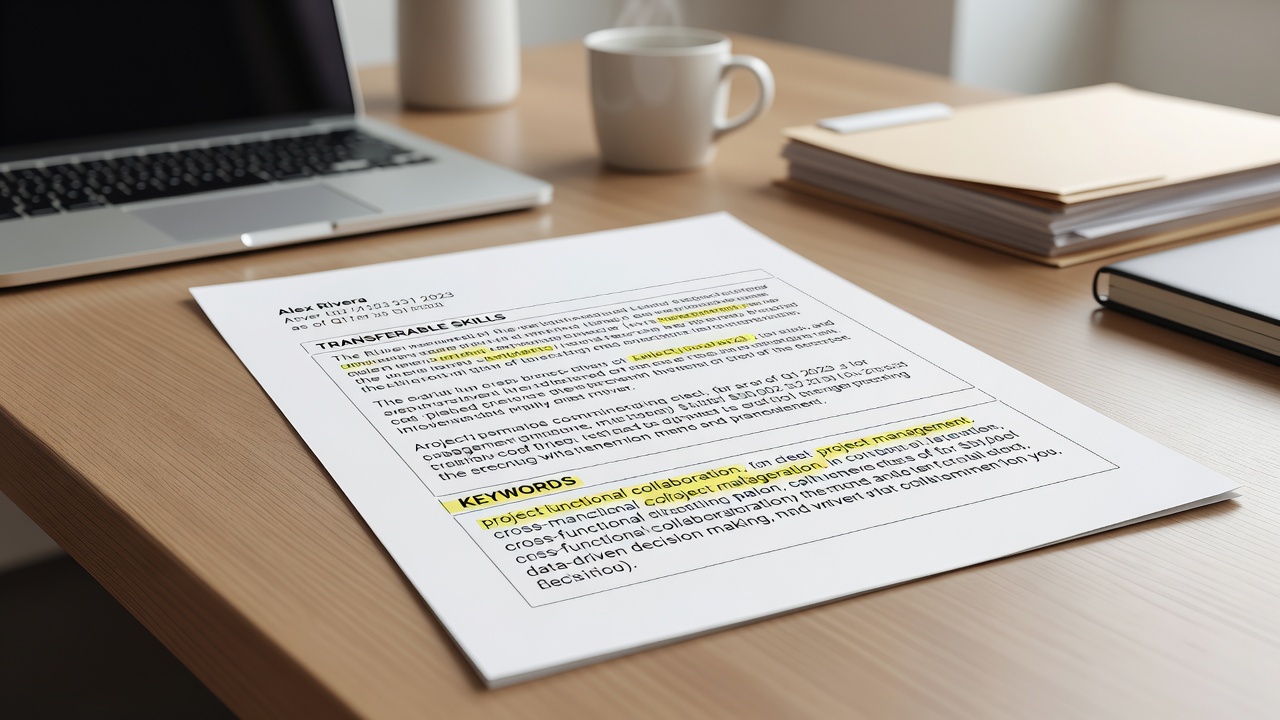
Effective vs. Generic Approaches: A Comparison
- Generic approach: "I am excited to apply for this position because I believe my background aligns well with the requirements and I am eager to contribute to your team."
- Effective approach: "My five years coordinating cross-functional teams during large-scale event planning directly equips me to lead your agile product development sprints, as demonstrated by achieving a 40% improvement in on-time delivery rates through enhanced collaboration protocols."
The effective version quantifies impact, draws explicit parallels, and uses language that mirrors the job posting to create immediate relevance for the reader.
Practical Checklist for Immediate Application
- Conduct in-depth research on the company culture, recent projects, and industry trends using sources like the Bureau of Labor Statistics for context on growth areas.
- Match 60-70% of the keywords and phrases from the job description throughout your letter.
- Quantify achievements using metrics from previous roles, even when translating them to a new context.
- Review tone to ensure it remains professional yet conversational and confident.
- Limit length to 300-450 words to respect the reader's time.
- Customize the email subject line to include the role title and your name for better open rates.
- Proofread multiple times and consider peer feedback before sending.
Common Pitfalls to Avoid During Career Transitions
Focus excessively on your previous role without translating its relevance, use overly formal or apologetic language, or neglect to address employment gaps directly. Never apologize for changing careers; instead, position the move as a strategic evolution that brings fresh perspectives. Avoid sending identical letters to multiple employers, as personalization remains critical for standing out in competitive applicant pools.
Short FAQ
How long should my cover letter be for a career switch?
Target 300-450 words to provide sufficient detail while maintaining engagement and respecting recruiter time constraints.
What tone works best when pivoting industries?
Adopt a confident, enthusiastic tone that balances professionalism with approachability, avoiding both arrogance and self-deprecation.
How do I quantify achievements without direct experience in the new field?
Translate metrics from prior roles—such as team sizes managed, revenue influenced, or efficiency gains—into terminology familiar to the target industry, always grounding claims in verifiable past results.
Conclusion
Mastering the art of targeted cover letters is a powerful tool for navigating career switches successfully in 2026. By implementing these research-backed strategies, refining your storytelling approach, and applying the provided checklists, your applications will resonate more strongly with both ATS platforms and hiring decision-makers. Supplement your efforts with networking opportunities on platforms like LinkedIn to further strengthen your transition. Consistent application of these techniques will help open doors to rewarding new professional paths.


No comments yet. Be the first!