 Jobboy

Introduction: Why Podcast Guesting Matters for 2026 Job Hunting
In today’s saturated job market, submitting applications through job boards often feels like shouting into the void. Podcast guesting provides a powerful alternative by positioning you as an expert in front of engaged audiences who include hiring managers, recruiters, and potential referral sources. This strategy allows job seekers to bypass traditional job applications entirely while building authentic relationships that lead to 2026 job offers. By appearing on relevant shows, you demonstrate thought leadership, share real-world insights, and create content that continues working for you long after the recording ends. Integrating podcast guesting with keywords such as job hunting and job applications strengthens your overall online presence and search visibility.
This comprehensive guide walks through every phase of the process, from discovery to measurement, with actionable templates, real-world examples, and proven metrics. Whether you are entry-level or a seasoned professional, these tactics deliver results when executed consistently.
Identifying Relevant Podcasts in Your Target Industry
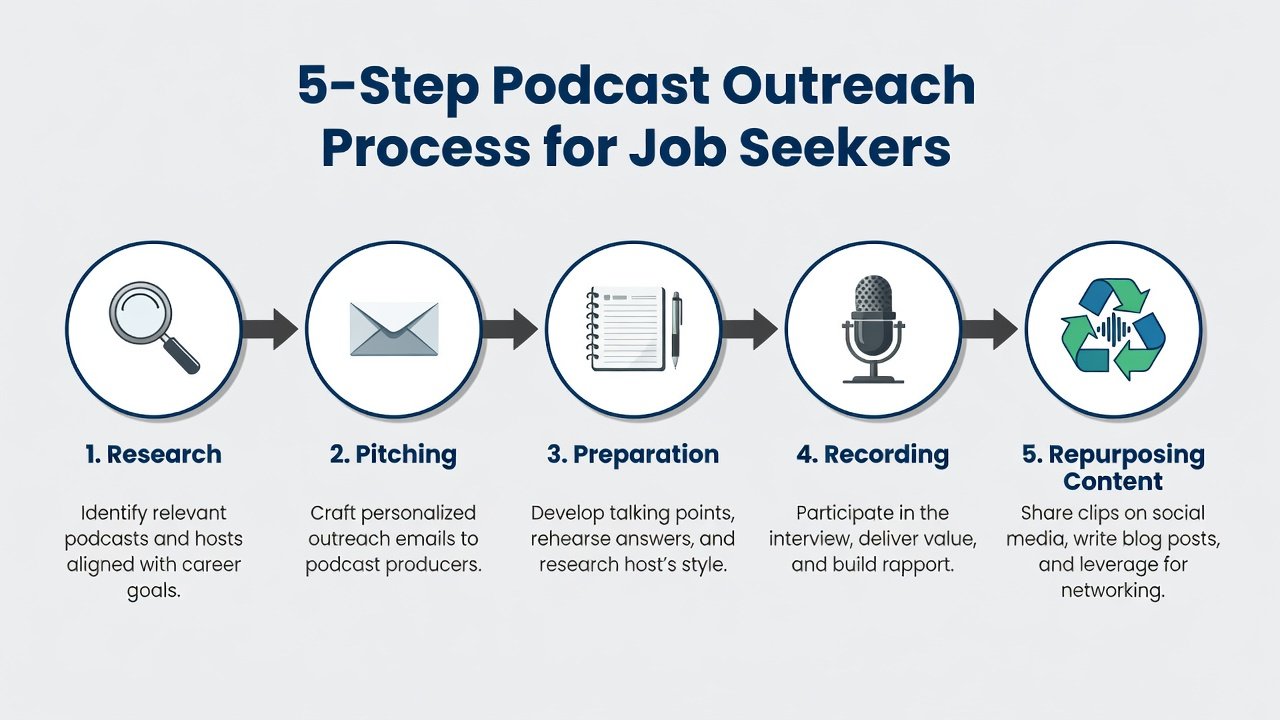
Begin by building a targeted list of 20–30 shows that reach decision-makers in your field. Use search operators on Google such as “marketing podcast 2026” or “tech career interview show” combined with platform searches on Apple Podcasts and Spotify. Cross-reference with LinkedIn by searching for hosts who post about recent episodes and noting their audience engagement levels. Focus on mid-tier shows with 5,000 to 50,000 monthly downloads, as these hosts are more responsive to new guests and their listeners are highly targeted.
Listen to at least three recent episodes of each shortlisted show to understand tone, format, and recurring themes. Check past guest lists for alignment with your experience level. Tools like podcast directories, industry newsletters, and Twitter lists of creators can accelerate discovery. Prioritize shows that welcome first-time guests and discuss career navigation, industry trends, or skill development.
Crafting Irresistible Pitches That Highlight Your Expertise
Effective pitches are personalized, concise, and value-driven. Open by referencing a specific recent episode and explain how your background directly addresses a pain point raised by the host. Include two or three bullet points outlining unique angles you can cover and attach a one-page media kit with bio, headshot, and sample talking points.
Step-by-step outreach template:
- Subject line: “Episode idea: How [Your Specific Achievement] can help listeners with [Listener Challenge]”
- Personalized opening paragraph referencing the show.
- Value proposition: three concise bullets on your expertise.
- Clear call-to-action with three suggested dates and a link to your calendar.
- Professional sign-off with LinkedIn profile and one-sentence bio.
Customize this template for LinkedIn DMs and Twitter outreach. One successful example involved a product manager who pitched a story about scaling remote teams; the appearance generated three direct messages from hiring managers within 48 hours.
Preparing for Interviews That Showcase Your Skills
Thorough preparation turns a good appearance into a job-generating opportunity. Research the host’s background, recent episodes, and listener demographics. Prepare five signature stories that illustrate problem-solving, leadership, and measurable results. Practice answering questions about job hunting challenges while naturally weaving in your expertise and industry knowledge.
Create a preparation checklist: review show notes, prepare three questions to ask the host, test your audio setup, and rehearse answers to common objections. Record yourself answering sample questions and review for clarity and energy. Avoid generic advice; instead, share specific frameworks or case studies that listeners can apply immediately.
Common mistakes include over-preparing scripted answers, neglecting to promote your availability for follow-up conversations, and failing to ask the host for introductions to their network.
Repurposing Audio Clips for LinkedIn and Resumes
After recording, request the raw audio file and create 30- to 90-second highlight clips using free editing tools. Post these on LinkedIn with captions that tie your insights to current job hunting trends. Add episode links and timestamps to your resume under a “Featured Speaking” section to demonstrate proactive networking. Repurposed content extends the lifespan of each appearance and reinforces search terms like job applications across multiple platforms.
Step-by-Step Outreach Templates and Examples of Success
Here is an expanded email template ready for customization:
Dear [Host Name], Your recent episode on [specific topic] resonated with me because [personal connection]. As a [your role] who recently [measurable achievement], I can share practical strategies for [listener benefit] that your audience will find immediately useful. I’ve prepared three episode angles: 1) [angle one], 2) [angle two], 3) [angle three]. I’m available on these dates: [list three]. Would you be open to a 20-minute call to discuss fit? Best regards, [Your Name] [LinkedIn] [Calendar link]
Success stories include an entry-level data analyst who appeared on a career-growth podcast in Q1 2026 and received two referral interviews from listeners. A mid-career project manager used three appearances to build a network that resulted in an unadvertised role at a target company.
Metrics for Tracking Impact on Job Search Visibility
Establish a simple tracking system before your first appearance. Monitor LinkedIn profile views, connection requests, and direct messages in the 30 days following each episode. Use UTM parameters in show notes to measure website or portfolio traffic. Track qualitative metrics such as referral mentions and recruiter outreach. Aim for a minimum 15% lift in profile visibility and at least one quality conversation per three appearances. Spreadsheet columns should include episode title, air date, downloads, new connections, and outcomes.
SEO Benefits: Backlinks from Show Notes and Keyword Integration
Show notes frequently include links to your LinkedIn, website, or portfolio, creating authoritative backlinks that improve search rankings. Optimize your own content and episode descriptions with primary keywords such as job hunting and job applications. Over time, these signals position you higher in recruiter searches. For additional best practices on digital visibility, visit Spotify and Apple Podcasts.
FAQs on Time Investment and Measuring ROI
How much time does podcast guesting require for entry-level versus experienced seekers?
Entry-level candidates typically invest 6–10 hours per cycle, including research, pitching, preparation, recording, and repurposing. Experienced professionals often reduce this to 4–6 hours by leveraging existing networks and reusable pitch materials.
What ROI should I expect and how do I measure it?
Track offers generated, network growth, and content engagement. Most dedicated job seekers see 1–3 meaningful leads after 4–6 targeted appearances when they follow up promptly and repurpose content effectively.
Is podcast guesting suitable for all career stages?
Yes. Entry-level seekers benefit from building visibility, while senior professionals use appearances to attract board or leadership opportunities.
Conclusion
Podcast guesting transforms passive applications into active relationship-building that accelerates 2026 job offers. By systematically identifying shows, crafting strong pitches, preparing thoroughly, and repurposing content, you create lasting visibility that traditional job boards cannot match. Start with three targeted pitches this week and build momentum from there.

No comments yet. Be the first!