 Jobboy

Introduction
Receiving multiple job offers is an exciting milestone in any career journey. In 2026, job seekers face a dynamic employment landscape shaped by evolving workplace trends, remote options, and shifting economic conditions. This guide provides a comprehensive framework to help you evaluate offers thoughtfully, ensuring alignment with your personal and professional goals. The process involves careful analysis beyond surface-level details, incorporating long-term implications for your career trajectory and personal life.
Deciding between opportunities requires more than comparing salaries. Factors like company culture, long-term growth potential, work-life balance, and role fit all play critical roles. Rushing this decision can lead to regret, while a structured approach maximizes satisfaction and success. Many professionals find themselves overwhelmed when juggling several attractive prospects, making a methodical evaluation essential for informed choices.
Understanding Your Core Priorities
Before diving into offer details, clarify what matters most to you. Reflect on your values, lifestyle needs, and five-year career vision. Create a personal priorities list ranking elements such as financial stability, skill development, flexibility, and impact. This exercise helps filter noise from genuine needs. Consider journaling your responses to questions like: What does success look like for me in three years? How important is geographic location or team collaboration?
This self-assessment forms the foundation of your evaluation. For instance, if family time ranks high, prioritize roles with strong work-life balance policies over higher-paying positions with demanding schedules. Revisit this list periodically as life circumstances evolve, ensuring your decision remains relevant.
Key Evaluation Criteria
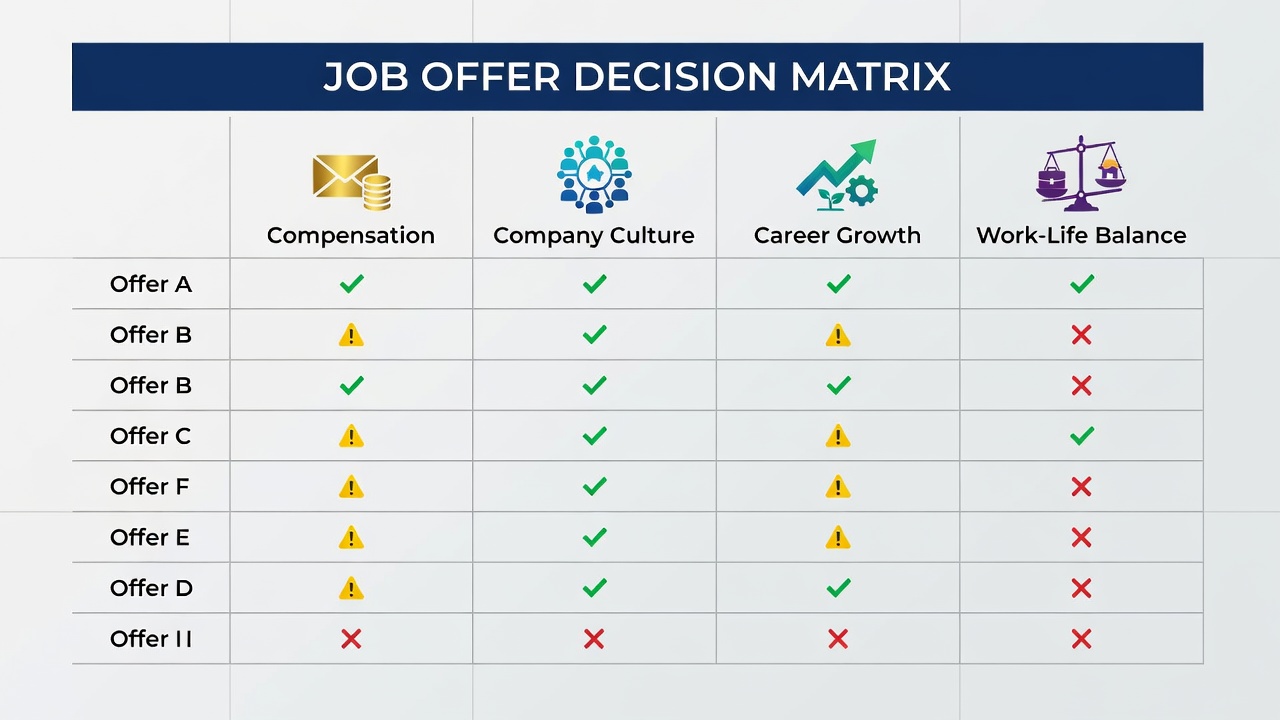
Examine each offer across several dimensions to gain a holistic view. Breaking down criteria into manageable categories prevents overlooking important aspects that could affect your daily experience and future prospects.
Compensation and Benefits
Review base pay, bonuses, equity, health coverage, retirement contributions, and perks like professional development stipends. Consider total rewards rather than isolated numbers. Factor in cost of living if relocation is involved. Examine vesting schedules for any stock options and understand how benefits scale with tenure. Resources from the U.S. Department of Labor can provide additional context on standard benefit structures.
Company Culture and Values
Research the organization's mission, leadership style, and employee feedback. Look for alignment with your working preferences—collaborative environments versus independent roles, for example. Review recent employee reviews on platforms and note patterns in communication styles or diversity initiatives. A mismatch here often leads to early dissatisfaction.
Growth Opportunities
Assess promotion paths, mentorship programs, training access, and industry exposure. Roles that challenge you and expand your skill set often yield greater long-term rewards. Look for evidence of internal mobility data and ask about typical timelines for advancement during interviews. The Bureau of Labor Statistics offers insights into occupational outlooks that can inform your growth projections.
Work-Life Balance
Evaluate expected hours, flexibility options, parental leave policies, and wellness support. Sustainable workloads prevent burnout and support overall well-being. Inquire about average team response times outside business hours and any formal policies around disconnecting.
Role Alignment with Career Goals
Determine how the position advances your trajectory. Does it build on your strengths while addressing gaps? Consider whether the work excites you and contributes to your broader aspirations. Map the role's responsibilities against your ideal job description to identify overlaps and potential frustrations.
Step-by-Step Decision Framework
Follow this expanded process to methodically compare options and reduce decision fatigue.
- List all offers and gather detailed documentation for each, including offer letters, benefit summaries, and role descriptions.
- Score every offer on a 1-10 scale across your priority criteria, using consistent metrics for fairness.
- Calculate weighted totals based on your ranked importance, assigning higher multipliers to top priorities.
- Conduct informational interviews or reach out to current employees for insights on day-to-day realities.
- Model scenarios for one, three, and five years ahead, factoring in potential raises, skill acquisition, and market changes.
- Seek input from trusted mentors while reserving final judgment for yourself to maintain ownership of the outcome.
- Allow adequate time for reflection before responding, typically 48 to 72 hours minimum unless deadlines are strict.
- Review any contracts with a legal professional if terms seem complex or unusual.
Comparison Table Example
| Criterion | Offer A | Offer B | Offer C |
|---|---|---|---|
| Compensation | Strong base + bonus | Equity heavy | Balanced package |
| Culture | Collaborative | Fast-paced startup | Structured corporate |
| Growth | Clear promotions | Rapid learning curve | Specialized training |
| Work-Life Balance | Hybrid flexibility | High demands | Strong boundaries |
| Role Alignment | Direct skill match | Stretch opportunity | Steady progression |
Real-World Examples
Consider Sarah, who weighed a higher-paying corporate role against a mission-driven nonprofit position. By scoring growth opportunities and values alignment, she chose the nonprofit and reported higher job satisfaction within six months, citing meaningful projects and supportive colleagues. Another example involves Mark, who accepted a role ignoring red flags around management turnover. Within a year, he faced instability and wished he had probed deeper during the evaluation stage, leading to a premature job search restart.
A third case features Priya, who used the weighted scoring system to choose between two tech firms. Her emphasis on mentorship tipped the scale, resulting in accelerated skill development and a promotion within eighteen months.
Common Pitfalls to Avoid
- Rushing decisions due to external pressure from recruiters or peers, which often leads to overlooked details.
- Ignoring cultural red flags such as vague answers about team dynamics or high turnover mentions.
- Overvaluing short-term compensation at the expense of development potential and personal fulfillment.
- Failing to negotiate or clarify terms before signing, missing opportunities for better packages.
- Disregarding gut feelings after thorough analysis, as intuition often signals deeper mismatches.
- Not considering the full onboarding timeline and how it aligns with personal commitments.
FAQs on Negotiation and Counteroffers
When is the best time to negotiate?
Negotiate after receiving a formal offer but before acceptance. Express enthusiasm while presenting your case with data and priorities. Prepare specific requests backed by market research and your unique qualifications.
How should you handle counteroffers from your current employer?
Evaluate whether the counteroffer addresses underlying reasons for leaving. Often, staying due to a counteroffer leads to lingering dissatisfaction. Weigh it against new opportunities using the same framework. Consider long-term trust implications and whether the issues prompting your search have truly been resolved.
Conclusion
Evaluating multiple job offers in 2026 demands deliberate analysis across compensation, culture, growth, balance, and alignment. By following this practical guide and framework, you position yourself for a fulfilling career move. Take time, gather insights, and choose the path that best supports your long-term success. Remember that thoughtful evaluation today builds a stronger foundation for tomorrow's achievements.


No comments yet. Be the first!