 Jobboy

Introduction: Gaining a Strategic Edge in the 2026 Job Market
In an era where traditional job boards often leave candidates competing in oversaturated pools, forward-thinking professionals are turning to big data strategies to anticipate hiring trends. By analyzing vast datasets from government agencies, industry reports, and AI platforms, job seekers can identify emerging opportunities in high-growth sectors well before they appear on mainstream listings. This approach transforms reactive searching into proactive career planning, allowing you to align your skills with future demands and reduce application fatigue. The 2026 job landscape is expected to favor roles in technology, sustainability, healthcare, and data-driven fields, driven by advancements in artificial intelligence, climate initiatives, and post-pandemic workforce shifts. Harnessing predictive insights means sourcing reliable data, building tracking systems, and interpreting signals accurately while avoiding common pitfalls like data overload or misinterpretation of short-term fluctuations. This guide provides practical, step-by-step methods tailored for data-savvy individuals seeking a competitive advantage, including concrete examples of dataset queries and dashboard construction that anyone with basic spreadsheet skills can implement immediately.
Sourcing Public Labor Data and Industry Reports
Publicly available datasets form the foundation of any big data job strategy. Start with official sources that release regular employment statistics. The Bureau of Labor Statistics offers comprehensive occupational outlooks, including projected growth rates through 2032, which can be extrapolated for 2026 trends by focusing on compound annual growth rates for specific occupations. Similarly, the U.S. Census Bureau provides demographic and industry employment data that reveal shifting workforce patterns, such as migration to tech hubs or growth in remote-capable roles. To query these effectively, download the latest Occupational Employment and Wage Statistics (OEWS) CSV files, filter by NAICS industry codes, and cross-tabulate with projected openings data. Industry reports from organizations like the OECD and World Economic Forum add qualitative context on global megatrends. The World Economic Forum publishes annual Future of Jobs reports that highlight skill gaps and emerging roles. Cross-reference these with AI-powered platforms such as LinkedIn's Economic Graph or Indeed's hiring lab for real-time signals. Always verify data freshness—focus on releases from the past 12 months to ensure relevance for 2026 predictions. Additional free sources include state labor department portals and the U.S. Census Bureau longitudinal employer-household dynamics dataset, which allows mapping of job flows between industries. For example, a simple query might involve filtering Census data for net job gains in the professional services sector over the last two quarters and correlating it with BLS growth projections to flag high-potential areas like cybersecurity or green energy consulting.
Building a Simple Dashboard for Trend Tracking
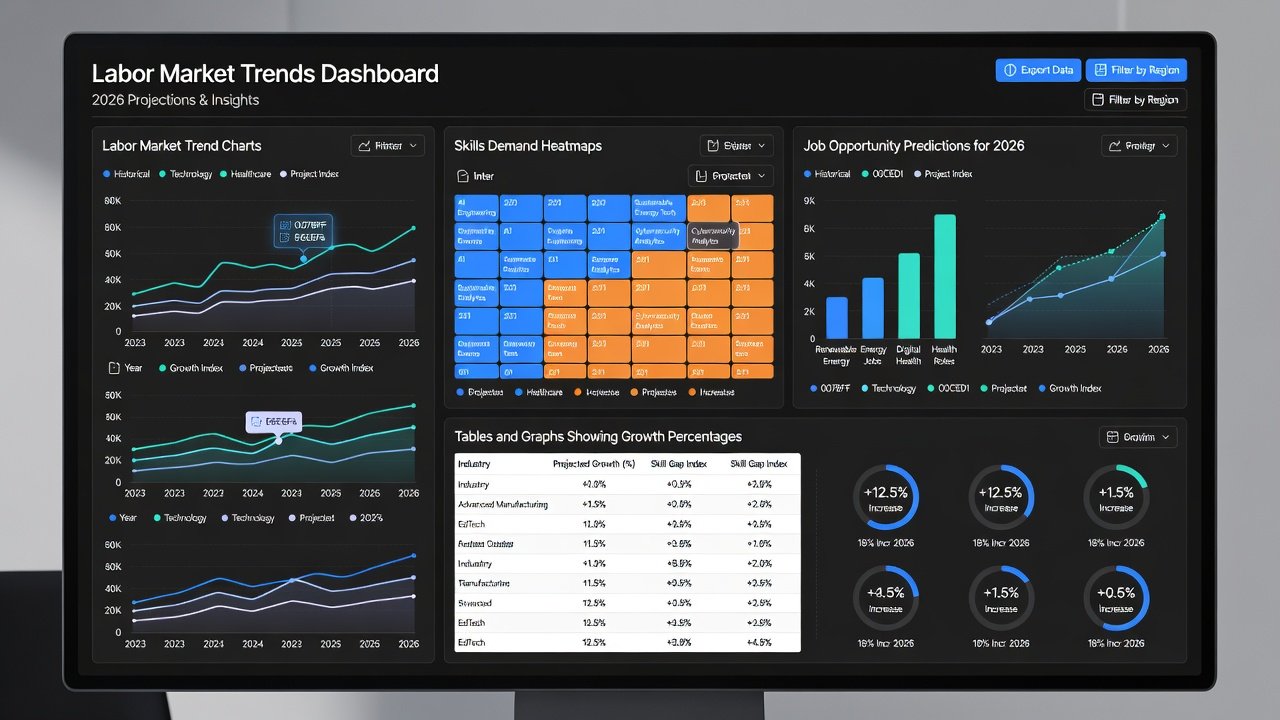
Creating your own dashboard doesn't require advanced coding skills. Use free tools like Google Sheets or Microsoft Power BI to aggregate data. Here's a detailed step-by-step example that produces a functional tracker in under two hours: First, identify key metrics such as job growth percentages, skill frequency in postings, and regional demand by pulling from at least three sources. Second, query free datasets by downloading CSV files from BLS occupational projections and importing them into Sheets; use formulas like VLOOKUP or QUERY to match roles with growth data, for instance =QUERY(A2:F500, "select A, B where C > 10 order by B desc"). Third, visualize trends by creating line charts showing projected increases in fields like AI engineering or renewable energy specialists, and add pivot tables to break down demand by experience level. Fourth, set alerts using conditional formatting to highlight roles exceeding typical growth thresholds, and incorporate a simple scoring system where each data point receives a weighted score based on recency and source reliability. Fifth, automate updates by connecting Google Sheets to public APIs where available or scheduling manual refreshes weekly. This dashboard becomes your personal early-warning system for opportunities, allowing side-by-side comparison of multiple career paths. Test it by tracking three target roles over a month and adjusting weights based on accuracy against actual postings.
Interpreting Skills Demand Signals
Skills demand signals appear in job postings, course enrollments, and certification trends. Analyze data from platforms like Coursera or edX to see which skills correlate with rising job volumes. For instance, Python proficiency and cloud computing certifications often precede demand spikes in tech roles. Compare these against BLS data to validate signals and avoid hype-driven fields that may not sustain through 2026. Practical tip: Track keywords across hundreds of postings using free scraping tools or APIs from public sites, then cluster them into categories like technical, soft, and domain-specific skills. Look for clusters—roles mentioning both "data analytics" and "sustainability" indicate emerging hybrid positions ideal for 2026. Another example involves monitoring certification issuance data from bodies like CompTIA or AWS, where a 20% year-over-year increase in a credential can signal upcoming hiring waves in related occupations.
Timing Applications Based on Predictive Insights
Predictive models help time applications during low-competition windows, such as post-holiday periods or after major industry reports drop. Proactive candidates monitor dashboard trends to apply 4-6 weeks before peak hiring seasons in targeted sectors. This contrasts with reactive approaches that flood applicants during high-visibility job fairs or after viral news about a company's expansion. Use your dashboard to flag when a sector's projected openings exceed historical averages by 25%, then prepare tailored applications in advance.
Case Comparison: Proactive vs Reactive Job Searches
Consider two professionals targeting data science roles. The reactive searcher applies only to postings on LinkedIn, facing 200+ applicants per role and often missing niche opportunities. The proactive one uses dashboard insights to identify growing demand in healthcare analytics, upskills via targeted courses, and applies directly to companies expanding in that area—often securing interviews with 30-50% fewer competitors. Real-world examples show proactive strategies yielding offers 2-3 months earlier on average, with higher starting alignment to long-term career goals. A second case involves a marketing professional who shifted to sustainability reporting after dashboard analysis revealed 18% projected growth; the reactive counterpart remained in saturated general marketing roles.
Common Mistakes to Avoid When Using Big Data for Job Hunting
Many professionals new to these methods fall into traps that undermine results. Over-relying on a single data source can lead to skewed predictions—always triangulate at least three datasets. Ignoring regional variations is another error; national trends may not apply locally, so filter by metropolitan statistical areas in BLS data. Failing to update dashboards regularly means missing inflection points. Finally, neglecting ethical considerations or applying insights without skill validation can result in mismatched applications. Review your system quarterly and test predictions against actual outcomes to refine accuracy.
FAQ on Ethical Data Use in Job Forecasting
- How can I ensure ethical sourcing? Stick to publicly available, anonymized datasets and respect platform terms of service. Avoid scraping private user data or using proprietary employer information without permission.
- Is it fair to use predictive tools? Yes, as long as insights inform personal development rather than manipulation of hiring processes. Transparency with employers about skill alignment builds trust and long-term relationships.
- What about privacy concerns? Never store personal identifiers from datasets; focus solely on aggregate trends and delete raw files after analysis.
- Can small errors in data interpretation harm my search? Yes, so validate findings with multiple sources and consider consulting career advisors for high-stakes decisions.
Conclusion
Big data strategies empower job seekers to move beyond guesswork and into informed decision-making for 2026 opportunities. By sourcing authoritative data, building dashboards, interpreting signals, timing applications strategically, and applying ethically, you position yourself for roles that align with genuine market growth. Start small with one dataset today, refine your system over subsequent weeks, and watch your career trajectory accelerate with data-backed confidence.

No comments yet. Be the first!