 Jobboy

Introduction
In the competitive job market of 2026, generic interview responses no longer suffice. Recruiters and hiring managers seek candidates who can prove their impact with concrete data. Quantifying achievements transforms vague statements into powerful, memorable stories that demonstrate real value. This approach aligns perfectly with the search intent of candidates aiming to excel through evidence-based storytelling rather than unsubstantiated claims. By focusing on measurable outcomes, you differentiate yourself from applicants who rely on buzzwords alone, showing exactly how you have contributed to past organizations in tangible ways.
Throughout this guide, you will discover practical methods to identify, structure, and adapt quantifiable results for various interview formats. You will also learn how to build a reliable personal metrics bank and apply these techniques across behavioral, situational, and even technical questions. By the end, you will have a clear framework that strengthens every answer and positions you as a results-driven professional ready for 2026 roles.
Identifying Relevant Achievements from Your Experience
Start by auditing your professional history. Review performance reviews, project reports, and past role descriptions to extract measurable outcomes. Focus on areas such as revenue growth, cost savings, efficiency improvements, team leadership, and customer satisfaction scores. Even roles without obvious sales figures often contain data points like ticket resolution rates or process optimization percentages. Break down each position into key responsibilities and ask targeted questions: What was the baseline performance when I started? How did my actions change that number? What was the time frame and scope of impact?
Organize findings into categories: individual contributions, team impacts, and company-wide results. This categorization helps tailor responses to specific job descriptions and highlights transferable skills across industries. Consider both quantitative metrics like percentages and dollar values as well as qualitative data converted into numbers, such as employee retention rates or Net Promoter Scores. Document everything in a spreadsheet for easy reference during preparation.
Structuring Answers with Quantifiable Results
The STAR method (Situation, Task, Action, Result) remains effective when enhanced with numbers. Replace qualitative descriptions with precise metrics. For example, instead of saying you improved team productivity, state that you increased output by 35% within six months through targeted workflow changes. Always contextualize numbers by explaining the baseline before your involvement and the time frame involved. This adds credibility and prevents interviewers from questioning the scale of your claims.
Integrate metrics naturally into the Result portion of STAR while briefly referencing supporting actions. Practice delivering these stories aloud to ensure they flow conversationally rather than sounding like a data dump. When possible, tie your results directly to business objectives such as revenue growth or risk reduction to show strategic thinking.
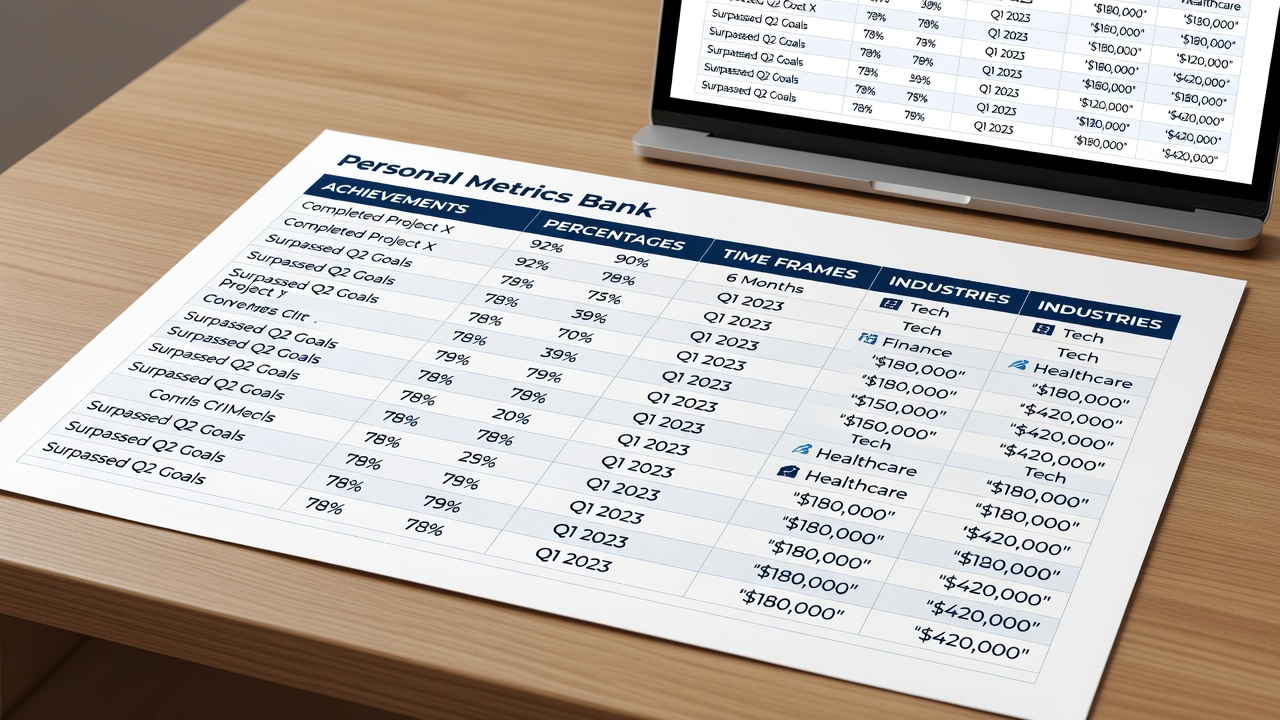
Building a Personal Metrics Bank: Practical Steps
Create a living document that tracks achievements in real time. Follow these steps:
- Weekly review: Note any completed projects and associated outcomes, capturing details while they remain fresh in your memory.
- Quantify immediately: Attach numbers such as percentages, dollar amounts, or time saved, verifying them against reports or analytics whenever possible.
- Store supporting evidence: Keep emails, dashboards, or reports for quick reference during interview prep so you can back up claims with confidence.
- Update quarterly: Align metrics with evolving career goals and target roles, removing outdated entries and highlighting recent wins.
- Seek external validation: Cross-reference your numbers with team feedback or performance dashboards to ensure accuracy and add another layer of credibility.
This habit ensures you enter interviews with ready-to-use data points that feel authentic and current. Resources from organizations like the Society for Human Resource Management can provide additional frameworks for tracking professional impact.
Real-World Examples Across Industries
Marketing professionals might cite a campaign that generated 2,500 qualified leads and a 28% conversion rate, leading to $180,000 in attributed revenue over four months. Software engineers can highlight code optimizations that reduced load times by 40% and improved user retention by 22%, directly contributing to lower churn. Healthcare administrators often reference process changes that lowered patient wait times by 22 minutes on average while maintaining quality scores above 95%.
In finance, an analyst could describe implementing automated reconciliation that cut monthly closing time from 12 days to 5 days, saving 140 hours annually. Educators might quantify curriculum redesigns that raised student test scores by 18% across a cohort of 120 learners. These examples illustrate how nearly every field offers opportunities for quantification when candidates dig beneath surface-level duties and examine project outcomes systematically.
Weak vs. Strong Response Comparisons
Weak answer: "I managed social media accounts and grew our following."
Strong answer: "I managed social media accounts and increased follower engagement by 65% over nine months by implementing a data-driven content calendar, resulting in a 40% rise in website traffic from those channels and 12% more inbound inquiries."
Weak answer: "I led a team on a project."
Strong answer: "I led a cross-functional team of eight on a product launch project that delivered the solution two weeks ahead of schedule and 15% under budget, generating $420,000 in first-quarter sales."
The strong versions provide context, specific actions, and measurable outcomes that directly tie to business goals, making responses far more persuasive.
Common Mistakes to Avoid When Quantifying Achievements
Many candidates fall into traps that weaken their data-driven answers. Avoid exaggerating numbers without evidence, as interviewers may probe deeper during reference checks. Do not use percentages without baselines, such as claiming "200% growth" without stating the original figure. Steer clear of focusing solely on personal glory; always acknowledge team contributions when metrics involve collaborative efforts. Finally, resist overloading answers with too many statistics—select the two or three most relevant metrics that align with the question.
Adapting Data for Behavioral and Situational Questions
Behavioral questions like "Tell me about a time you led a team" benefit from metrics showing team performance improvements under your guidance, such as a 30% increase in project delivery speed. Situational questions allow you to project past quantified successes onto hypothetical scenarios, reinforcing your capability with evidence. Always select metrics that align with the company’s stated priorities, such as sustainability goals or digital transformation targets. Research the organization beforehand using sites like LinkedIn to identify which numbers will resonate most.
Frequently Asked Questions
What if my role lacks obvious numbers?
Focus on time saved, error reduction rates, or qualitative feedback converted into satisfaction scores. Many support and administrative roles track internal metrics like response times or project completion rates that can be quantified with simple before-and-after comparisons.
How recent should the data be?
Prioritize achievements from the past two to three years, but include older standout results if they remain relevant to the target role and demonstrate consistent performance patterns.
Can I use estimates?
Use estimates only when backed by reasonable calculations you can explain. Always prefer verified figures from reports or analytics tools to maintain credibility during follow-up questions.
Should I prepare metrics for every possible question?
Prepare a core set of five to seven versatile stories that can be adapted. This flexibility allows you to pivot your data points to match unexpected questions while staying authentic.
Conclusion
Mastering the art of quantifying achievements equips you to deliver confident, data-driven answers that resonate with 2026 hiring teams. By systematically building your metrics bank and practicing structured responses, you position yourself as a results-oriented professional ready to contribute immediately. Start auditing your experience today and transform your interview performance into a compelling showcase of proven impact.


No comments yet. Be the first!