 Jobboy

Introduction
Receiving multiple job offers at once is an exciting yet complex situation for any professional. In 2026, the job market continues to evolve with hybrid work models, rapid technological changes, and increased emphasis on employee well-being. Simply comparing base salaries is no longer sufficient. Instead, thoughtful evaluation requires examining long-term career alignment, company culture, financial health of potential employers, and personal lifestyle impacts. This comprehensive guide equips job seekers with proven frameworks, step-by-step processes, real-world examples, and practical tools to make confident decisions that support sustained professional success. By investing time in structured analysis now, you can avoid future regrets and position yourself for meaningful advancement over the next decade.
Key Factors Beyond Salary
While compensation remains important, several interconnected elements often determine overall job satisfaction and career trajectory. Long-term growth potential includes access to mentorship programs, leadership training, and clear promotion pathways. Work-life balance encompasses flexible scheduling, remote work policies, and mental health support initiatives. Company stability involves analyzing revenue trends, leadership tenure, and industry positioning. Benefits packages should be reviewed for health coverage quality, retirement contributions, parental leave, and professional development stipends.
Each factor interacts differently depending on your career stage. Early-career professionals might prioritize skill-building opportunities, whereas mid-career individuals often value stability and balance. Consider your personal priorities by reflecting on past roles and identifying what contributed most to your fulfillment or frustration. For instance, if previous positions left you burned out due to constant overtime, then work-life balance should receive higher weighting in your decision process. Similarly, professionals nearing retirement may focus more on retirement matching and healthcare quality than on rapid promotion tracks.
Step-by-Step Evaluation Process
Follow this detailed sequence to organize your analysis systematically. First, gather every offer letter and supporting documents into a single folder or spreadsheet. Next, conduct thorough research on each organization using reliable public data sources such as SEC filings for publicly traded companies. Then, list your top five non-negotiable priorities based on your five-year career vision. Calculate the full value of each package by factoring in bonuses, equity, and perks. Reach out to current or former employees through professional networks for candid insights. Finally, prepare thoughtful negotiation points and set a decision deadline that respects all parties.
Throughout this process, document your reasoning at every stage. This creates a personal reference that reduces second-guessing and helps communicate your choice effectively to recruiters or mentors. Additionally, schedule dedicated time blocks for each step rather than rushing through them in a single evening, as thoughtful reflection often reveals overlooked details.
Comparison Frameworks and Decision Matrix
A weighted decision matrix transforms subjective feelings into objective scores. Begin by listing evaluation criteria and assigning importance weights that total 100 percent. Rate each offer from one to ten on every criterion, then multiply ratings by weights to generate totals. This method highlights trade-offs clearly and supports data-driven conclusions.
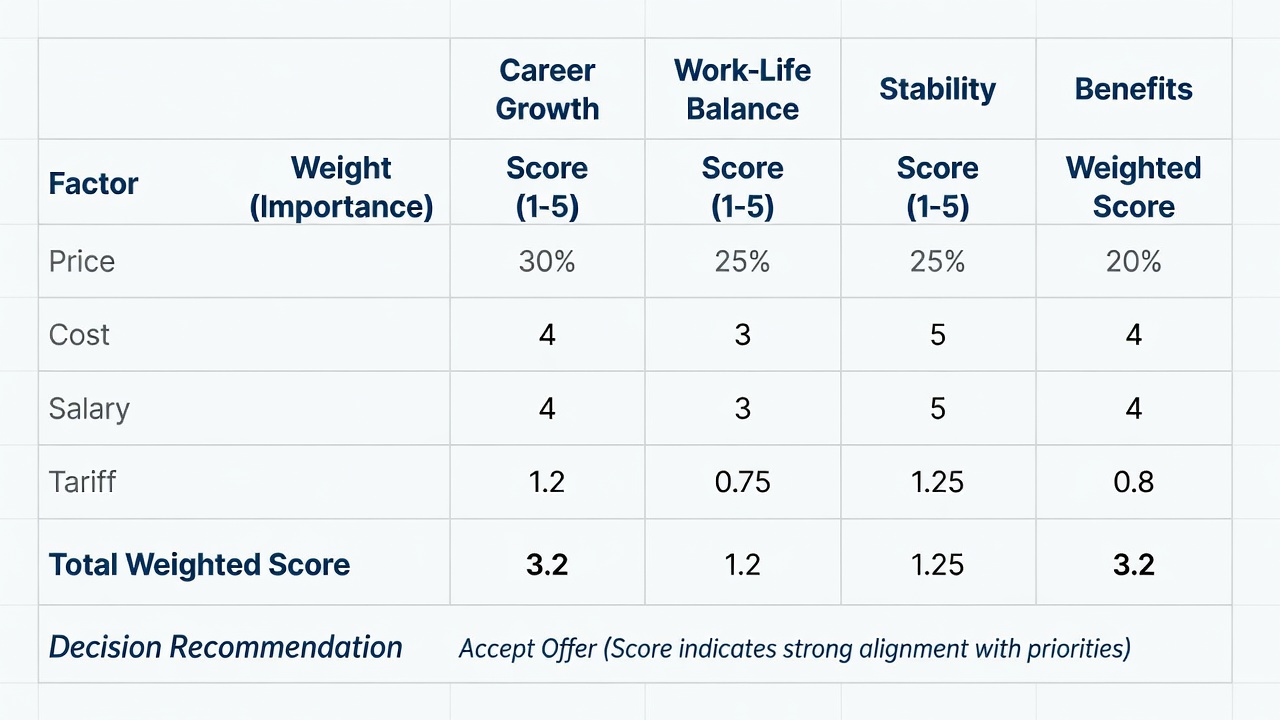
Expanded Decision Matrix Example
| Factor | Weight | Offer A Score | Offer B Score | Offer C Score |
|---|---|---|---|---|
| Career Growth Opportunities | 30% | 8 | 7 | 9 |
| Work-Life Balance | 25% | 9 | 6 | 8 |
| Company Financial Stability | 20% | 7 | 9 | 6 |
| Benefits Package Quality | 15% | 8 | 7 | 8 |
| Location and Commute Impact | 10% | 6 | 8 | 5 |
Review the highest-scoring offer against your gut feeling. If discrepancies appear, revisit the weighting system to ensure it truly reflects your values. Consider running sensitivity tests by adjusting weights slightly to see if the top choice remains consistent.
Real-World Scenarios with Pros and Cons
Consider a software engineer choosing between a fast-growing startup and a Fortune 500 corporation. The startup offers equity that could yield significant returns but carries higher failure risk and longer hours. The established company provides predictable advancement, robust training programs, and generous parental leave, yet may limit exposure to cutting-edge projects.
Another common scenario involves selecting between a fully remote position and a hybrid role requiring relocation. Remote work supports family proximity and eliminates commuting stress but may reduce spontaneous collaboration. Relocation can accelerate networking yet introduces housing costs and adjustment challenges for partners or children. A third scenario might pit a role in a stable but slow-growing industry against one in an emerging sector with higher volatility yet greater innovation potential. In each case, map pros and cons in a two-column list and discuss options with trusted advisors before proceeding.
Handling Common Dilemmas
Counteroffers from Current Employers
When your existing employer learns of competing offers, they may propose improved terms. Assess whether the counteroffer resolves underlying issues such as limited growth or poor management. Request all changes in writing and verify new responsibilities align with your goals. Many professionals accept counteroffers only to leave within a year, so evaluate long-term cultural fit carefully. It is also wise to consider how the counteroffer process might affect future trust with your current manager.
Relocation and International Moves
Relocation decisions require checklists covering cost-of-living adjustments, school quality for families, spousal employment support, and immigration requirements. Consult official government resources like USA.gov for moving guidelines and visa processes. Factor in time zone differences for global roles and test remote collaboration tools during any trial period. Additionally, evaluate the long-term career implications of moving, such as whether the new location offers better networking opportunities or industry clusters.
Practical Checklists for Thorough Review
- Benefits audit covering medical, dental, vision, 401k matching, unlimited PTO policies, and wellness stipends.
- Red flag identification including vague promotion timelines, high recent turnover, or inconsistent recruiter communication.
- Negotiation preparation such as gathering market salary data and practicing counter-proposals within 48 to 72 hours of receiving an offer.
- Personal impact assessment listing effects on commute time, family schedules, and mental health.
- Long-term alignment review checking how each role supports your skills development and industry relevance over five years.
FAQs
When is the best time to negotiate multiple job offers?
Begin negotiations only after receiving all offers in writing. Aim to respond within one week of the first offer while maintaining transparency with recruiters about your timeline.
What red flags should prompt extra caution?
Watch for pressure to accept quickly without review time, reluctance to discuss team dynamics, or discrepancies between verbal promises and written contracts.
How can I compare equity and bonus structures fairly?
Request vesting schedules, performance metrics, and historical payout data. Convert equity estimates into conservative scenarios rather than optimistic projections.
Should I accept the highest paying offer automatically?
No. Higher pay can mask poor culture or limited growth. Always weigh compensation against the full set of factors using your decision matrix to avoid short-term gains that lead to long-term dissatisfaction.
Conclusion
Strategic evaluation of multiple offers leads to choices that support both immediate satisfaction and long-term career health. By applying structured frameworks, detailed checklists, and external research from sources such as BLS.gov for labor market data and WHO.int for wellness standards, you can navigate the 2026 job market with clarity and confidence. Take time to reflect, document your analysis, and select the opportunity that best aligns with your values and aspirations. Remember that the right decision today builds the foundation for future opportunities and personal fulfillment.


No comments yet. Be the first!