 Jobboy

Introduction
In the competitive 2026 job market, employers prioritize candidates who can think critically under pressure. This skill helps professionals analyze problems, evaluate options, and make data-driven decisions that drive business results. Demonstrating critical thinking during interviews sets you apart by showing you can handle complex challenges rather than just reciting qualifications or past duties. Recruiters increasingly use behavioral and situational questions to assess this ability because it predicts on-the-job performance more reliably than technical skills alone.
This comprehensive guide provides actionable strategies, including how to spot relevant questions, structure responses with real scenarios, and prepare effectively through targeted exercises. You will also find in-depth comparisons of strong and weak answers, practical checklists, common pitfalls with avoidance tactics, and answers to common follow-up questions from interviewers. By the end, you will have a complete framework to showcase your critical thinking confidently in any 2026 interview setting.
Why Critical Thinking Matters in 2026 Interviews
Workplaces in 2026 face rapid technological change, hybrid teams, and evolving regulations across industries. Recruiters seek individuals who can adapt by questioning assumptions, synthesizing information from multiple sources, and anticipating second-order consequences. Critical thinking directly ties to job interview tips because it reveals your ability to contribute immediately rather than requiring extensive onboarding or supervision. According to labor market analyses from authoritative sources, roles requiring advanced problem-solving continue to grow, making this skill a key differentiator.
Research from leading career resources confirms that behavioral questions now dominate interviews to assess this skill. Preparing targeted responses helps you align your experience with employer needs while demonstrating intellectual curiosity and sound judgment. Bureau of Labor Statistics data highlights the demand for analytical roles, underscoring why candidates must prepare beyond surface-level answers.
Identifying Questions That Test Critical Thinking
Look for prompts that require analysis over facts. These questions often begin with phrases like “describe a time,” “how would you,” or “tell me about a decision.” Common examples include: “Describe a time you solved a problem with incomplete information,” “How would you prioritize tasks when facing conflicting deadlines from multiple stakeholders,” and “Tell me about a decision that had unexpected consequences and how you adjusted.”
These questions evaluate your reasoning process rather than memorized facts. Prepare by reviewing job descriptions for keywords like “problem-solving,” “analysis,” and “innovation.” Additionally, research the company’s recent challenges through earnings calls or news to anticipate tailored hypotheticals. Practice identifying the underlying skill being tested so your answer stays focused and relevant.
Structuring Example Answers with Real Scenarios
Use the STAR method (Situation, Task, Action, Result) but expand it to emphasize critical thinking steps: identify the core problem, gather and evaluate data, consider alternatives with pros and cons, implement the chosen path, and reflect on outcomes and lessons. This expanded structure shows depth without rambling.
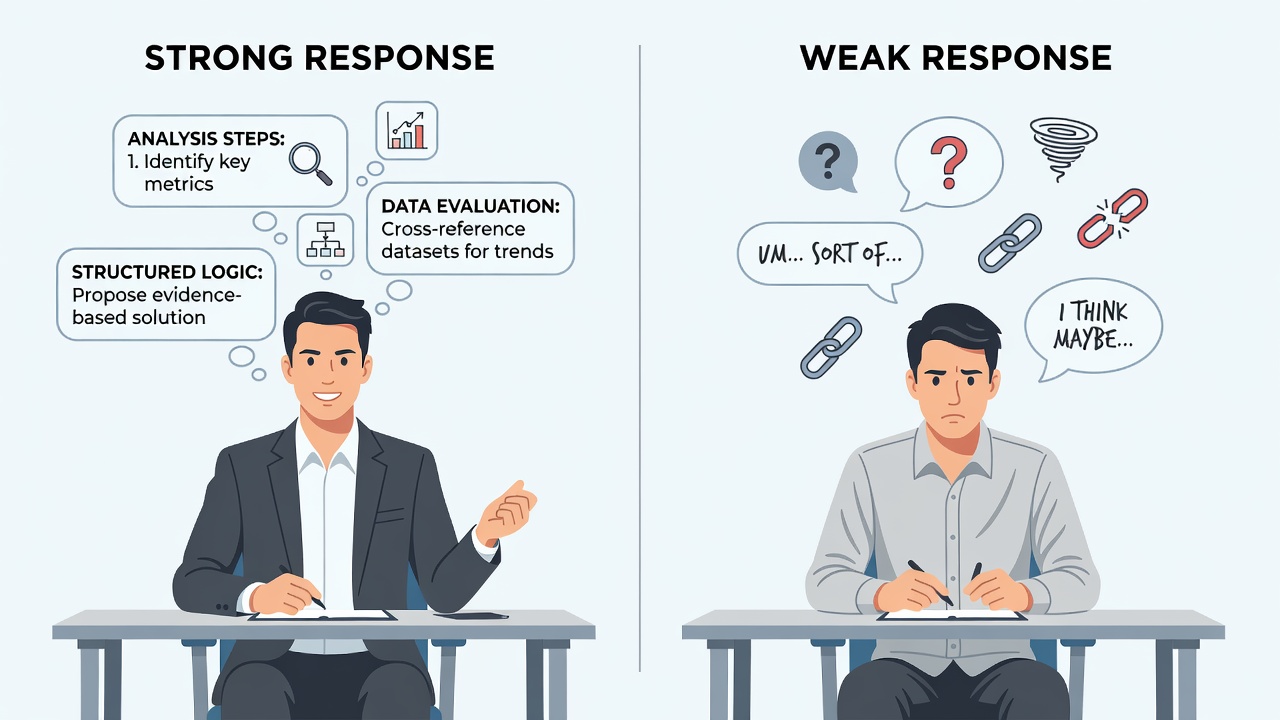
Scenario Example 1 – Budget Constraint: A project faced a sudden 20 percent budget reduction mid-way through execution. Strong response: “In my previous role, our team encountered a 20 percent budget reduction. I gathered data on all deliverables, ranked them by impact using a weighted matrix, and consulted stakeholders for input. We reallocated resources to high-value tasks, completing the project on time with measurable efficiency gains.” Weak response: “We just worked harder and finished somehow.” The strong version demonstrates structured evaluation and quantifiable results.
Scenario Example 2 – Process Improvement: A recurring customer complaint about delivery delays. Strong response: “I mapped the entire workflow, identified bottlenecks through time-tracking analysis, tested two alternative routing options in a pilot, and implemented the one reducing delays by a significant margin while maintaining quality standards.” This shows methodical analysis from start to finish.
Step-by-Step Preparation Exercises
Follow these detailed exercises to build confidence: First, review five to seven past projects and map each to a critical thinking framework, noting the data sources you used and alternatives considered. Second, practice aloud with a timer, focusing on articulating your thought process rather than just outcomes. Third, record responses and critique for clarity, logical flow, and depth of reasoning. Fourth, simulate follow-up questions such as “What if resources were even tighter or the timeline shorter?” to practice adaptability. Fifth, seek feedback from a mentor or career coach who can challenge your assumptions. Repeat these exercises weekly leading up to interviews, gradually increasing complexity by incorporating industry-specific trends.
Additional practice includes creating decision trees for common workplace dilemmas and reviewing case studies from CareerOneStop resources to refine your analytical approach.
Actionable Checklist for Interview Day
- Prepare three to five stories highlighting analysis, trade-offs considered, and measurable outcomes.
- Listen fully before responding and ask clarifying questions if information feels incomplete.
- Quantify results wherever possible, such as efficiency gains or risk reductions.
- Connect your thinking process explicitly to the company’s current challenges or goals.
- End answers by explaining what you learned and how it would apply in the new role.
- Prepare thoughtful questions to ask the interviewer that demonstrate your analytical mindset.
Common Pitfalls to Avoid
Many candidates rush to solutions without showing their reasoning process, leaving interviewers unsure of how conclusions were reached. Others focus only on positive outcomes while ignoring trade-offs or risks considered. Avoid vague language such as “I just knew it would work” and ensure every answer demonstrates logical progression. Over-preparing scripted answers can sound inauthentic—practice flexibility by varying wording during rehearsals. Another frequent mistake is failing to tie the example back to the target role, which weakens relevance. Finally, neglecting to address ethical considerations or stakeholder impact can signal incomplete critical thinking.
Advanced Techniques for 2026 Interviews
Incorporate forward-looking elements by referencing emerging tools like AI-assisted decision frameworks or data visualization platforms when discussing your process. For virtual interviews, maintain engagement through screen-sharing examples of past analyses if appropriate. Compare your approach to industry benchmarks from sources like SHRM to add credibility. These techniques elevate responses from competent to exceptional.
Short FAQ Section
What if the interviewer asks a hypothetical unrelated to my experience?
Break it down logically: state your assumptions clearly, outline the analytical steps you would take, evaluate potential risks, and propose a decision framework. This reveals your thinking process even without direct experience.
How long should my answers be?
Aim for one to two minutes. Include context, your analytical process, key alternatives considered, and results while remaining concise and avoiding unnecessary details.
Can I use examples from non-work settings?
Yes, as long as they demonstrate professional-level reasoning, such as volunteer leadership, academic research projects, or community initiatives that involved data analysis or stakeholder management.
Conclusion
Mastering the demonstration of critical thinking requires deliberate practice with structured responses, self-reflection, and ongoing refinement. By preparing targeted examples, expanding your analytical depth, and avoiding common traps, you position yourself as a thoughtful, high-value candidate ready for demanding 2026 roles. Apply these techniques consistently across interviews to turn opportunities into job offers and accelerate your career trajectory.


No comments yet. Be the first!