 Jobboy

Introduction to Stay Interviews in Modern Talent Retention
In today's competitive job market, organizations are shifting focus from reactive measures to proactive strategies for keeping top talent. Stay interviews have emerged as a key tool in hiring and recruiting, allowing employers to understand employee motivations before issues arise. Unlike traditional feedback methods, these conversations help align retention efforts with talent acquisition goals, fostering stronger employer branding and reducing costly turnover. By 2026, forward-thinking companies are embedding stay interviews into their core HR processes to stay ahead of workforce trends and build resilient teams. This approach moves beyond annual surveys by creating ongoing dialogue that reveals what truly drives employee loyalty. When executed well, stay interviews transform retention from a guessing game into a data-driven discipline that supports both immediate team stability and long-term organizational growth.
Research from leading workforce organizations shows that proactive retention tactics like stay interviews can significantly lower voluntary departures. This guide provides a comprehensive look at implementing stay interviews effectively, with practical examples and templates you can adapt immediately.
How Stay Interviews Differ from Exit Interviews
Exit interviews occur after an employee has decided to leave, offering insights into past problems but little opportunity for immediate action. In contrast, stay interviews are conducted with current employees to uncover reasons they remain and identify potential risks early. This proactive approach supports talent acquisition by turning feedback into actionable retention plans rather than post-departure analysis. Consider a mid-level marketing manager who feels overlooked for promotions; an exit interview might document frustration too late, while a stay interview can surface the issue and lead to a development plan that keeps the employee engaged. The timing difference is critical: stay interviews build loyalty in real time, while exit interviews often highlight issues too late. Both contribute to employer branding, but stay interviews prevent talent loss altogether and create a culture where employees feel heard continuously rather than only at departure.
Benefits of Stay Interviews for Retention and Branding
Implementing stay interviews yields multiple advantages that extend across the employee lifecycle. They enhance employee engagement by signaling that leadership values input, which often leads to higher discretionary effort and productivity. Feedback collected also provides rich data for refining talent acquisition strategies, helping recruiters craft more authentic job descriptions that reflect real workplace culture. Organizations using this tactic frequently report stronger employer branding, as positive internal changes become external proof points in recruiting campaigns. Additional benefits include early detection of burnout risks, improved manager-employee relationships, and the ability to benchmark against industry standards. For example, teams that conduct regular stay interviews often see faster resolution of workload concerns before they escalate into resignations. When integrated with broader HR initiatives, these conversations create a feedback loop that continuously strengthens both retention and the company's reputation as an employer of choice.
Crafting Effective Stay Interview Questions
Strong questions focus on positives and growth opportunities while avoiding accusatory language. Effective examples include: What aspects of your current role make you excited to come to work each day? Which recent project gave you the greatest sense of accomplishment? How can leadership better support your professional development goals over the next year? What would make your day-to-day experience even more fulfilling? How do you prefer to receive recognition for your contributions? Avoid yes/no formats; instead, use open-ended prompts to encourage detailed responses. Tailor questions to departments or roles for relevance. A sales team might emphasize target-setting and commission structures, while an engineering group may focus on technical resources and innovation time. Prepare 8-12 questions maximum to keep the conversation flowing naturally without feeling like an interrogation.
Scheduling Best Practices
Schedule stay interviews quarterly or semi-annually in a private, comfortable setting free from interruptions. Keep sessions to 30-45 minutes to respect time while allowing depth. Prepare by reviewing recent performance data, recent wins, and any known concerns. Ensure confidentiality to build trust, and communicate the purpose clearly in advance so employees do not mistake the meeting for a performance review. Best practice includes conducting them during natural business cycles but separating them from formal evaluations to maintain a conversational tone. Many organizations block recurring calendar slots and send short pre-meeting questionnaires to prime thoughtful responses.
Analyzing Feedback for Employer Branding Improvements
Collect responses systematically using secure notes or HR platforms. Categorize themes such as compensation perceptions, management styles, career growth paths, and work-life balance. Use insights to update employer branding campaigns, ensuring external messaging matches internal realities. For instance, if multiple employees mention flexible scheduling as a top retention factor, highlight this in recruitment materials and internal policy updates. This analysis directly feeds into talent acquisition by highlighting unique selling points that resonate with both current and prospective employees. Regular theme reviews also help identify department-specific issues that may require targeted interventions.
Measuring Impact on Reducing Turnover
Track metrics like retention rates pre- and post-implementation, employee satisfaction scores, and voluntary exit reasons. Compare data over six to twelve months to quantify success. Useful benchmarks can be drawn from resources such as SHRM and Gallup. Additional measures include tracking internal promotion rates and engagement survey improvements. Regular measurement ensures stay interviews remain an evolving part of retention strategy rather than a one-time exercise.
Step-by-Step Implementation Guide
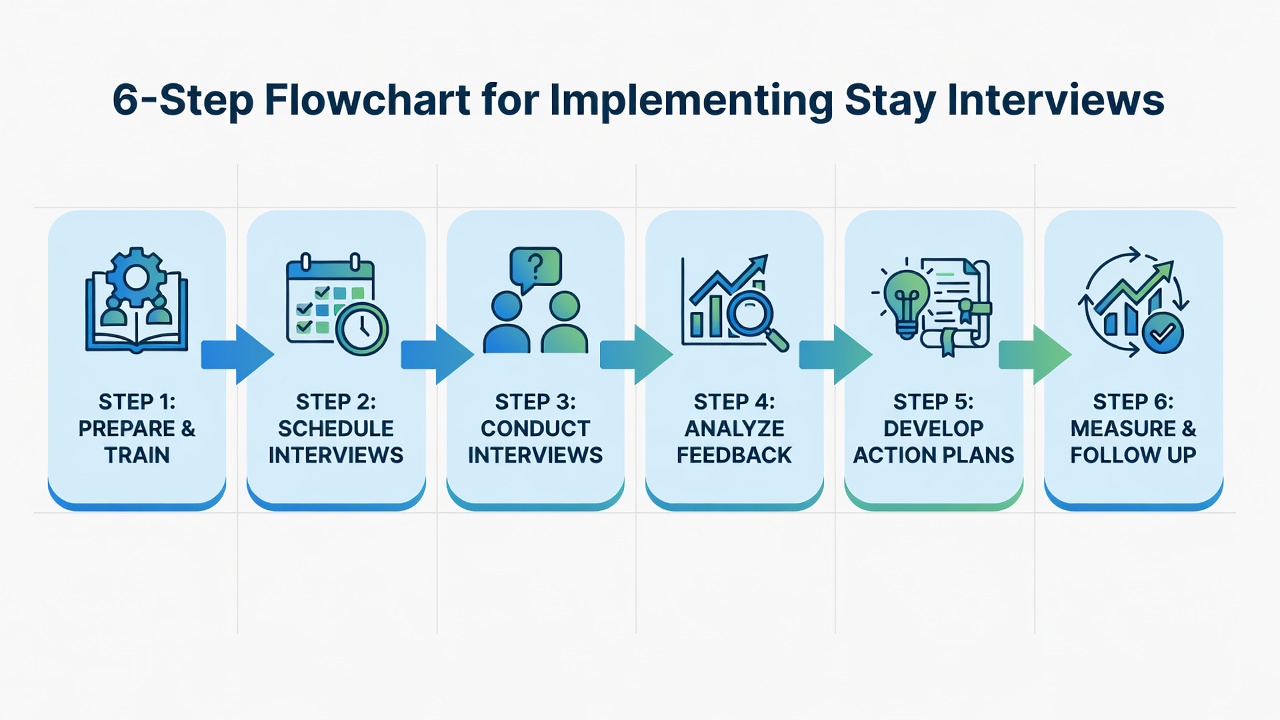
Follow these six detailed phases for successful rollout: First, train managers on conducting neutral, empathetic conversations through role-play workshops. Second, select a pilot group of employees across levels and departments to test the process. Third, develop a consistent question template customized by role. Fourth, schedule sessions with clear communication about purpose and confidentiality. Fifth, document responses and analyze results to create individualized and team-wide action plans. Sixth, follow up with employees within 30-60 days on changes implemented based on their input. This structured approach minimizes resistance and maximizes value while creating accountability at every level.
Sample Stay Interview Template
Use this adaptable template as your foundation. Begin with an opening that thanks the employee and explains the purpose of the conversation. Core questions should cover motivation, recognition preferences, development needs, workload balance, and suggestions for improvement. Close by asking for any additional thoughts and outlining next steps for follow-up. Customize based on team feedback for ongoing relevance, and always leave space for open-ended comments that may reveal unexpected insights.
Real-World Case Comparisons
One mid-sized technology firm reduced voluntary turnover by implementing quarterly stay interviews across all departments, using aggregated insights to introduce targeted wellness initiatives and clearer career ladders. A regional healthcare provider compared pre- and post-implementation data over 18 months and observed stronger employer branding that improved both internal retention and external candidate quality. In another example, a manufacturing company paired stay interviews with manager training, resulting in faster resolution of safety concerns and higher reported trust scores. These cases illustrate the tactic's versatility across industries and company sizes when supported by consistent execution and visible follow-through.
Mistakes to Avoid When Conducting Stay Interviews
Common pitfalls include treating the session like a performance review, failing to act on feedback, asking leading questions, or neglecting confidentiality. Managers should also avoid promising specific changes they cannot deliver and should never use the conversation to solicit complaints without a plan for constructive dialogue. Organizations that skip manager training or conduct interviews too infrequently often see diminished returns and employee skepticism.
FAQ: Common HR Concerns About Stay Interviews
How often should they occur? Most experts recommend at least twice yearly, with quarterly sessions ideal for fast-moving environments.
Who should conduct them? Direct managers or trained HR specialists who practice active listening and remain neutral.
What if feedback is negative? Treat it as an opportunity for improvement rather than criticism, and focus on collaborative solutions.
Are they confidential? Yes, with only aggregated themes shared organization-wide while individual comments remain private.
How do stay interviews integrate with existing surveys? They complement annual engagement surveys by providing richer, qualitative context that surveys often miss.
Conclusion
Stay interviews represent a forward-thinking approach to retention in 2026. By integrating them thoughtfully into your HR strategy, organizations can enhance talent acquisition, refine employer branding, and achieve measurable reductions in turnover. Start with a small pilot, measure consistently using external benchmarks from sources such as BLS, and iterate based on results for lasting impact across your workforce.


No comments yet. Be the first!