 Jobboy

Introduction
Job seekers in 2026 navigate an increasingly complex employment landscape where emotional and cognitive factors heavily influence application and acceptance decisions. Understanding these psychological drivers allows recruiters to design hiring funnels that resonate more deeply, reduce drop-offs, and improve offer acceptance rates. Behavioral psychology offers powerful lenses for examining how candidates perceive opportunities, weigh risks, and respond to messaging throughout the recruitment process.
This article examines key principles from behavioral psychology, including decision-making biases and emotional triggers, while providing actionable frameworks for mapping candidate journeys and comparing traditional versus psychology-informed approaches. By integrating these insights, organizations can create more effective, candidate-centered hiring experiences that stand out in competitive talent markets.
Core Psychological Drivers in Job Search Behavior
Candidates rarely evaluate opportunities purely on salary or title. Instead, they respond to perceived value, risk, and emotional fit. Motivation often stems from a combination of intrinsic needs for autonomy, mastery, and purpose alongside extrinsic factors such as stability and recognition. Search intent around job opportunities frequently reveals patterns driven by cognitive shortcuts and emotional responses rather than rational analysis alone.
Common triggers include the desire for status improvement, fear of missing out on better roles, and the need for psychological safety in new environments. Recruiters who recognize these drivers can craft communications that address both logical and emotional concerns, leading to higher engagement at every funnel stage.
Loss Aversion in Salary Negotiations
Loss aversion, a concept rooted in prospect theory, means candidates may reject a higher-paying role if they perceive the move as risking current benefits or status. This bias appears strongly during salary negotiations and counteroffer stages, where individuals overweight potential downsides compared to equivalent upsides. Recruiters can counter this by framing offers around what candidates stand to gain rather than what they might lose.
Practical application includes presenting total compensation packages that highlight growth opportunities, benefits continuity, and long-term earning potential. In tech, companies using structured compensation bands report smoother negotiations when they emphasize non-monetary advantages early. Retail employers have seen similar success by illustrating how flexible schedules preserve work-life balance while still advancing careers. Understanding this bias helps prevent talented candidates from self-selecting out due to perceived risk.
Building Trust Through Transparent Communication
Trust forms the foundation of any successful hiring relationship. Candidates today expect clarity on role expectations, company culture, and advancement paths. Opaque processes trigger suspicion and increase application abandonment. Transparent communication involves sharing realistic timelines, publishing salary ranges where legally appropriate, and providing regular feedback updates. This approach reduces anxiety and positions the employer as respectful of the candidate’s time and emotional investment.
According to research highlighted by SHRM, organizations that prioritize transparency see measurable improvements in candidate satisfaction and completion rates. Real-world examples show that weekly status emails during interview loops can decrease ghosting behavior by addressing uncertainty directly. Trust also extends to post-offer stages, where clear onboarding previews help new hires feel prepared rather than overwhelmed.
Tailoring Messaging to Personality Types
Different personality profiles respond to distinct messaging styles. Analytical candidates appreciate data-driven details about role impact and metrics. Relationship-oriented individuals prioritize team culture and collaboration stories. Adventurous profiles seek innovation challenges and autonomy. Recruiters can segment outreach using brief assessments or LinkedIn profile cues to customize email subject lines, job descriptions, and interview questions accordingly.
For instance, an analytical candidate might receive a message focused on key performance indicators and growth projections, while a relationship-focused candidate sees stories about team dynamics and mentorship programs. This personalization increases response rates and helps candidates self-select into roles where they are more likely to thrive. Over time, these tailored approaches reduce mis-hires and improve retention.
Mapping the Candidate Journey with Psychological Insights
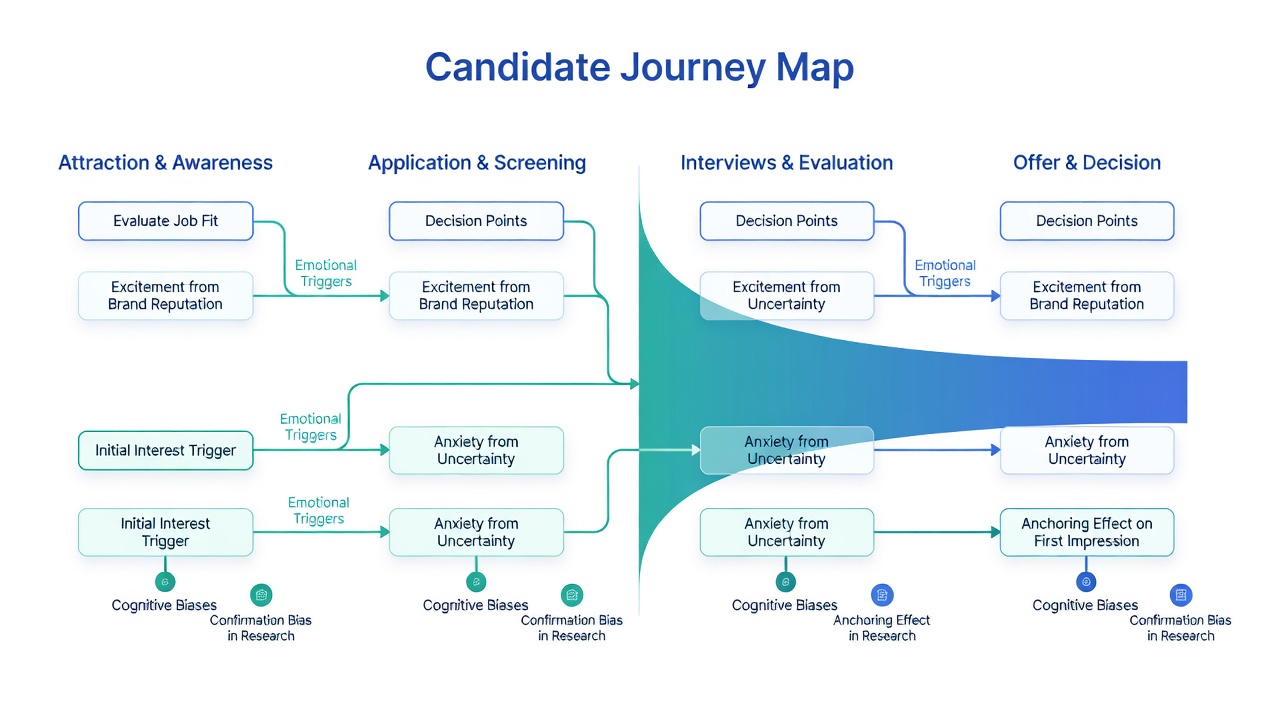
Effective funnel optimization begins with journey mapping that incorporates emotional touchpoints. Follow these practical steps:
- Identify each stage from awareness to offer acceptance and note drop-off points.
- Document emotional states such as excitement, doubt, or urgency at every interaction.
- Pinpoint bias triggers like anchoring on initial salary figures or confirmation bias in interviews.
- Design targeted interventions such as reassurance emails, peer testimonials, or progress visualizations.
- Measure drop-off rates before and after changes, then iterate messaging based on data.
- Include post-acceptance touchpoints to reinforce the decision and reduce buyer’s remorse.
By applying these steps systematically, recruiters create smoother experiences that respect psychological realities rather than ignoring them.
Real-World Examples from Tech and Retail
In the tech sector, a major software firm reduced time-to-offer by 25% after introducing bias-aware interview scorecards that de-emphasized first impressions and focused on structured criteria. Another example involved using loss-aversion framing in offer letters, resulting in higher acceptance among mid-career engineers concerned about leaving stable positions. Retail chains have improved seasonal hiring by using personality-aligned job previews that highlight both stability and flexible scheduling options, leading to higher application completion rates and lower early turnover.
These cases demonstrate that psychology-driven tweaks, such as adding short videos from current employees or clear rejection timelines, deliver measurable results across industries. Comparing outcomes before and after implementation shows consistent gains in both quality of hire and candidate experience scores.
Traditional vs Psychology-Driven Hiring Approaches
Traditional funnels rely on linear processes and generic job postings that treat all candidates identically. Psychology-driven approaches integrate behavioral nudges, personalized communication, and bias mitigation at every stage. The latter consistently yields higher engagement and lower regret rates among new hires. For example, traditional methods might use one-size-fits-all rejection emails, while psychology-informed ones provide constructive feedback and future opportunity framing to maintain positive relationships.
Organizations shifting to the latter often partner with Harvard Business Review insights on behavioral economics to refine their processes. The difference becomes especially clear in competitive markets where candidates have multiple offers and choose based on emotional resonance as much as compensation.
Additional Decision-Making Biases and Emotional Triggers
Beyond loss aversion, anchoring bias can cause candidates to fixate on the first salary number mentioned, while confirmation bias leads interviewers to seek evidence that supports initial impressions. Emotional triggers such as excitement from rapid responses or frustration from long silences also shape behavior. Addressing these requires deliberate design choices like using neutral scorecards and sending prompt, warm communications.
Ethical Application and Quick-Win Tactics
Applying psychological insights ethically means avoiding manipulation and focusing on genuine alignment between candidate and role. Quick wins include adding clear next-step expectations to every communication, using positive framing in rejection messages, and testing small changes to application forms. Recruiters should regularly audit processes for unintended bias and seek feedback from diverse candidate groups. Resources from APA provide guidance on maintaining ethical standards when applying behavioral science in professional settings.
Conclusion
Integrating behavioral psychology into hiring funnels creates more humane, effective recruitment processes that benefit both candidates and organizations. By understanding biases, building trust, and tailoring experiences, recruiters can significantly improve outcomes in 2026 and beyond.
FAQs
How can recruiters apply these insights without crossing ethical lines?
Focus on transparency and mutual benefit. Use insights to improve clarity and reduce friction rather than to pressure candidates into decisions that do not serve them long-term.
What are the fastest tactics to test this week?
Start by publishing salary ranges, adding reassurance language to offer letters, and segmenting one outreach campaign by personality cues. Track response and completion metrics to validate impact.


No comments yet. Be the first!