 Jobboy

Introduction: Why Structured Decision-Making Matters in 2026
The workplace continues to evolve rapidly in 2026, driven by widespread AI adoption, persistent hybrid work models, skills-based hiring practices, and shifting economic conditions. Professionals at all career stages now face complex choices involving promotions, lateral moves, complete industry pivots, or targeted upskilling investments. Without a structured approach, decisions often fall prey to cognitive biases such as recency effect or over-optimism about future outcomes. Decision frameworks offer a repeatable, evidence-based process that clarifies priorities, quantifies trade-offs, and builds confidence in the final choice.
This comprehensive guide explores how to adapt proven tools like weighted scoring matrices and scenario planning specifically for 2026 career decisions. Readers will discover detailed step-by-step instructions, multiple real-world examples from diverse industries, side-by-side framework comparisons, practical worksheets, checklists, and answers to common implementation questions. By the end, you will have actionable resources to apply immediately.
Core Frameworks for Career Decisions
Weighted Scoring Matrix
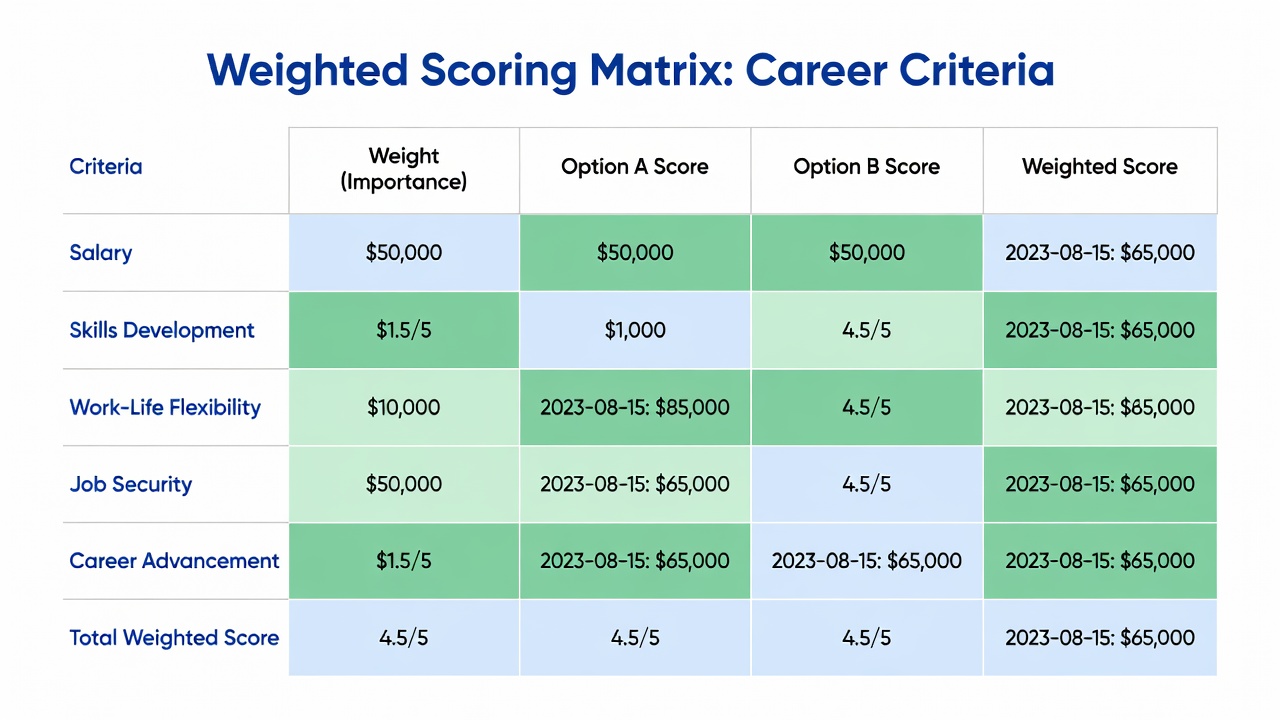
The weighted scoring matrix remains one of the most accessible yet powerful tools. It forces you to define what matters most—such as long-term earning potential, skill acquisition speed, work-life integration, organizational culture fit, and geographic flexibility—then assign relative importance through percentage weights. Each career option is scored objectively against these criteria, producing a numerical ranking that minimizes emotional influence.
Scenario Planning
Scenario planning prepares you for uncertainty by constructing three to four plausible future states. In 2026, these might include accelerated AI automation reducing certain roles, continued remote-work normalization, or regulatory changes affecting specific sectors. For each scenario you outline triggers, your likely responses, and early warning indicators, creating a more resilient career strategy.
Complementary Approaches
- Pros-and-cons lists upgraded with forced ranking to surface hidden priorities
- Decision trees that incorporate probability estimates for branching outcomes
- Pre-mortem analysis where you imagine the decision has failed and work backward to identify risks
- Multi-attribute utility theory for highly complex, multi-variable situations
Step-by-Step Application of a Weighted Scoring Matrix
Follow this expanded process to ensure rigor. First, spend time reflecting on your values and non-negotiables through journaling or conversations with trusted mentors. Second, select five to eight criteria and assign weights that sum exactly to 100 percent; revisit the weights after sleeping on them. Third, research each option thoroughly using labor market data from sources such as the Bureau of Labor Statistics and the Department of Labor. Fourth, score options on a consistent 1–10 scale with written justification for each rating. Fifth, calculate weighted totals and perform sensitivity analysis by varying the top two weights by 10–15 percent to test robustness. Finally, document assumptions and schedule a six-month review checkpoint.
Real-World Examples Across Industries
A senior software engineer at a Fortune 500 company used a weighted matrix to compare staying for a management promotion versus joining a Series B startup. Criteria included equity upside, leadership development, technical depth, and family relocation impact. The matrix revealed the startup path scored 22 percent higher once long-term learning was properly weighted. In the pharmaceutical sector, a clinical research associate applied scenario planning to decide between moving into regulatory affairs or pursuing a data-science certification. Three scenarios modeled different FDA policy shifts and AI-driven trial efficiencies, resulting in a hybrid role combining both directions.
Another case involved a K-12 teacher evaluating a move into corporate learning and development. Using a decision tree, she mapped probabilities of budget cuts in education versus corporate training demand growth, ultimately choosing the corporate path with a clear upskilling timeline. These examples illustrate how frameworks adapt across knowledge work, healthcare, and education.
Comparing Popular Decision Frameworks
Choosing the right framework depends on time available, decision complexity, and uncertainty level. Weighted scoring excels when options are concrete and criteria measurable. Scenario planning shines in volatile environments where external variables dominate. Decision trees help when choices unfold sequentially with known probabilities. Pre-mortem exercises add value for high-stakes moves where failure modes are hard to anticipate. Many professionals combine frameworks—for instance, running a weighted matrix first, then stress-testing the top option with scenario planning.
Practical Worksheets and Checklists
Begin with this expanded pre-decision checklist: list non-negotiables, gather salary and growth data from authoritative government sources, set a firm deadline, involve one accountability partner, and define success metrics for post-decision evaluation. Next, create a simple spreadsheet template with columns for criteria, weights, raw scores, weighted scores, and justification notes. Add a separate tab for scenario narratives including best-case, base-case, and worst-case descriptions plus early indicators. Review the matrix output with a mentor and adjust any scores that feel inconsistent. After implementation, track outcomes quarterly against the original criteria to refine future applications.
Common Mistakes to Avoid
- Over-weighting immediate compensation while under-valuing skill currency that compounds over five to ten years
- Treating scenario planning as storytelling rather than assigning rough probabilities and monitoring triggers
- Failing to revisit the framework when new information emerges, such as unexpected company restructuring
- Using too many criteria, which dilutes focus and increases cognitive load
- Allowing groupthink when decisions involve family or team input without independent scoring first
Frequently Asked Questions
How often should I update my career decision framework?
Conduct a full review annually or immediately after major life events or industry disruptions. Minor weight adjustments can occur quarterly as priorities shift.
Can these frameworks work for team or family decisions?
Absolutely. Facilitate a joint session to define shared criteria and weights, then average individual scores or use consensus scoring to increase commitment.
What if two options receive nearly identical scores?
Introduce an additional differentiating criterion, adjust weights slightly, or run a quick pre-mortem on the tied options to reveal hidden risks.
How do I incorporate upskilling costs and time into the matrix?
Treat required training hours and tuition as negative scores on a dedicated criterion, or create a separate time-to-proficiency metric with its own weight.
Integrating Frameworks with 2026 Upskilling Trends
Many career choices now involve deciding whether to invest in AI literacy, data analytics, or leadership certifications. Apply the same weighted matrix by adding criteria such as course completion time, employer reimbursement likelihood, and immediate applicability to current role. Scenario planning helps evaluate whether a skill will remain relevant if automation accelerates.
Measuring Success After the Decision
Define quantitative and qualitative success indicators at the time of decision. Track metrics such as quarterly skill assessments, network expansion, and satisfaction scores. Schedule formal reviews at three, six, and twelve months to capture early signals and make course corrections if needed.
Conclusion
Decision frameworks transform ambiguous career crossroads into structured, transparent processes. By mastering weighted scoring matrices, scenario planning, and supporting techniques, professionals can navigate 2026 workplace shifts with greater clarity and alignment to both short-term realities and long-term aspirations. Begin applying one framework to a current choice this week, document your reasoning, and iterate based on results. The discipline compounds, leading to consistently better career outcomes over time.


No comments yet. Be the first!