 Jobboy

Introduction: Why Scenario Planning Matters for Your Career in 2026
The job market in 2026 is shaped by rapid technological advances, economic shifts, and evolving workplace dynamics. Traditional linear career paths no longer suffice for long-term success. Scenario planning offers a proactive approach, enabling professionals to anticipate multiple futures and prepare accordingly. This method draws from strategic business practices but adapts seamlessly to individual career trajectories. Professionals across industries face disruptions from generative AI, climate policy changes, and hybrid work models that can alter job roles overnight. By identifying key drivers of change such as AI adoption and remote work trends, you can build resilient strategies that protect against obsolescence while positioning you for emerging opportunities. This article provides a comprehensive guide, including step-by-step frameworks, real-world applications, and practical tools that go far beyond basic advice to deliver actionable insights for mid-career professionals and executives alike.
Scenario planning helps you move from reactive job hunting to deliberate career architecture. It encourages examining weak signals today that could become major forces tomorrow, such as regulatory shifts in data privacy or the rise of decentralized finance. Readers searching for forward-thinking career strategies will find detailed methods here to create personalized roadmaps that withstand volatility.
Understanding Scenario Planning Versus Linear Career Planning
Linear career planning follows a single trajectory: set a goal, follow steps, achieve promotion. While straightforward, it falters amid uncertainty because it assumes stable conditions that rarely persist. Scenario planning, by contrast, explores multiple plausible futures, fostering adaptability and reducing the risk of being blindsided. The approach originated in military and corporate strategy but has proven highly effective for individuals navigating volatile labor markets.
Key differences include flexibility in response to disruptions and emphasis on contingency actions. For instance, instead of assuming steady corporate ladder climbs, professionals consider paths involving pivots to freelance, entrepreneurship, or entirely new industries. Linear planning often leads to frustration when promotions stall or layoffs occur, whereas scenario planning builds psychological resilience and concrete backup options. A comparison table might show linear planning as rigid and single-outcome focused, while scenario planning is dynamic, multi-outcome oriented, and regularly updated based on new data.
Step-by-Step Framework for Creating Career Scenarios
Follow this proven framework to develop robust career scenarios that can guide decisions for the next three to five years:
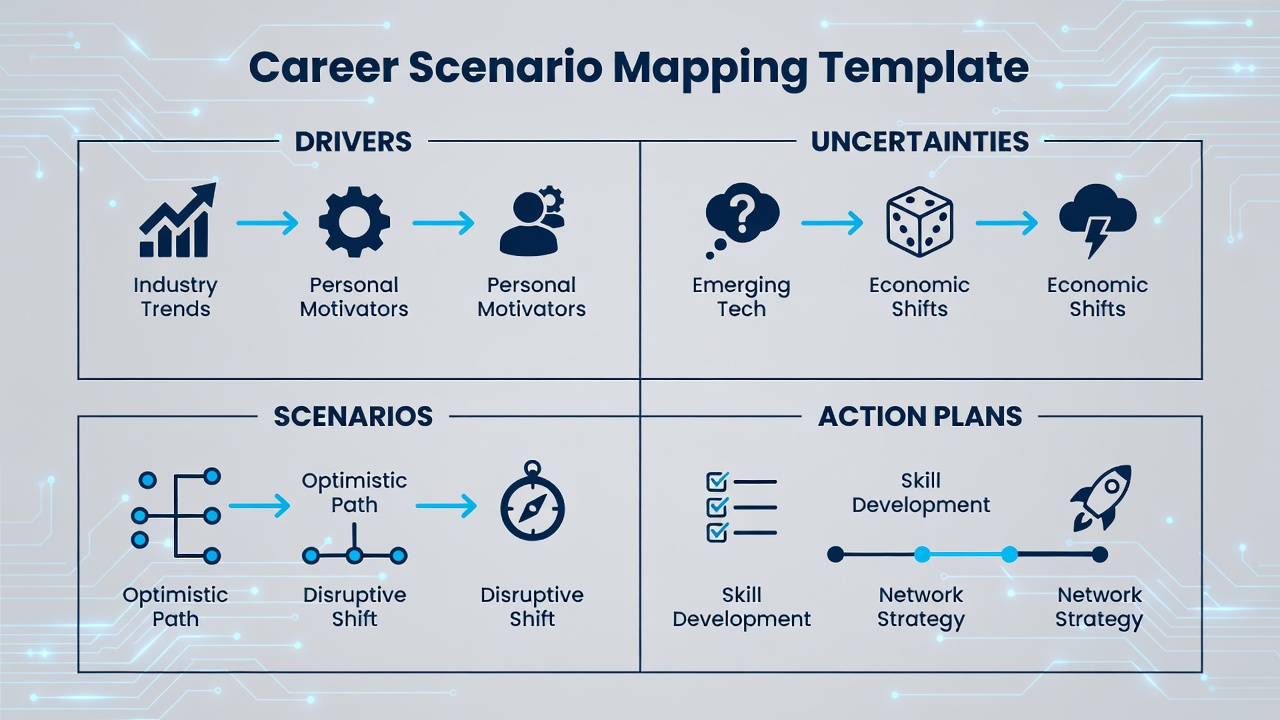
- Identify key drivers: Analyze external factors like technological innovation, demographic shifts, and economic indicators from sources such as the U.S. Bureau of Labor Statistics. Consider both macro trends and industry-specific signals.
- Define uncertainties: Pinpoint high-impact variables, such as AI integration rates or changes in remote-work policies, that could swing dramatically in either direction.
- Construct scenarios: Develop 3-4 narratives, from optimistic growth to disruptive change, giving each a memorable name and vivid description of what your role and industry look like in that future.
- Assess implications: Evaluate impacts on skills, roles, compensation potential, and work-life balance for every scenario, noting required resources or barriers.
- Develop action plans: Outline concrete steps for each scenario, including targeted upskilling, networking targets, and financial buffers, then prioritize overlapping actions that serve multiple futures.
Apply this iteratively, reviewing quarterly to stay aligned with market shifts. Document assumptions and revisit them when new information emerges, such as quarterly earnings reports or policy announcements.
Real-World Examples from Tech and Finance Sectors
In tech, professionals at companies like Google use scenario planning to prepare for AI-driven role evolutions. A software engineer might map paths toward AI ethics specialization or entrepreneurship if automation accelerates, or toward product management if coding becomes commoditized. Another example involves data scientists anticipating stricter privacy regulations and preparing compliance-focused expertise as a hedge.
Finance professionals at firms like JPMorgan Chase anticipate regulatory changes and fintech disruptions. One example involves planning transitions to sustainable investing roles amid climate-focused policies, while another explores moves into decentralized finance if blockchain adoption surges. These cases highlight how scenario planning turns uncertainty into opportunity by creating clear decision points and trigger events that prompt action.
Additional illustrations include a product manager in fintech who built scenarios around central bank digital currencies, leading her to acquire blockchain certifications early and secure a leadership role when the technology mainstreamed. Such stories demonstrate the tangible career acceleration possible when multiple futures are considered systematically.
Integrating Scenario Planning with Upskilling and Networking
Align scenarios with continuous learning by mapping required competencies to each future path. For every scenario, list three to five priority skills and select courses or certifications that address them. Networking amplifies this effort: connect with mentors across industries to validate assumptions and uncover hidden opportunities. Practical tip: Schedule monthly informational interviews tied directly to your scenarios. Prepare targeted questions about emerging roles and challenges. Join professional communities on platforms that host discussions about future-of-work topics. This builds relationships that support multiple futures rather than a single narrow trajectory. Track networking contacts in a simple CRM so you can re-engage when a scenario begins to materialize.
Using Scenario Mapping Templates for Career Decisions
Create a simple template with columns for drivers, scenarios, risks, opportunities, and immediate actions. Populate it during dedicated planning sessions and update during annual reviews or after major events like job changes or industry news. This visual tool clarifies priorities and reveals promotion pathways that linear planning would miss. Include a timeline row showing milestones for each scenario and color-code high-priority actions. Many professionals print the template or maintain it in a shared document for easy reference during performance reviews.
Tips for Aligning Scenarios with Promotions and Career Changes
- Map scenarios to current role milestones so you can demonstrate strategic thinking during promotion discussions.
- Prepare transition plans for lateral moves or industry shifts, including updated resumes and LinkedIn profiles tailored to each scenario.
- Monitor metrics like skill gaps and market demand quarterly using labor statistics and job postings.
- Balance short-term stability with long-term adaptability by maintaining an emergency fund and keeping your network warm.
- Communicate selected scenarios with trusted mentors to gain feedback and accountability.
Common Mistakes to Avoid When Applying Scenario Planning
Many professionals make the error of creating overly optimistic scenarios without downside risks. Others treat the exercise as a one-time event rather than an ongoing process. Avoid anchoring too heavily to your current role or industry, and ensure you test assumptions against external data rather than internal hopes. Finally, do not neglect the emotional side; building mental flexibility is as important as creating action lists.
FAQ: Common Challenges in Implementing Career Scenario Planning
How often should I update my scenarios? Review every three to six months or after significant market events such as major layoffs or policy changes.
What if scenarios feel overwhelming? Start with two contrasting futures to build confidence before expanding to four.
Can this apply to entry-level professionals? Absolutely—early adoption builds foundational resilience and accelerates advancement.
How do I measure success? Track whether your actions reduce risk across multiple scenarios and open doors you would not have considered otherwise.
Conclusion: Taking Action Today
Scenario planning empowers proactive career growth amid 2026 uncertainties. By applying the framework, learning from examples, and integrating with upskilling, you position yourself for sustained success. Begin with one driver analysis this week to start building your multiple futures and reviewing them regularly.

No comments yet. Be the first!