 Jobboy

Introduction
In 2026, career advancement increasingly depends on more than technical expertise or years of experience. Emotional intelligence, often abbreviated as EI or EQ, has become a decisive factor in securing promotions, navigating complex team dynamics, and achieving long-term professional success. This comprehensive guide serves as a beginner-friendly resource for understanding and developing emotional intelligence to accelerate your career trajectory. We will explore the five core components of EI in depth, provide practical building steps complete with self-assessment exercises, and share real-world workplace examples that illustrate both successes and pitfalls. Whether you are preparing for a career change, aiming for a leadership role, or simply seeking to improve daily workplace interactions, this article delivers actionable strategies tailored to the demands of the modern professional landscape.
Why Emotional Intelligence Matters for Career Growth in 2026
Workplaces continue to evolve with hybrid models, rapid technological change, and an emphasis on collaborative problem-solving. Professionals who demonstrate strong emotional intelligence stand out during performance evaluations and promotion discussions because they foster trust, resolve conflicts efficiently, and inspire teams. Research consistently links higher EI levels to better leadership outcomes and increased employee retention. By investing in these skills now, you position yourself ahead of peers who rely solely on hard skills. This section sets the foundation for why dedicating time to EI development yields measurable career returns over the next 12 months and beyond.
The Five Core Components of Emotional Intelligence
1. Self-Awareness
Self-awareness forms the cornerstone of emotional intelligence by enabling you to recognize your own emotions, strengths, weaknesses, and their effects on colleagues. In 2026 career contexts, leaders who lack this component often misread team sentiment and make decisions that erode morale. Practical steps include maintaining a daily emotion journal where you note specific triggers, physical sensations, and subsequent behaviors. A powerful self-assessment exercise involves rating your emotional responses on a scale of one to ten immediately after key meetings and reflecting on patterns weekly. Real-world workplace examples show a marketing director who identified her tendency toward impatience during budget reviews; by acknowledging this, she began pausing to reframe discussions, resulting in more collaborative outcomes and eventual promotion to VP level. Another example involves an engineer who realized stress from tight deadlines caused abrupt emails, prompting her to schedule buffer time and improve cross-team relationships.
2. Self-Regulation
Self-regulation involves managing disruptive emotions and impulses effectively while maintaining a positive outlook. This skill proves essential during high-stakes negotiations or feedback sessions in fast-paced 2026 environments. Practical steps feature practicing the 4-7-8 breathing technique before challenging conversations and creating personal “pause protocols” such as stepping away for two minutes when tension rises. Self-assessment can include tracking how often you react impulsively versus thoughtfully over a two-week period. A compelling example comes from a sales manager who, after receiving unexpected criticism from a client, resisted the urge to defend himself immediately. Instead, he scheduled a follow-up call after reflection, turning the situation into a strengthened partnership. Low self-regulation, conversely, might manifest as public outbursts that damage professional reputations and stall advancement.
3. Motivation
Intrinsic motivation drives individuals to pursue goals with energy and persistence beyond external rewards like salary increases. For career growth, this component fuels resilience when facing setbacks such as project failures or organizational restructuring. Practical steps include setting micro-goals aligned with personal values and conducting weekly reviews to celebrate small wins. A self-assessment exercise requires listing three reasons why your work matters to you personally and rating alignment with daily tasks. Real-world examples illustrate a product manager who stayed motivated by focusing on user impact rather than quarterly metrics, leading to innovative features that earned company-wide recognition and a fast-track to senior leadership. Colleagues with lower motivation often disengage during challenges, missing opportunities for visibility.
4. Empathy
Empathy enables you to understand and share the feelings of others, fostering inclusive environments critical for diverse 2026 teams. Practical steps involve active listening techniques such as paraphrasing colleagues’ statements during one-on-ones and observing nonverbal cues in virtual meetings. Self-assessment exercises include asking trusted peers for feedback on how well you demonstrate understanding. A team leader who noticed a junior colleague’s hesitation during presentations offered private coaching sessions, boosting the employee’s confidence and improving overall department performance. Another scenario features a customer service supervisor who empathized with frustrated clients, de-escalating issues and increasing satisfaction scores. Empathy deficits frequently result in miscommunications that hinder collaboration and limit promotion prospects.
5. Social Skills
Social skills encompass the ability to build and maintain relationships, communicate clearly, and navigate social complexities. These abilities directly influence networking success and team leadership in contemporary workplaces. Practical steps include scheduling recurring coffee chats with colleagues from different departments and practicing conflict resolution frameworks. Self-assessment can involve reviewing the quality of your professional relationships through a simple network map updated monthly. Examples include a consultant who leveraged strong social skills to mediate between competing stakeholders on a major project, earning praise that accelerated her path to partnership. Professionals lacking these skills often struggle to form alliances that open doors to new opportunities.
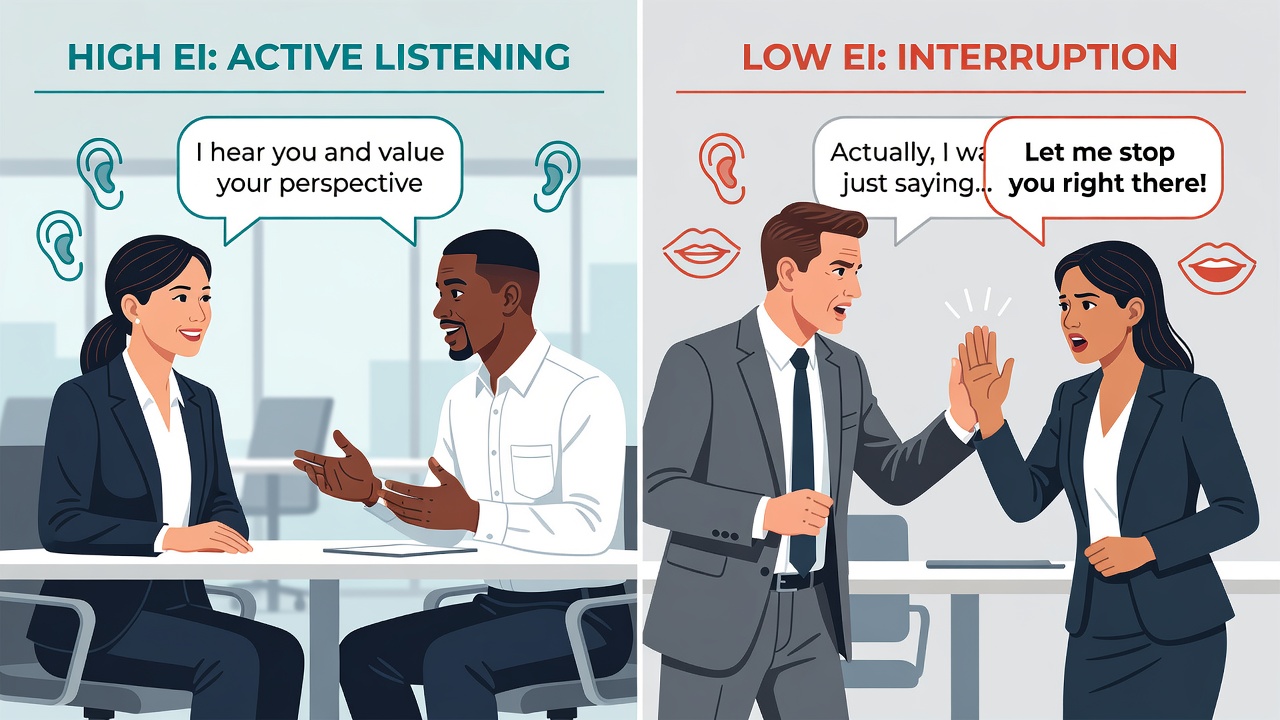
High vs Low EI Scenarios in Networking and Leadership
Comparing high and low emotional intelligence behaviors reveals clear career implications. In networking contexts, high-EI professionals listen actively, ask insightful follow-up questions, and send personalized messages afterward, creating meaningful connections that lead to referrals and collaborations. Low-EI counterparts dominate conversations, overlook social cues, and fail to follow up, resulting in superficial contacts and missed advancement chances. Leadership scenarios further highlight differences: high-EI leaders adapt communication styles to individual team members, provide constructive feedback with empathy, and celebrate collective wins, driving higher engagement and retention rates. Low-EI leaders issue directives without context, dismiss concerns, and react defensively to challenges, often leading to turnover and stalled team progress. These contrasts underscore why EI training frequently correlates with faster promotion timelines.
Integrating EI into LinkedIn Profiles and Performance Reviews
To showcase emotional intelligence professionally, weave specific stories into your LinkedIn About section that demonstrate empathy or successful conflict resolution, such as “Facilitated cross-department workshops that improved project delivery timelines by fostering open dialogue.” In performance reviews, quantify EI contributions with examples like “Applied active listening techniques during quarterly planning, resulting in 30 percent higher team alignment scores.” Update your profile regularly with endorsements from colleagues highlighting interpersonal strengths, and request recommendation letters that reference these qualities explicitly. This strategic integration helps recruiters and managers recognize your EI capabilities beyond technical achievements.
Tracking Progress Over 90 Days
A structured 90-day plan ensures consistent development. Weeks 1-4 focus on self-awareness through daily journaling and bi-weekly self-ratings. Weeks 5-8 emphasize self-regulation and motivation by incorporating breathing exercises and value-aligned micro-goals, with progress logged in a simple spreadsheet. Weeks 9-12 integrate empathy and social skills via scheduled interactions and peer feedback sessions. Monthly reviews with a mentor or trusted colleague provide accountability, while end-of-quarter self-assessments measure improvements in workplace scenarios. This timeline allows beginners to build habits gradually while observing tangible shifts in professional interactions and opportunities.
Frequently Asked Questions About EI and Career ROI
- How can I measure return on investment from EI training? Track metrics such as promotion rates, peer feedback scores, networking outcomes, and project collaboration success before and after focused development periods.
- Is emotional intelligence training beneficial for career changers? Absolutely; many transitioning professionals report smoother onboarding and stronger new-role relationships thanks to enhanced interpersonal awareness and adaptability.
- How quickly can EI skills be developed? With deliberate daily practice over 90 days, most individuals notice meaningful improvements in workplace communication and leadership presence.
- Are there reliable tools for assessing EI progress? Validated self-assessment quizzes from established psychology resources combined with 360-degree feedback from colleagues offer practical measurement options.
Conclusion
Emotional intelligence stands as a powerful catalyst for career growth in 2026 and beyond. By mastering the five core components through targeted exercises, real-world application, and systematic tracking, you create a competitive advantage that technical skills alone cannot provide. Begin with one component this week and expand steadily. For additional evidence-based guidance, consult authoritative sources such as the American Psychological Association, Harvard Business Review, and Society for Human Resource Management. Your investment in emotional intelligence today will shape the professional opportunities of tomorrow.


No comments yet. Be the first!