 Jobboy

Introduction: Why Cognitive Biases Threaten Your 2026 Career Trajectory
In 2026, professionals face unprecedented opportunities in AI-driven roles, remote work expansions, and skill-based hiring. Yet cognitive biases like sunk cost fallacy, confirmation bias, and anchoring frequently derail even the most ambitious career plans. These mental shortcuts, rooted in neuroscience and behavioral economics, distort how we evaluate promotions, job changes, and upskilling investments. Understanding and countering them can unlock measurable growth across industries from tech to healthcare. Behavioral research shows these biases affect decision-making across industries. By integrating practical frameworks with networking tactics and career journaling, you can shift from reactive choices to strategic ones that align with long-term objectives rather than emotional attachments.
The modern career landscape demands agility, but our brains often default to patterns that served us in simpler times. Neuroscience reveals that the amygdala influences emotional responses to loss, making it hard to abandon familiar paths. This introduction sets the stage for exploring each bias in depth with actionable solutions tailored for 2026 professionals seeking promotions or transitions.
Sunk Cost Fallacy in Career Decisions
The sunk cost fallacy occurs when professionals continue investing time or effort into a path simply because of prior commitments, ignoring future potential. For example, a marketing manager might stay in a stagnant role after investing five years, fearing lost time, while missing a 2026 pivot to data analytics that could double earning potential. This bias stems from loss aversion, a principle in behavioral economics where the pain of losing outweighs potential gains. Real-world case: Sarah, a software engineer, declined a 2025 promotion to product management because she had already spent years coding. By early 2026, she recognized the bias and transitioned successfully after applying a debiasing checklist that included weekly progress audits.
Another example involves a mid-level HR specialist who completed multiple certifications in traditional recruitment methods. Despite market shifts toward AI screening tools, she hesitated to retrain, citing her prior educational investments. After six months of stalled advancement, she reframed her thinking by focusing solely on projected 2026 outcomes. This led to enrollment in targeted online courses and a successful lateral move within her company.
Debiasing Framework for Sunk Costs
- Separate past investments from future value by listing only forward-looking metrics like skill demand forecasts.
- Ask: "If starting today, would I choose this path?" and document answers in a dedicated notebook.
- Set decision deadlines independent of history, such as reviewing career options every quarter regardless of tenure.
- Consult a mentor to provide external perspectives that challenge emotional attachments.
- Track opportunity costs explicitly by comparing current trajectory against alternative paths using simple spreadsheets.
Confirmation Bias and Upskilling Choices
Confirmation bias leads individuals to seek information that validates existing beliefs while ignoring contradictory evidence. In career planning, this might mean only reading success stories about your current industry while dismissing data on emerging fields like sustainable tech or quantum computing applications. This bias narrows exposure and perpetuates outdated strategies in a rapidly evolving job market.
Example: A finance professional avoided fintech certifications in 2025, selectively focusing on traditional banking reports. By 2026, peers advanced ahead due to broader skill acquisition. To counter this, actively seek disconfirming evidence weekly through diverse sources. Compare biased versus rational approaches in structured lists that highlight differences in information gathering and decision speed.
Practical exercise: Create a weekly bias audit where you deliberately read three articles opposing your preferred career direction. This builds cognitive flexibility supported by research from institutions like the American Psychological Association.
Anchoring Bias in Salary Negotiations and Promotions
Anchoring happens when initial information disproportionately influences judgments. A first job offer or outdated salary figure can anchor expectations, leading to under-negotiation in 2026's dynamic market. Professionals often fixate on their starting salary from years ago, missing adjustments for inflation, skill premiums, and economic shifts. Implementation guide: Research multiple data points before discussions using government labor statistics and industry benchmarks. Use reflection prompts like "What anchors am I relying on?" to surface hidden influences before key conversations.
Consider a project manager anchored to a $95,000 salary from 2023. In 2026 negotiations, she researched current ranges and secured a 25% increase by presenting comparative data. This demonstrates how breaking anchors through preparation yields tangible results.
Integrating Debiasing with Networking and LinkedIn Strategies
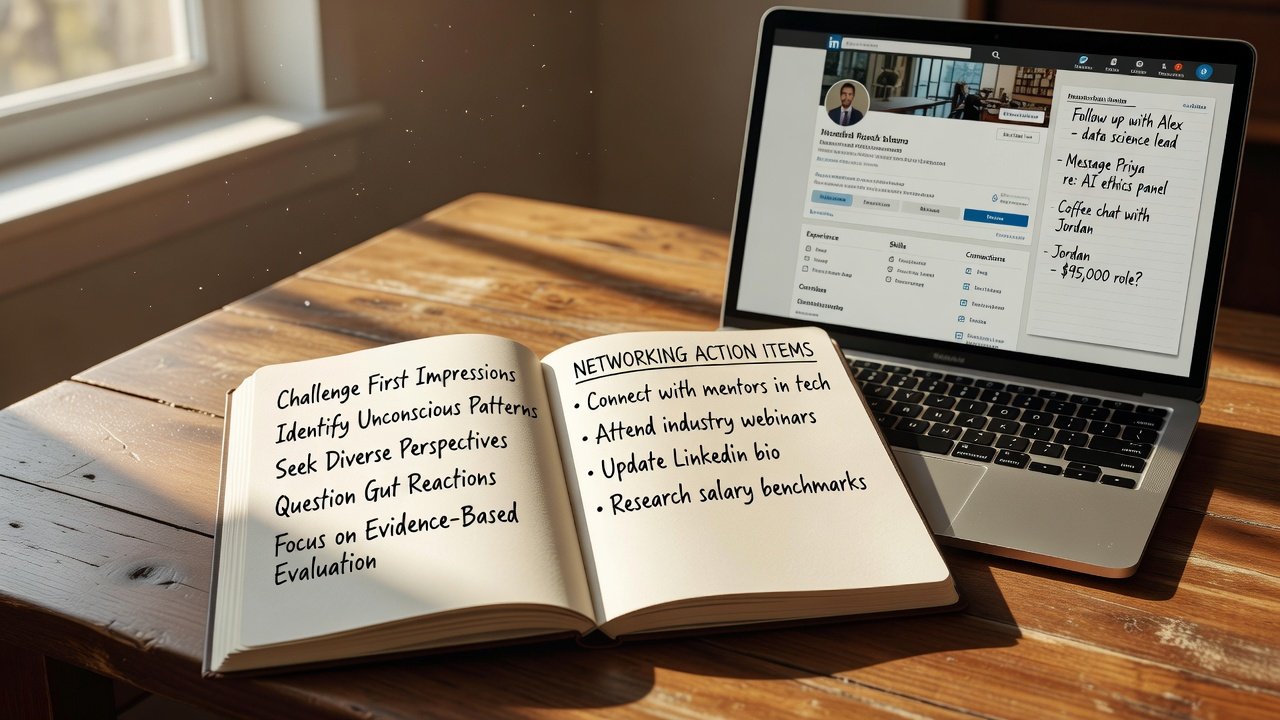
Effective networking counters biases by exposing you to diverse viewpoints. On LinkedIn, follow thought leaders outside your industry and engage with contrarian posts. Schedule monthly informational interviews to challenge assumptions and gather fresh insights. Expand your network by joining cross-functional groups and participating in virtual events focused on emerging trends. This approach reduces confirmation bias by introducing new data points naturally.
Step-by-Step Networking Guide
- Identify three professionals in target fields via LinkedIn search filters for skills and locations.
- Prepare bias-aware questions such as "What evidence changed your view on this career move?"
- Document insights in a journal immediately after each conversation.
- Follow up within 48 hours with personalized value, like sharing a relevant article.
- Review network diversity quarterly to ensure representation from multiple sectors.
Career Journaling Prompts and Reflection Exercises
Daily journaling builds awareness and strengthens decision-making neural pathways. Use these prompts consistently: What evidence contradicts my current career assumption? Am I honoring sunk costs or future value? Which anchors from past roles influence today's choices? How might confirmation bias be limiting my upskilling options this month? Track patterns over 30 days to identify recurring biases and measure progress through reduced emotional reactivity.
Neuroscience insight: Regular reflection strengthens prefrontal cortex activity, improving rational decision-making over time. Combine journaling with meditation apps for enhanced focus during high-stakes career reviews.
Comparison: Biased vs Rational Career Approaches
Biased approaches often lead to stagnation, while rational ones accelerate growth. For instance, biased upskilling focuses on familiar tools; rational methods prioritize high-demand skills validated by labor data from sources like the OECD. Create side-by-side comparisons for each major decision: biased might involve staying in comfort zones, whereas rational includes testing multiple hypotheses through small experiments like micro-courses or side projects. This structured comparison fosters better outcomes in promotions and job changes.
Practical Debiasing Frameworks and Implementation
Combine the three biases into a unified checklist applied before any career move. First, audit for sunk costs by ignoring historical time spent. Second, challenge confirmation by seeking three opposing views. Third, reset anchors with fresh market research. Apply this in team settings or with accountability partners for reinforcement. Real examples show professionals achieving faster promotions after 90 days of consistent use.
Short FAQ Section
How long does it take to overcome these biases?
Consistent application of frameworks typically shows results within 4-6 weeks of deliberate practice, with deeper habit formation occurring around three months.
Can journaling alone eliminate confirmation bias?
Journaling helps but works best combined with external feedback and diverse information sources such as those from the National Institutes of Health.
What role does neuroscience play in these career biases?
Neuroscience highlights how the brain's reward system reinforces biased choices, making deliberate overrides essential for long-term success.
Are these strategies effective for remote workers?
Yes, remote professionals benefit equally by adapting networking to virtual platforms and journaling to digital tools for consistent application.
Conclusion: Building Bias-Resistant Career Growth in 2026
By applying these neuroscience-backed strategies, professionals can navigate 2026's opportunities with clarity. Start today with one reflection exercise and expand your network deliberately. Rational decisions compound into significant career advancement, turning potential derailments into pathways for sustained success and fulfillment.

No comments yet. Be the first!