 Jobboy

Understanding the Availability Heuristic in Modern Career Decisions
The availability heuristic is a mental shortcut where people judge the likelihood of events based on how easily examples come to mind. In 2026 career networking, this bias leads professionals to overweight recent LinkedIn success stories or vivid job-switch tales while ignoring broader data. Behavioral economics research from institutions like the National Bureau of Economic Research shows this distortion affects millions navigating promotions and pivots. Professionals often recall dramatic posts about quick promotions or dramatic career pivots because those stories stand out emotionally, creating a false sense of frequency and probability. This cognitive bias, first identified in psychological studies, becomes especially problematic in fast-moving digital environments where algorithms amplify the most engaging content rather than the most representative outcomes.
Real-World Scenarios: Biased Decisions in Action
Consider a mid-level marketing manager who sees three colleagues post about rapid promotions after taking a specific AI certification course. Overweighting these vivid examples, she enrolls immediately without checking industry-wide completion rates or role requirements. Another scenario involves a software engineer who quits after reading dramatic stories of remote work freedom, only to face prolonged job searches because market conditions differ from those anecdotes. A third example features a sales professional who doubles down on cold LinkedIn messaging after seeing one high-profile thread about closing deals this way, neglecting to consider that most successful connections occur through warm introductions or sustained relationship building not showcased publicly. These cases illustrate how availability distorts priorities in upskilling, networking volume, and timing of job changes, often leading to regret when results fail to match the highlighted examples.
Comparisons: Biased vs. Rational Outcomes
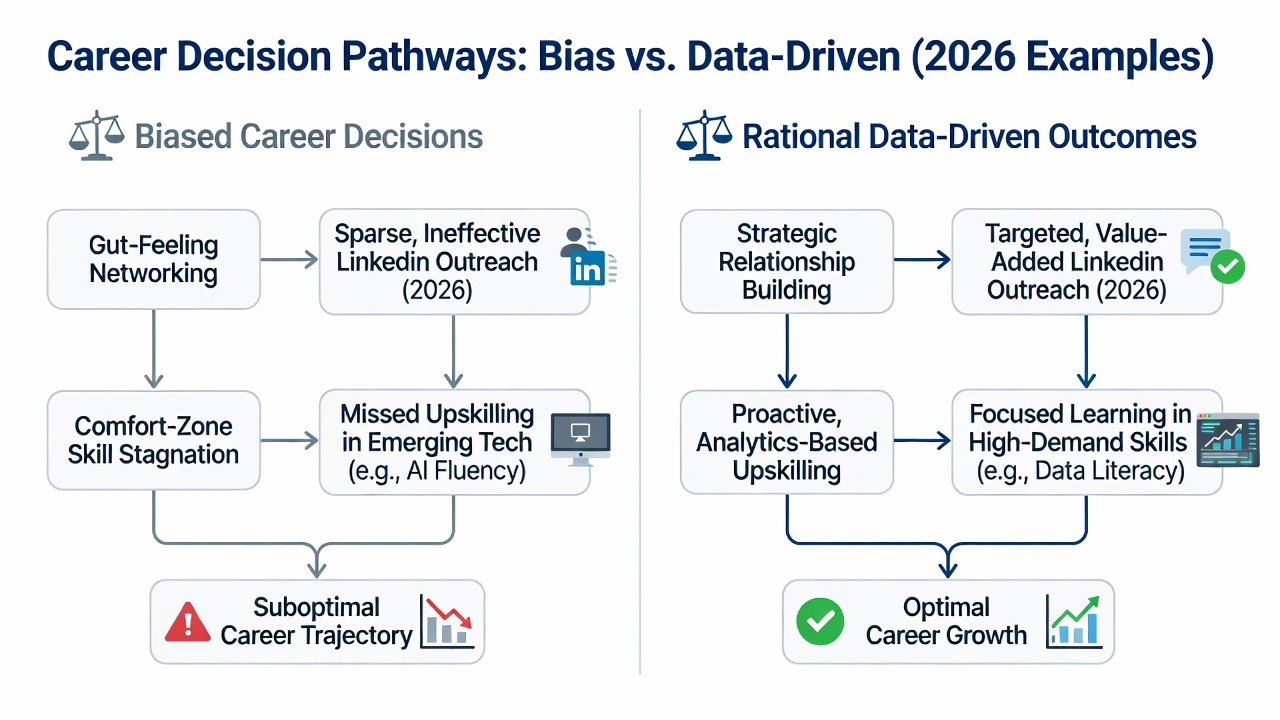
- Biased outcome: A professional prioritizes outreach to high-profile contacts based on one viral thread, resulting in low response rates and wasted time while missing steady opportunities from lesser-known networks.
- Rational outcome: The same individual logs 50 outreach attempts across varied networks, analyzes response data, and adjusts messaging for higher conversion through consistent testing and iteration.
- Biased outcome: Upskilling focuses on trending topics highlighted in recent posts without verifying long-term demand or alignment with personal strengths.
- Rational outcome: Skill investments follow analysis of multiple labor market reports and personal performance gaps identified through structured self-assessment.
In 2026 examples, biased networking often leads to chasing trending skills like prompt engineering without verifying demand, while rational approaches include reviewing labor statistics from government sources and peer-reviewed studies.
Debiasing Exercises: Pre-Mortems and Data Logging
To counter the availability heuristic, implement pre-mortems before major moves. Imagine your networking campaign failing in six months—what overlooked factors caused it? Pair this with data logging: track every LinkedIn interaction, skill investment, and job inquiry in a simple spreadsheet for objective review. Additional exercises include the “consider the opposite” technique where you deliberately seek evidence against your initial reaction to a career story. Regular journaling of emotional responses to online content helps separate vividness from actual relevance. Professionals who adopt these methods report clearer decision-making and reduced anxiety around career moves because they rely on accumulated evidence rather than isolated memorable events.
Step-by-step framework for evaluating networking opportunities:
- Define your goal with measurable criteria (e.g., three informational interviews per month).
- List recent vivid examples influencing you and rate their representativeness on a 1-10 scale.
- Seek disconfirming evidence from neutral sources like industry reports.
- Apply a 48-hour cooling-off period before acting on advice.
- Review logged data monthly to identify patterns and adjust tactics.
- Consult at least two mentors or data sources outside your immediate network for balance.
Practical Frameworks for Career Advice Evaluation
When assessing upskilling priorities or job changes, use a weighted decision matrix. Assign points to factors like salary growth potential, work-life balance, and skill transferability. Cross-reference advice against multiple data points rather than single stories. For job changes specifically, create a pros-and-cons list that includes both short-term emotional appeal and long-term trajectory alignment. This structured approach reduces the pull of recent vivid examples and promotes decisions grounded in comprehensive evaluation.
Common Mistakes to Avoid When Applying Career Advice
One frequent error is treating viral LinkedIn threads as representative case studies instead of outliers designed for engagement. Another mistake involves ignoring base rates—failing to ask how common certain outcomes truly are across the broader professional population. Professionals also often skip tracking results, allowing confirmation bias to reinforce the original heuristic. Finally, many overlook the role of timing and individual context when replicating strategies from others’ stories, leading to mismatched applications that waste resources and momentum.
Checklists for Objective Career Planning
- Review at least three diverse sources before committing to a new skill or connection strategy.
- Log all career-related inputs weekly with source, emotional impact, and objective relevance.
- Conduct quarterly pre-mortems on planned pivots and networking campaigns.
- Compare personal outcomes against aggregate data from reputable career platforms and academic summaries.
- Schedule regular reviews of decision journals to spot recurring availability bias patterns.
Reflection Questions for Professional Growth
How many recent LinkedIn posts have shaped your current job search strategy? What data could you collect to challenge those influences? Are your upskilling choices driven by visibility or verified demand? How might your recent networking efforts change if you weighted quiet successes equally with loud ones?
FAQ on Applying Mental Models to Career Development
How does the availability heuristic specifically affect LinkedIn outreach?
It causes professionals to replicate strategies from highly visible success posts, ignoring that most successful networking happens through quieter, consistent efforts not amplified on social media. This leads to inefficient time allocation and missed opportunities with less visible contacts.
What are effective ways to debias job change decisions?
Use pre-mortems, maintain decision journals, and consult longitudinal studies rather than anecdotal timelines shared online. Incorporating data from sources like the American Psychological Association helps ground choices in broader evidence.
Can these techniques improve 2026 promotion prospects?
Yes, by focusing on objective performance metrics and diverse feedback instead of recent colleague anecdotes, leading to more strategic skill development and relationship building supported by frameworks from resources such as Harvard Business Review.

No comments yet. Be the first!