 Jobboy

Introduction: Why Inversion Thinking Matters for Your 2026 Career
In a rapidly evolving job market, professionals often look back with regret on missed opportunities or poor decisions. Inversion thinking, a mental model popularized by Charlie Munger, flips the script by asking what actions would lead to failure and then systematically avoiding them. This approach is particularly powerful for dodging common 2026 career regrets such as inadequate networking or halted skill development. By focusing on the opposite of success, you can proactively build resilience against biases like sunk cost and status quo. This comprehensive guide explores practical applications, real-world examples, tools, and strategies to integrate inversion into your career planning. Many executives and mid-career professionals have used this technique to transform potential setbacks into opportunities for advancement, making it a cornerstone of strategic career management in uncertain economic times.
Understanding Inversion as a Mental Model
Inversion involves starting with the end goal of failure and working backward. Instead of asking "How do I get promoted?" consider "What would prevent me from advancing?" This method counters natural optimism bias and reveals hidden risks that traditional planning often overlooks. Research from cognitive psychology shows that avoiding negatives often yields better results than chasing positives alone. For career contexts in 2026, this means identifying pitfalls like ignoring industry shifts or maintaining toxic work relationships early. The model draws from first-principles reasoning and has been adopted in fields ranging from investing to personal development. When applied consistently, inversion creates a defensive strategy that protects your long-term trajectory while opening doors to unexpected growth.
Common 2026 Career Pitfalls Inversion Can Prevent
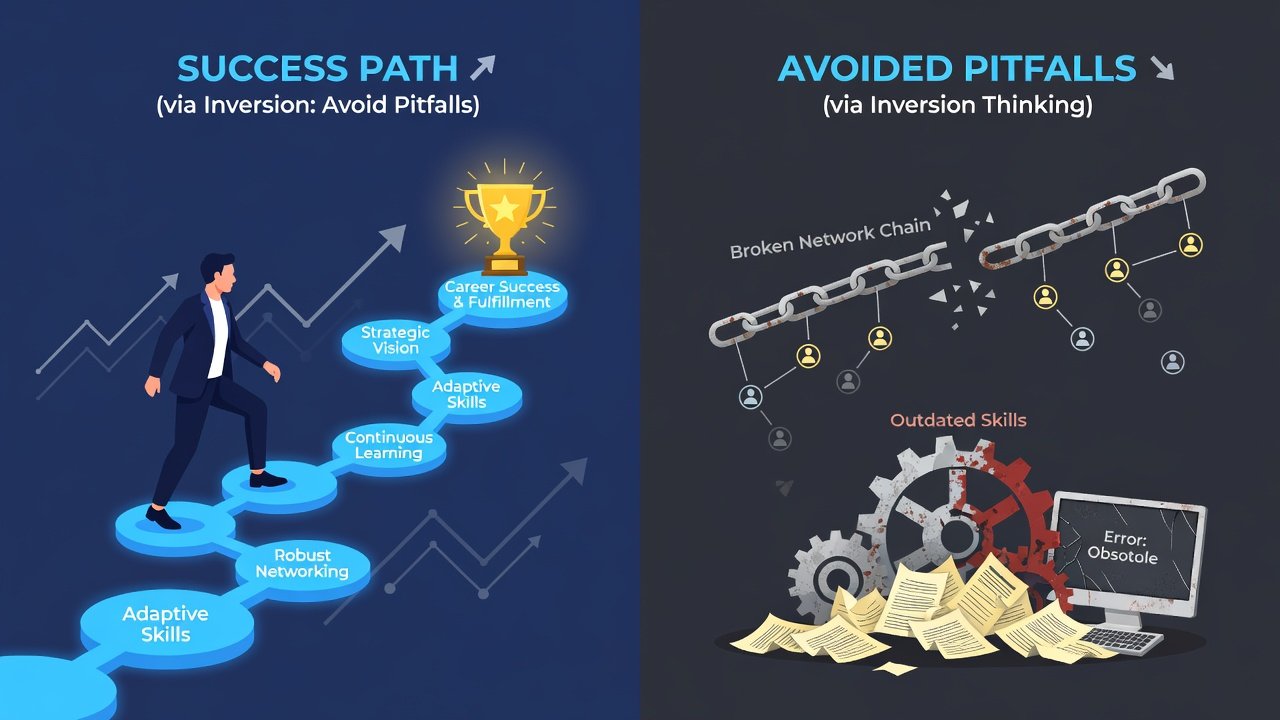
Many professionals face stalled progress due to predictable errors. Key areas include poor networking where failing to maintain relationships leads to isolation during job transitions. Stalled upskilling occurs when individuals neglect continuous learning amid AI and automation advances. Sunk cost bias causes persistence in unfulfilling roles due to past investments of time and energy. Status quo bias leads to resisting change even when better opportunities exist. Additional pitfalls involve poor work-life boundaries that result in burnout and overlooking emerging technologies that render current skills obsolete. Applying inversion helps map these traps and create avoidance plans tailored to individual circumstances and industry demands.
Step-by-Step Exercises for Career Planning
Follow these exercises to apply inversion effectively. First, define failure scenarios by listing five ways your career could derail in 2026, such as losing key contacts or missing certifications. Second, reverse-engineer solutions for each failure by outlining preventive actions like scheduling monthly networking calls or enrolling in targeted courses. Third, apply to promotion decisions by asking what behaviors would block a raise and then eliminate them, such as avoiding visibility projects or failing to document achievements. Fourth, conduct weekly reviews by dedicating 30 minutes to assess decisions through an inversion lens. Fifth, simulate worst-case outcomes for major moves like job changes and develop contingency steps. Sixth, involve a trusted mentor to review your inverted lists for blind spots. Seventh, track progress quarterly to refine your avoidance strategies based on real outcomes.
Real-World Examples of Inversion in Action
Consider Sarah, a marketing manager who used inversion to counter sunk cost bias. By listing actions that would waste her decade in the field, she pivoted to data analytics before her role became obsolete, securing a promotion within six months and expanding her professional network across tech sectors. Another example is Raj, who avoided status quo bias in tech by inverting his networking strategy. Instead of staying comfortable with old colleagues, he identified isolation risks and built cross-industry connections, landing a leadership role at a startup. A third case involves Elena, a finance professional who inverted her upskilling approach. She identified habits that would leave her behind on regulatory changes and committed to monthly learning sessions, resulting in a specialized certification that positioned her for a senior advisory position. These cases demonstrate how inversion turns potential regrets into strategic wins across diverse industries.
Practical Tools and Checklists
Implement inversion with these resources. Use a career inversion checklist that includes reviewing goals monthly against failure modes, auditing your network for gaps, assessing skill relevance quarterly, and documenting one preventive action weekly. Journal templates help document inverted scenarios with prompts for emotional and practical reflections. Digital tools like Notion or Trello allow tracking of preventive actions with reminders and progress visualizations. Printable worksheets can outline failure paths and countermeasures for annual planning sessions. Combine these with regular self-assessments to ensure consistent application and measurable improvements in decision quality over time.
LinkedIn Strategies Using Inversion
Optimize your LinkedIn presence by inverting common mistakes. Instead of sporadic posting, identify what would cause profile neglect and commit to consistent value-sharing through articles and comments. Connect with thought leaders by avoiding generic messages and instead offering specific insights or collaboration ideas. Update your profile by considering elements that would signal stagnation, such as outdated accomplishments, and refresh them proactively. Engage in groups by countering isolation tactics like lurking without contribution. LinkedIn offers robust tools for these targeted approaches, enabling professionals to build visibility while avoiding the pitfalls of passive presence.
Common Mistakes to Avoid When Using Inversion
One frequent error is over-focusing on minor risks while ignoring high-impact ones, which dilutes effectiveness. Another is failing to revisit inverted lists as circumstances change, leading to outdated strategies. Avoid sharing your full failure scenarios publicly to prevent unnecessary anxiety among peers. Do not apply inversion in isolation without balancing it with positive goal visualization, as this can create a negative mindset. Finally, neglecting to measure results from preventive actions misses opportunities for refinement and motivation.
Integrating Inversion with Daily Career Experiments
Start small by experimenting with one inverted action daily, such as reaching out to a new contact to prevent networking gaps. Track results in a simple log and adjust based on feedback. This builds habits for long-term success by turning abstract thinking into concrete behaviors. Over weeks, layer in more complex experiments like testing new learning platforms or role-playing difficult conversations. The key is consistency paired with reflection to sustain momentum and adapt to evolving career landscapes.
FAQs on Inversion Thinking
How does inversion differ from traditional goal-setting? It emphasizes risk avoidance over direct pursuit, often revealing overlooked obstacles that standard plans miss.
Can inversion be used with other mental models? Yes, pair it with first principles thinking for deeper insights or with opportunity cost analysis for balanced decisions. Farnam Street provides excellent resources on combining these approaches.
What if I identify too many failure points? Prioritize the top three most likely and impactful ones to maintain focus and avoid overwhelm.
How often should I practice inversion exercises? Begin with weekly sessions and scale to monthly reviews once habits solidify for sustained impact.
Is inversion suitable for team or organizational use? Absolutely, teams can apply it in strategy meetings to anticipate project risks and improve collective outcomes.
Conclusion
Inversion thinking equips professionals to navigate 2026 with fewer regrets by focusing on avoidance of pitfalls. Through detailed exercises, multiple real-world examples, expanded checklists, and consistent application via tools and LinkedIn, you can foster proactive career development and achieve lasting growth. Start today by listing your top failure scenarios and begin reversing them into actionable safeguards.

No comments yet. Be the first!