 Jobboy

Introduction to Smarter Salary Negotiations
In the competitive job market of 2026, salary negotiation remains a critical skill for maximizing your earning potential. Yet, many professionals leave money on the table due to avoidable mistakes. This article breaks down eight common pitfalls, estimates their costs based on projected 2026 averages from industry data, and provides actionable fixes, including ready-to-use scripts. We'll also cover strategies for negotiating benefits and pay raises, ending with a comprehensive checklist to prepare you for success.
According to the U.S. Bureau of Labor Statistics, average annual salaries across sectors are expected to hover around $65,000 in 2026, with mid-level professionals earning up to $90,000. Failing to negotiate can cost you thousands annually—compounding over a career. Let's dive into the errors and how to sidestep them.
1. Ignoring Total Compensation
Many focus solely on base salary, overlooking bonuses, stock options, and perks. In 2026, total compensation packages often add 20-30% to base pay, per projections from economic reports.
Cost: You could miss out on $15,000-$25,000 annually in a mid-level role, leading to $300,000+ lost over 20 years without compound growth.
Fix: Research holistic packages using tools like salary calculators. Emphasize benefits like 401(k) matches, which can save you thousands in retirement.
Script: "I'm excited about the role and the base salary of $80,000. Could we discuss the full package, including bonuses, equity, and health benefits? For instance, how does the 401(k) matching work?"
2. Skipping Industry Research
Not knowing market rates leads to undervaluing yourself. With inflation and skill shortages in tech and healthcare, 2026 benchmarks show 10-15% variances by region and role.
Cost: Accepting 15% below market could mean $12,000 less per year, totaling $240,000 over two decades.
Fix: Use reliable sources for data. Visit the Bureau of Labor Statistics for occupational wages and adjust for your location.
Script: "Based on my research from BLS data, similar roles in this area pay $85,000-$95,000. Given my experience, I'm targeting the higher end—can we align on that?"
3. Accepting the First Offer Without Countering
Rushing to say yes signals desperation. Employers often lowball by 10-20%, expecting negotiation.
Cost: In 2026, this might cost $8,000-$16,000 yearly for entry-to-mid roles, equating to $160,000+ lifetime loss.
Fix: Always prepare a counteroffer backed by your value. Highlight achievements to justify it.
Script: "Thank you for the $75,000 offer. Considering my track record of increasing team efficiency by 25%, I'd like to propose $88,000 to reflect that impact."
4. Focusing Only on Base Salary
Base pay is just one piece; ignoring raises and performance ties limits future growth. Annual raises average 3-5% in 2026 projections.
Cost: Without negotiating raise structures, you might forgo $4,000-$7,000 per year post-first-year, compounding to $100,000+ over a decade.
Fix: Tie negotiations to clear promotion paths and merit increases. For pay raises, request reviews every six months.
Script: "Along with the base, can we outline a plan for annual reviews and raises? I'm aiming for at least 4% based on performance metrics."
5. Neglecting to Negotiate Benefits
Benefits like PTO, remote work, or tuition reimbursement can add $10,000+ in value yearly, especially with rising healthcare costs in 2026.
Cost: Skipping this could mean $5,000-$15,000 in untapped perks annually, affecting work-life balance and finances.
Fix: Prioritize non-monetary wins if salary is firm. Emphasize how benefits boost retention and productivity.
Script: "The salary works for me, but could we add two extra PTO days or remote work flexibility? That would greatly support my productivity."
6. Being Afraid to Ask or Seem Pushy
Fear of rejection prevents 60% of professionals from negotiating, per surveys. Confidence is key in a candidate-driven market.
Cost: This hesitation might result in $10,000 average shortfall per negotiation, or $200,000 over five job changes.
Fix: Practice with a mentor. Frame asks as collaborative discussions.
Script: "I value this opportunity and want to ensure it's mutually beneficial. What flexibility is there on the compensation to match my qualifications?"
7. Not Highlighting Your Unique Value
Generic pitches fail to justify higher pay. In 2026, with AI automating routine tasks, emphasize soft skills and results.
Cost: Undervaluing yourself could lead to $9,000-$18,000 less annually, stunting career progression.
Fix: Quantify achievements. For raises, link to company goals.
Script: "In my last role, I led a project that saved $50,000. How can we structure compensation to reflect similar contributions here?"
8. Forgetting Long-Term Implications
Short-term gains over lifetime earnings ignore equity growth or pension vesting, crucial in volatile 2026 economies.
Cost: Poor long-term deals might cost $20,000+ yearly in forgone equity, totaling millions over 30 years.
Fix: Negotiate vesting schedules and future raises. Consult resources like the Society for Human Resource Management for best practices.
Script: "Beyond the initial offer, can we discuss equity vesting and annual adjustment clauses to ensure long-term alignment?"
Benefits and Pay Raise Strategies
Negotiating benefits enhances total rewards: aim for comprehensive health plans covering 80%+ premiums, flexible hours for better retention, and professional development stipends up to $5,000 yearly. For pay raises, target 5-10% during reviews by documenting contributions quarterly. Use data-driven arguments, like industry benchmarks, to build a case. Remember, successful negotiations often yield 7-14% more than initial offers, per Harvard Business Review insights.
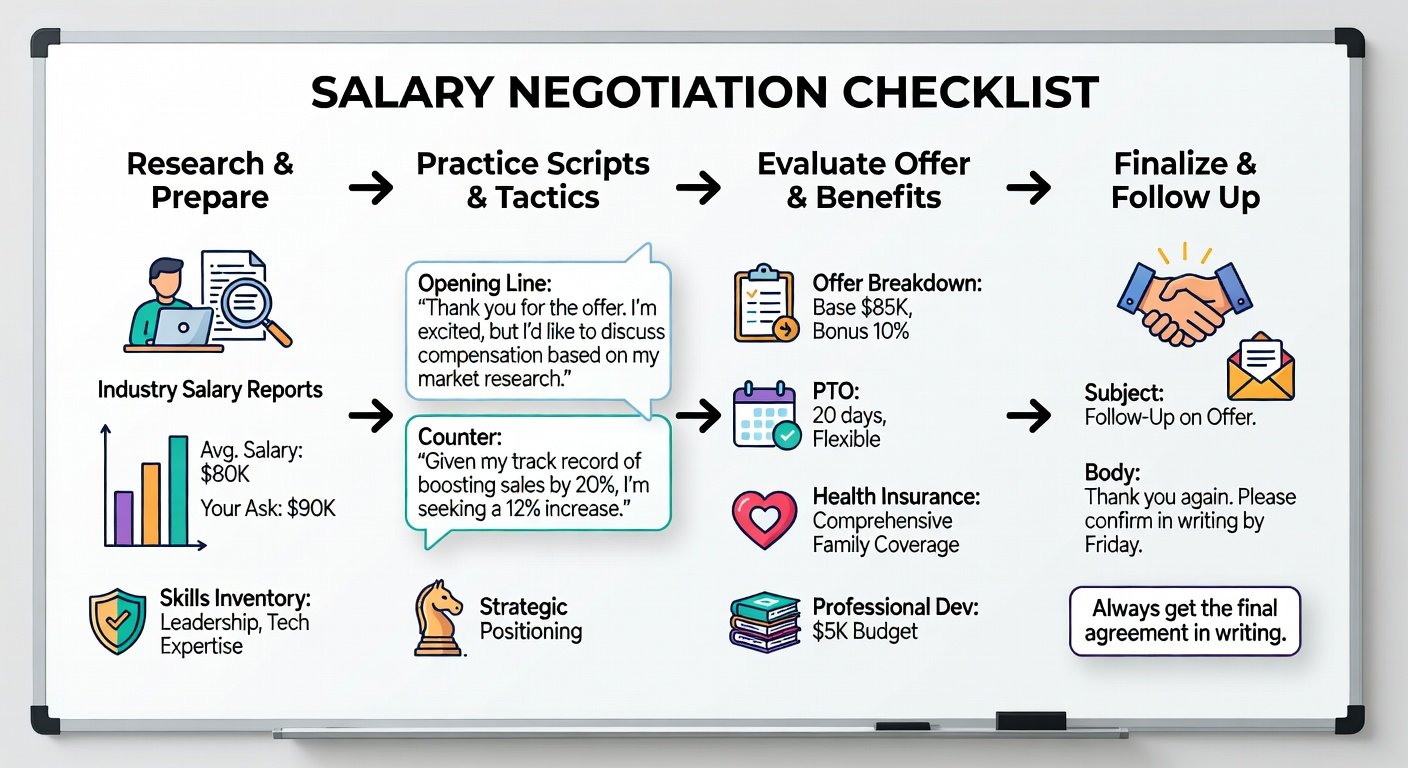
Salary Negotiation Checklist
- Research: Gather data on salary ranges, benefits, and company specifics (1-2 weeks prep).
- Value Assessment: List your achievements and unique skills with metrics.
- Practice: Rehearse scripts with a trusted advisor.
- Timing: Negotiate after receiving a written offer, via email or call.
- Counteroffer: Propose 10-20% above initial, with justifications.
- Benefits Focus: If salary is fixed, pivot to PTO, remote options, or bonuses.
- Follow-Up: Get everything in writing; schedule first review.
- Mindset: Stay positive, view as partnership.
By avoiding these mistakes and using this checklist, you'll position yourself for negotiations that not only boost immediate pay but also secure sustainable career growth in 2026 and beyond.


No comments yet. Be the first!