 Jobboy
Introduction to Remote Equity Compensation in 2026
Equity components such as RSUs and stock options form a critical part of total compensation for remote workers. As companies continue to hire globally, understanding benchmarks helps professionals negotiate effectively across experience levels. This guide examines valuation approaches, cost-of-living adjustments, and practical strategies tailored to junior, mid-level, and senior roles. In today's distributed workforce, equity can represent 30% or more of total pay, making it essential to master these elements for long-term financial planning and career growth.
Valuation Methods for Remote Equity Packages
Equity valuation starts with assessing grant value at current stock prices. Professionals use the Black-Scholes model for options and fair market value calculations for RSUs. Remote teams often reference 409A valuations to determine strike prices. Comparing these to cash salary equivalents reveals the true package worth, especially when factoring in volatility from public or private companies. For deeper insight, consider how expected volatility, time to expiration, and dividend yields influence option pricing. In practice, a junior remote engineer might receive options valued at a modest upfront amount but with significant upside if the company scales. Mid-level roles often blend RSUs with options for balanced risk and reward.
Advanced Valuation Techniques
Beyond basic models, discounted cash flow analysis helps project future equity worth based on company performance metrics. Remote candidates should request detailed cap tables and review recent funding rounds. This approach prevents over- or under-valuing grants during negotiations.
Cost-of-Living Adjustments Across Countries
Global remote roles require COL adjustments to equity offers. For instance, a US-based package might be scaled down for team members in lower-cost regions like Eastern Europe or Southeast Asia while maintaining competitive value. Factors include local tax rates, housing costs, and currency fluctuations. Benchmarks show adjustments of 20-50% depending on the country, ensuring equity remains attractive without inflating company expenses. Example: A senior developer in Portugal might accept 35% lower nominal equity than a US counterpart but achieve similar purchasing power after COL factors. Always model scenarios using tools from sources like the OECD for international comparisons.
Country-Specific Scenarios
In India, high growth potential offsets lower base equity through favorable tax treatments on certain grants. European roles often emphasize stability with longer vesting periods. North American benchmarks remain the highest but face intense competition. Professionals should calculate net present value after local inflation and exchange rates.
2026 Equity Benchmarks by Experience Level
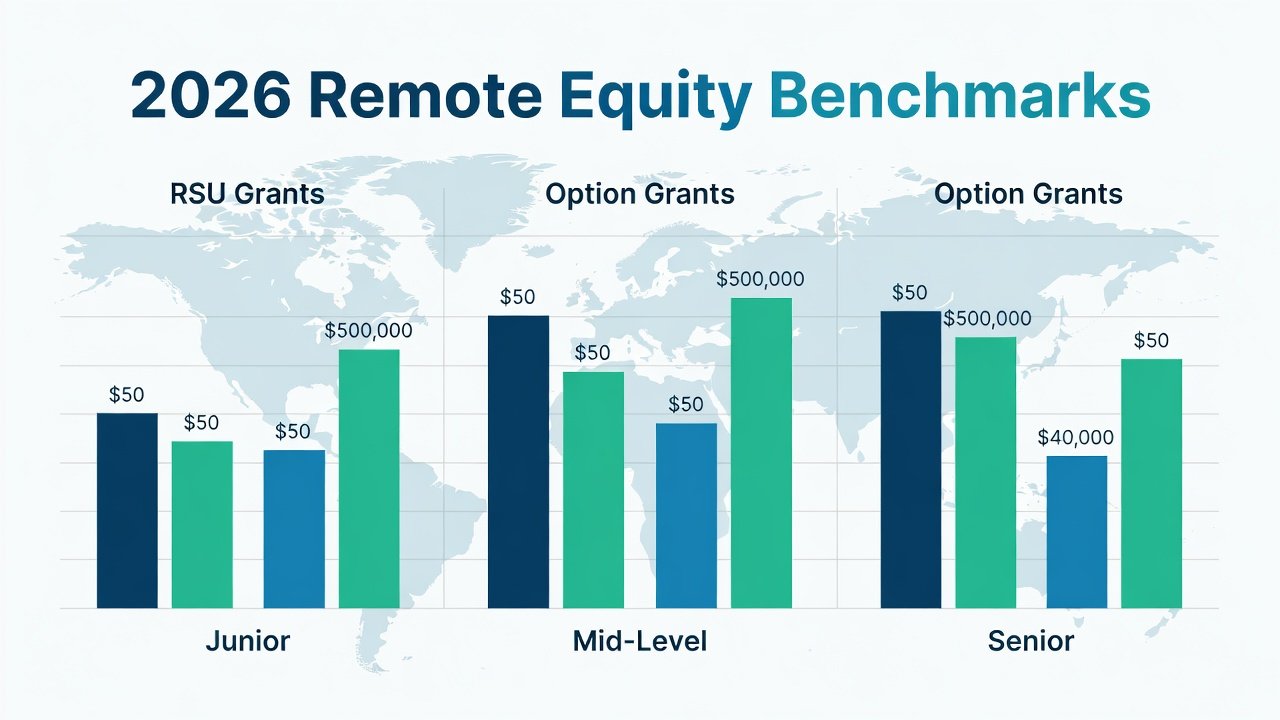
Data-driven benchmarks vary significantly by seniority. Junior roles typically receive smaller grants focused on learning opportunities, while seniors command larger percentages of total comp in equity.
| Experience Level | Typical Equity % of TC | RSU Grant Range | Option Grant Range |
|---|---|---|---|
| Junior (0-2 years) | 10-20% | 5,000-15,000 shares | 10,000-30,000 shares |
| Mid-Level (3-5 years) | 25-40% | 20,000-50,000 shares | 40,000-80,000 shares |
| Senior (6+ years) | 45-60% | 60,000-150,000 shares | 100,000-250,000 shares |
These figures represent typical remote tech roles as of late 2026 and should be adjusted for company stage and industry. Additional context shows startups offering higher equity percentages in exchange for lower cash salaries, while established firms balance with larger RSU allocations.

Negotiation Scripts for Each Level
Junior candidates can say: "Based on my research into 2026 benchmarks, I'm targeting 15% equity in my total package to align with market rates for remote positions." Mid-level professionals might add: "To reflect my contributions, I propose increasing the RSU grant by 25% with a refreshed vesting schedule." Seniors often negotiate: "Given my expertise, equity at 50% of TC including performance-based refreshers would make this offer competitive globally." Expand these scripts by preparing supporting data such as peer benchmarks and personal achievements. Role-play responses to common pushbacks like budget constraints.
Handling Counteroffers
When employers counter with lower equity, pivot to hybrid structures combining cash and equity. Document all discussions and follow up in writing for clarity.
Equity Refresh Tactics vs Initial Offer Negotiations
Step-by-step comparison: 1. Initial offers focus on signing bonuses and front-loaded grants. 2. Refresh tactics involve annual reviews tied to performance metrics. 3. Use benchmarks to request refreshes every 12-18 months. 4. Document achievements to justify increases. Real-world scenario: A mid-level engineer negotiated a 30% refresh after one year by citing promotion and market data, boosting long-term value. Another example involves a senior leader who secured accelerated vesting upon company acquisition through proactive refresh discussions.
Detailed Comparison Table
Initial negotiations emphasize total grant size, while refreshes prioritize retention and performance alignment. Refresh processes typically require quarterly check-ins and updated market analysis.
Tax Implications and Vesting Examples
Tax treatment differs by country and equity type. RSUs trigger income tax at vesting, while options may qualify for capital gains if held long-term. Vesting example: A four-year schedule with one-year cliff means 25% vests after year one, then monthly. A practical case: An employee receiving 40,000 RSUs at $50 share price faces immediate tax on $500,000 upon full vesting in year four. Consult resources like IRS guidelines for US filers or local equivalents. Global remote workers should model scenarios for double taxation risks and consider tax-advantaged accounts. Additional pitfalls include AMT on incentive stock options and reporting requirements for foreign equity holdings.
Practical FAQs on Global Remote Equity Pitfalls
- How do I handle currency fluctuations in equity value? Monitor quarterly and negotiate COL buffers in contracts.
- What if my company goes public mid-vesting? Accelerate discussions on liquidity events and explore secondary market options.
- Can I leverage benchmarks for raises? Yes, present updated market data during annual reviews with specific grant comparisons.
- Are there pitfalls with private company options? Yes, illiquidity and 409A risks require careful valuation review and diversification planning.
- How do vesting cliffs impact remote mobility? Plan job changes around cliff dates to maximize unvested equity capture.
- What tax forms are needed for international equity? Review IRS Form 8938 and FBAR for foreign assets alongside local filings.
Conclusion
Mastering 2026 remote equity benchmarks empowers professionals at every level to secure competitive packages. Combine valuation knowledge, tailored negotiations, and tax awareness for optimal results. Review offers against current data and seek expert advice for personalized strategies. With thorough preparation, remote workers can turn equity into a powerful wealth-building tool across borders and career stages.

No comments yet. Be the first!