 Jobboy

2026 Freelance vs Full-Time Comp Guide
In the evolving job market of 2026, professionals face a pivotal choice: the flexibility of freelancing or the structure of full-time employment. This guide dives deep into the compensation differences between these paths, helping you make an informed decision based on your career goals, financial needs, and lifestyle preferences. We'll explore salary benchmarks, benefits packages, equivalent compensation calculations, and practical negotiation strategies. Whether you're a tech whiz, marketing expert, or designer, understanding these nuances can significantly impact your earning potential and job satisfaction.
Understanding Compensation in 2026: Beyond the Base Salary
Compensation isn't just about your paycheck—it's the total value you receive from your work. For full-time employees, this includes salary, bonuses, health insurance, retirement contributions, and paid time off. Freelancers, on the other hand, must self-fund many of these perks, but they often command higher hourly or project rates to compensate. In 2026, economic shifts like remote work normalization and AI-driven efficiencies have widened the gap in how compensation is structured, making it essential to calculate true value.
According to recent labor market analyses, full-time roles in stable industries offer predictable income streams, while freelancing provides scalability but with income variability. To get started, consider using online tools like those from the U.S. Bureau of Labor Statistics to benchmark salaries in your field. For freelance rates, platforms like Upwork provide real-time data on project bids and earnings.
Salary Benchmarks by Industry in 2026
Salaries vary widely by industry, and 2026 trends show continued growth in high-demand sectors. In tech, full-time software developers typically earn competitive base salaries with equity options, while freelancers might charge premium rates for specialized skills like AI integration. Marketing professionals in full-time roles benefit from performance bonuses tied to campaigns, whereas freelancers often secure retainers for ongoing client work.
Design fields, such as graphic or UX design, highlight another contrast: full-time designers receive steady pay plus company-provided tools, but freelancers can diversify income through multiple clients, potentially exceeding full-time equivalents during peak seasons. Recent reports indicate that tech and marketing sectors lead in overall compensation growth, driven by digital transformation. For authoritative insights, refer to the U.S. Bureau of Labor Statistics homepage for occupational wage data.
- Tech: Full-time roles emphasize long-term stability with stock options; freelancers thrive on short-term, high-value contracts.
- Marketing: Full-time offers agency-backed resources; freelancers leverage personal networks for diverse projects.
- Design: Full-time includes collaborative environments; freelancers enjoy creative autonomy but handle self-marketing.
Full-Time Benefits vs. Freelancer Perks: What You're Really Getting
Full-time positions shine in benefits that freelancers must procure independently, often at a higher personal cost. Health insurance, for instance, is typically employer-subsidized in full-time roles, covering premiums and deductibles. Freelancers might opt for marketplace plans, which can be more expensive without group discounts.
Retirement savings like 401(k) matching are a staple in full-time comp, providing tax advantages and employer contributions. Freelancers rely on IRAs or SEP accounts, requiring disciplined self-funding. Paid time off, parental leave, and professional development stipends further tilt the scales toward full-time stability.
However, freelancers gain flexibility—setting their own schedules and choosing projects—which can translate to intangible perks like better work-life balance. To bridge the gap, many freelancers budget 20-30% of earnings for benefits, using tools like freelance insurance aggregators. For guidance on employee benefits, the U.S. Department of Labor offers comprehensive resources.
Calculating Equivalent Compensation: Examples and Tools
To compare apples to apples, calculate your total compensation package. Start by adding your base salary to the monetary value of benefits. For full-time, estimate health insurance worth (often 10-20% of salary) and retirement matches (up to 6%). Freelancers add self-paid equivalents to their gross earnings.
Example 1: Tech Professional
A full-time developer might have a base salary plus $5,000 in annual health coverage and 4% 401(k) match. Total comp: base + benefits value. A freelancer charging equivalent hourly rates would need to factor in self-insurance costs to match this.
Example 2: Marketing Specialist
Full-time: Salary + bonuses + paid vacation (valued at daily rate). Freelancer: Project fees minus taxes and no paid leave—aim for 1.5x the hourly equivalent to cover gaps.
Use free compensation calculators from sites like Glassdoor or Salary.com to personalize these. In 2026, these tools incorporate inflation and remote work adjustments for accuracy.
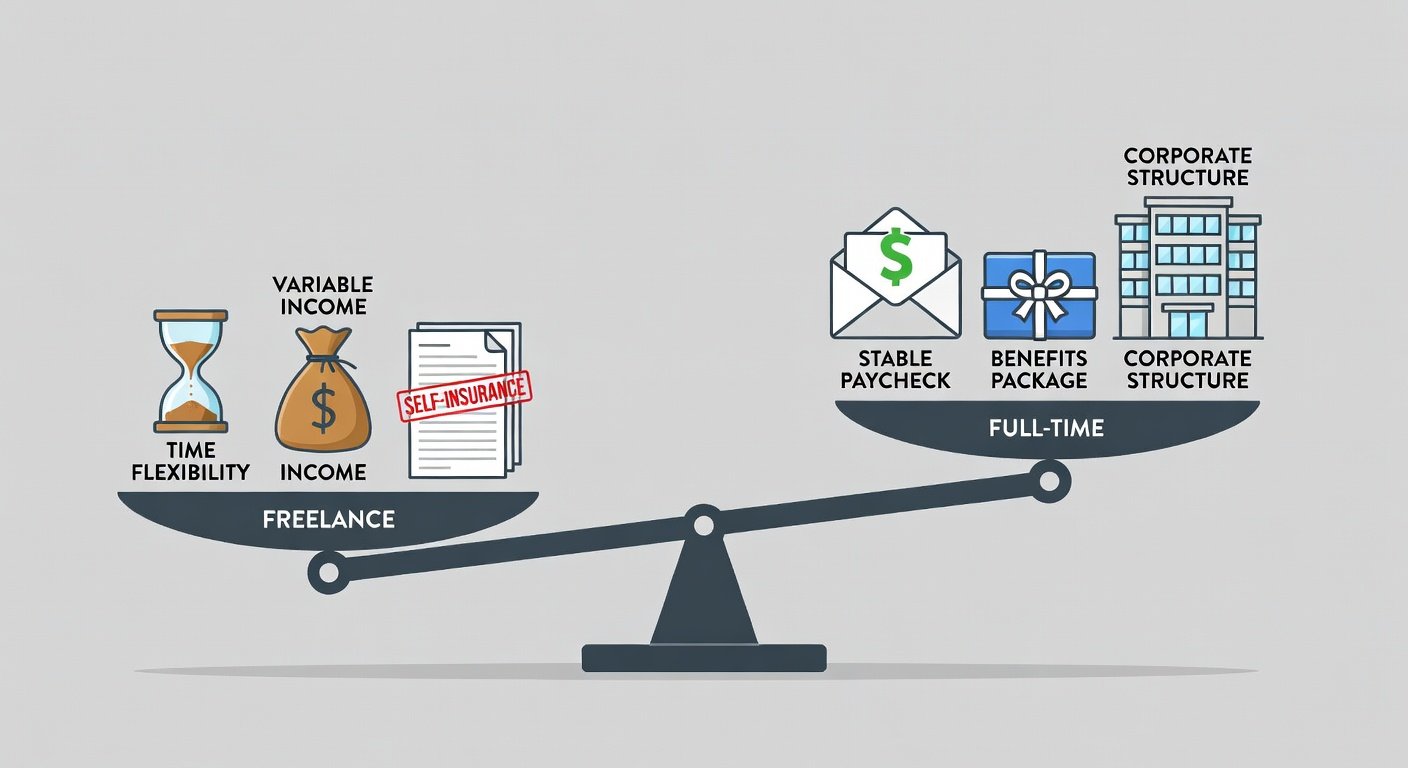
Pros and Cons: Freelance vs. Full-Time in a Table
Here's a quick comparison to weigh your options:
| Aspect | Freelance | Full-Time |
|---|---|---|
| Income Potential | High scalability; unlimited ceiling but variable | Stable base with predictable raises/bonuses |
| Benefits | Self-managed; flexible but costly | Comprehensive employer-provided package |
| Stability | Lower; depends on client pipeline | Higher; job security in established roles |
| Flexibility | Ultimate control over time and projects | Limited by company policies |
| Taxes | Self-employment taxes; quarterly payments | Withheld automatically; potential deductions |
This table underscores that while freelancing offers freedom, full-time provides security—choose based on your risk tolerance.
Real-World Industry Comparisons
In tech, freelancers often out-earn full-timers on specialized gigs like app development, but full-time roles at FAANG-like companies include equity that vests over years. Marketing freelancers excel in niche areas like SEO consulting, where full-time salaries are bolstered by team synergies. Designers in freelance mode can build portfolios faster, leading to premium rates, versus full-time's steady but capped progression.
Case study: A 2026 survey from Freelancers Union shows hybrid models—part-time freelance alongside full-time—gaining traction, blending stability with extra income. For global freelance trends, check Upwork's research section.
Step-by-Step Guide to Negotiating Your Compensation
Negotiation is key to bridging freelance-full-time gaps. Follow these steps:
- Research Market Rates: Use sites like Indeed or LinkedIn to gauge 2026 benchmarks for your role and location.
- Assess Your Value: Highlight unique skills, past achievements, and how you solve employer problems.
- Prepare Your Ask: For full-time, request 10-15% above initial offer, including benefits. Freelancers: Quote 20-50% above desired net to cover overhead.
- Practice Delivery: Role-play with a mentor; use data-backed arguments.
- Follow Up: Send a polite email recapping discussions. Sample: "Thank you for the offer. Based on my experience in [skill], I propose [rate/salary] to align with market standards."
- Know When to Walk: If terms don't meet your needs, explore alternatives.
For full-time, negotiate holistically—salary, remote options, PTO. Freelancers: Secure contracts with clear payment terms via tools like HelloSign.
FAQ: Taxes, Stability, and Scaling Income
Q: How do taxes differ between freelance and full-time?
A: Full-time workers have taxes withheld; freelancers pay self-employment taxes (around 15.3% for Social Security/Medicare) quarterly. Deduct business expenses to offset—consult IRS guidelines at irs.gov.
Q: Is freelancing more stable in 2026?
A: No, full-time offers more predictability, but freelancers can diversify clients for resilience against economic dips.
Q: How can I scale income as a freelancer?
A: Build a niche, raise rates with experience, automate admin tasks, and network on platforms like LinkedIn.
Q: What's the break-even point for benefits?
A: Calculate if freelance rates cover self-funded perks; many find equilibrium at 1.3-1.5x full-time hourly equivalents.
Conclusion: Choosing Your Path in 2026
Ultimately, freelance vs. full-time compensation boils down to your priorities: adventure and potential upside in freelancing, or security and perks in full-time work. By benchmarking salaries, valuing benefits, and mastering negotiations, you can optimize your comp regardless of the route. Assess your situation, run the numbers, and take action—your career trajectory awaits.


No comments yet. Be the first!