 Jobboy

Introduction to Executive Equity Negotiation in 2026
Private companies continue to attract top mid-to-senior talent through sophisticated compensation packages that extend far beyond base salaries. In 2026, executives must master the art of valuing illiquid equity, phantom stock options, and profit-sharing plans to build substantial long-term wealth. This comprehensive guide provides in-depth strategies, real-world examples, negotiation scripts, and decision frameworks tailored for professionals navigating private firm offers. Understanding these elements allows executives to move past simple salary discussions and focus on total compensation that aligns personal financial goals with company growth trajectories.
Understanding Illiquid Equity, Phantom Stock, and Profit-Sharing Plans
Illiquid equity represents direct ownership in the form of common or preferred shares that cannot be sold on public markets until a liquidity event occurs, such as an acquisition or initial public offering. Executives receiving this type of equity must evaluate vesting schedules, typically spanning four years with a one-year cliff, along with potential dilution from future funding rounds. Phantom stock options, by contrast, deliver cash payouts equivalent to the appreciation in company value without granting actual ownership, making them attractive for firms that wish to avoid share dilution. Profit-sharing plans allocate a percentage of annual or quarterly profits to participants based on predefined performance metrics, often tied to revenue targets or EBITDA thresholds.
Each component carries distinct tax implications and risk profiles. Illiquid equity may trigger capital gains taxes upon sale, while phantom stock is usually taxed as ordinary income at payout. Executives should request detailed modeling from company finance teams to project outcomes under multiple exit scenarios, including conservative, base, and optimistic valuation multiples. This deeper analysis reveals how these instruments contribute to overall wealth creation beyond immediate cash compensation.
Benchmarking Compensation Against Public Company Peers
Public company disclosures offer valuable reference points for calibrating private firm expectations. Reviewing proxy statements and annual filings from comparable public entities helps identify typical equity grant sizes at similar stages of revenue and headcount. 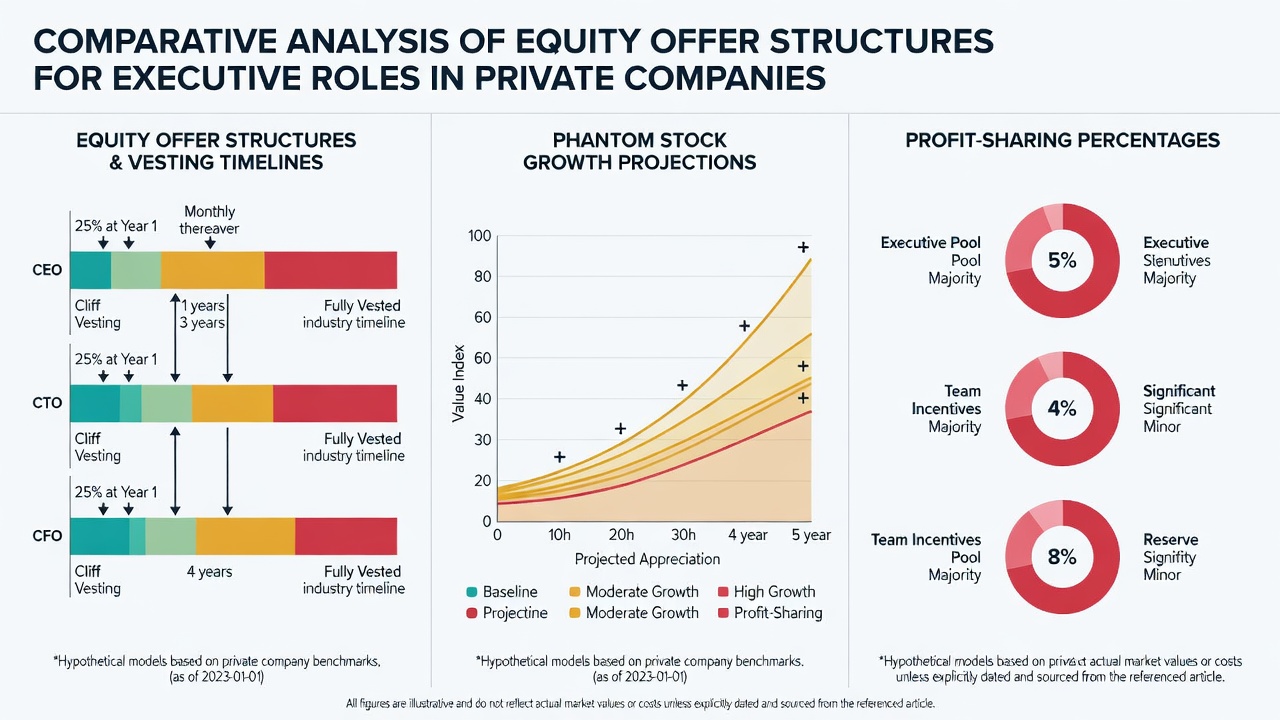
Resources from the U.S. Securities and Exchange Commission allow executives to access standardized disclosure data that informs realistic ask ranges. Cross-referencing these benchmarks with private market surveys provides a balanced view that strengthens negotiation positions.
Leveraging Data on Average Salary Trends
Salary trend data from government sources helps contextualize base pay relative to equity components. The Bureau of Labor Statistics publishes regular updates on compensation patterns across industries, enabling executives to quantify how much of total pay should shift toward long-term incentives. Incorporating this data into discussions demonstrates preparation and objectivity, reducing the likelihood of founder resistance. Executives can also review industry association reports to identify emerging trends in equity-heavy packages for mid-to-senior roles.
Strategic Timing Around Funding Rounds
Aligning compensation conversations with funding milestones creates natural leverage points. Pre-funding periods often see founders more receptive to equity adjustments that help attract or retain key leaders ahead of growth pushes. Post-round timing allows executives to reference new valuations when proposing refreshed grants or accelerated vesting. Multi-year agreements that include refresh clauses tied to subsequent rounds protect against dilution while demonstrating commitment to sustained value creation.
Step-by-Step Guide to Comparing Multiple Offers
Effective offer comparison begins with a structured framework. First, compile every element including base compensation, annual bonuses, equity grants, profit-sharing percentages, benefits, and severance provisions. Second, model each package under different liquidity timelines by applying probability-weighted outcomes to potential exit events. Third, adjust projections for personal factors such as tax jurisdiction, liquidity needs, and risk tolerance. Fourth, identify gaps and prepare targeted counterproposals that address the most valuable missing elements. Fifth, simulate negotiation outcomes by testing how small increases in equity percentages affect projected wealth across scenarios. This methodical approach transforms subjective feelings into data-driven decisions.
Effective Scripts for Negotiating Equity Benefits
Successful conversations use collaborative language that emphasizes alignment. One effective opening states: “I am excited about the long-term vision and want to ensure my incentives match the company’s growth objectives. Could we explore adjusting the phantom stock allocation to better reflect responsibilities at this level?” A follow-up script for profit-sharing might read: “To strengthen our partnership, I propose tying a modest profit-sharing component to specific revenue milestones, which would motivate performance while remaining flexible for the business.” When addressing vesting, executives can say: “I value the opportunity and would like to discuss acceleration provisions upon a change of control to protect both parties in various outcomes.” These scripts keep discussions constructive and focused on mutual benefit.
Common Mistakes to Avoid During Negotiations
Executives often undervalue the impact of dilution when accepting large equity grants without protective provisions. Another frequent error involves focusing solely on headline percentages rather than fully diluted ownership after anticipated rounds. Failing to request independent 409A valuations can lead to mispriced options that create tax complications later. Overlooking tax planning for different equity types frequently reduces net realization at exit. Finally, accepting verbal assurances without written confirmation in the offer letter exposes professionals to future disputes. Avoiding these pitfalls requires thorough due diligence and clear documentation at every stage.
FAQ: Addressing Common Founder Pushback
Q: Why increase equity when cash resources are limited? A: Equity grants align long-term interests and attract leaders who prioritize sustainable growth over short-term cash, ultimately driving higher company value.
Q: How should valuation disagreements be resolved? A: Reference recent independent 409A appraisals and consider milestone-based grants that adjust with objective performance indicators.
Q: What happens if future dilution concerns arise? A: Include anti-dilution protections or scheduled refresh grants tied to funding events to maintain proportional ownership.
Q: Can profit-sharing replace equity in some cases? A: Hybrid structures often work best, combining modest equity with profit-sharing to balance immediate rewards and long-term upside.
Q: How do we handle requests for acceleration clauses? A: Propose double-trigger acceleration that activates only upon change of control followed by termination without cause, protecting both the executive and company continuity.
Conclusion
Negotiating equity packages in private firms during 2026 requires thorough preparation, quantitative analysis, and strategic communication. By mastering valuation techniques, leveraging public benchmarks, timing requests effectively, and using proven scripts, executives can secure compensation structures that deliver meaningful long-term wealth. Applying these frameworks consistently transforms compensation discussions into opportunities for aligned success and career advancement.


No comments yet. Be the first!