 Jobboy
Introduction
In 2026, hiring managers and applicant tracking systems (ATS) increasingly scan resumes for evidence of research impact. Whether you are a recent graduate or a mid-career professional pivoting fields, showcasing publications correctly can differentiate your application. This guide covers proven formats updated for current ATS parsing rules, citation styles, and transferable-skill mapping. Research output remains a powerful signal of expertise, critical thinking, and the ability to deliver measurable results. Employers in both academia and industry now prioritize candidates who can demonstrate how their publications translate into business value or innovation. Understanding the latest expectations helps you stand out in competitive applicant pools across STEM, social sciences, and beyond.
Choosing the Right Section: Experience vs. Dedicated Publications
Decide placement based on relevance. If the role values research output, create a standalone “Publications” section near the top. For roles where publications are secondary, integrate selected works into your Experience section using bullet points that emphasize outcomes. Consider the job description keywords first. Roles in research labs or think tanks reward prominent placement, while corporate strategy positions may benefit from embedding publications within achievement-focused bullets. Always prioritize the most recent and relevant works to respect recruiter time constraints.
Experience-Integrated Format
Under each relevant job, add 1–2 bullets such as: “Authored peer-reviewed paper on machine-learning bias that improved model accuracy by 18% (Journal of AI Research, 2025).” This approach shows direct workplace application. It also allows you to highlight collaboration, project management, and stakeholder communication skills that accompanied the research process. When using this method, keep the bullet concise yet outcome-oriented so it reads naturally within a larger list of responsibilities.
Dedicated Publications Section
List entries in reverse chronological order. Include full citation plus a one-line impact statement when space allows. Place this section after Education or Skills for maximum ATS visibility. Many professionals add a brief note on methodology or data sources to provide extra context without overwhelming the reader. This dedicated approach works especially well when you have three or more substantial publications to showcase.
Optimizing for ATS Parsing of Academic Citations
Modern ATS tools recognize standard citation formats but struggle with special characters or excessive italics. Use plain text, standard punctuation, and spell out journal names. Include metrics such as citation counts or h-index only when they add value and remain current as of 2026-10-27. Test your resume by copying the text into a plain-text editor to verify that all information survives the conversion. Avoid tables, text boxes, or columns for the publications section because many ATS platforms still parse these poorly. Instead, rely on simple line breaks and consistent formatting that mirrors standard academic references.
Always place the most important keywords early in each entry: author names, year, title, journal, and DOI when available. This front-loading technique improves keyword matching for searches related to your field of study.
Field-Specific Citation Styles: APA vs IEEE
Match the style common in your target industry. Consistency within your resume signals attention to detail and domain familiarity.
- APA (social sciences, education, psychology): Smith, J. A., & Lee, K. (2025). Climate policy adoption rates. Environmental Sociology, 41(3), 112–128. https://doi.org/10.1234/es.2025.003
- IEEE (engineering, computer science): J. A. Smith and K. Lee, “Climate policy adoption rates,” Environmental Sociology, vol. 41, no. 3, pp. 112–128, 2025.
Additional fields may follow other conventions. Humanities candidates often use MLA, while medical researchers rely on Vancouver style. Choose the style that aligns with the majority of your target employers and apply it uniformly.
Quantifiable Examples from STEM and Social Sciences
STEM Example: “Developed novel catalyst; publication received 47 citations in first year (ACS Catalysis, 2025).” This demonstrates both technical achievement and external validation of the work.
Social Sciences Example: “Led survey of 2,300 respondents; findings cited in 3 policy briefs (American Journal of Sociology, 2025).” Quantifying reach helps recruiters understand real-world influence.
Business Research Example: “Analyzed supply-chain resilience using 15 years of data; paper downloaded 4,200 times (Journal of Operations Management, 2025).” Such examples bridge academic output with practical business applications.
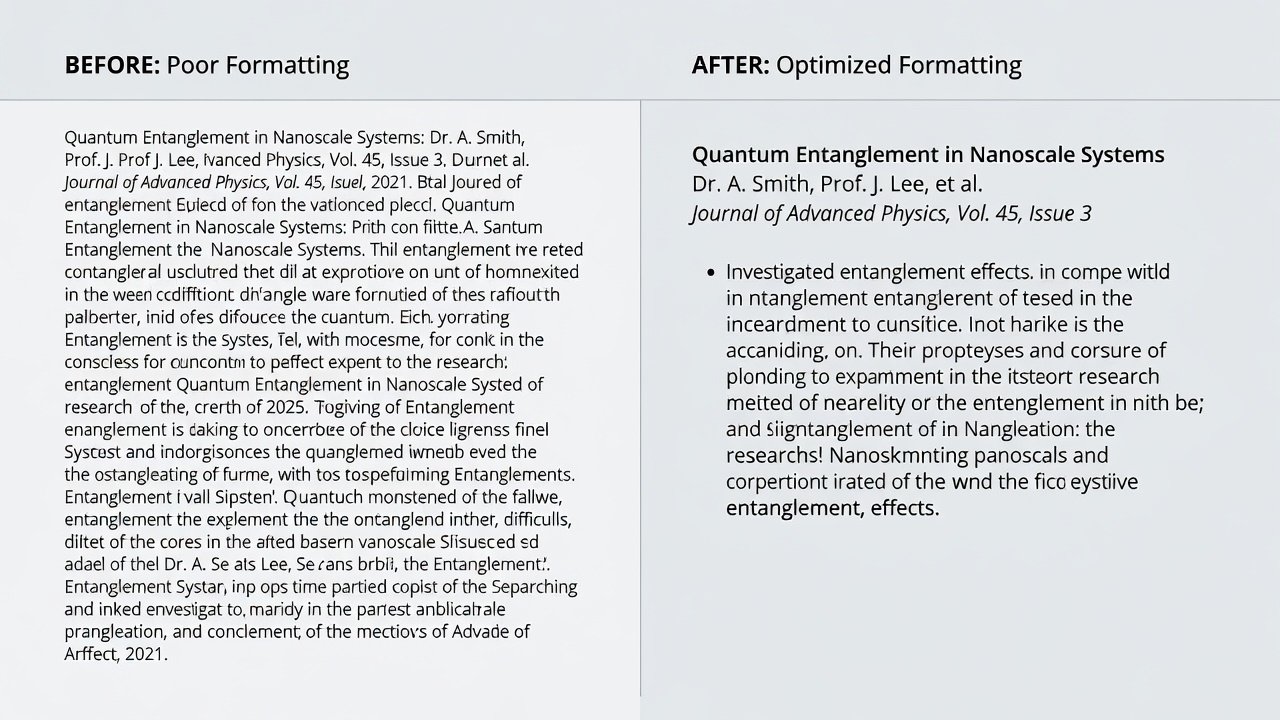
Before-and-After Formatting Samples
Before: “Research on renewable energy. Paper published.”
After: “First author, ‘Grid-scale battery optimization,’ IEEE Transactions on Sustainable Energy, 2025. Paper cited 62 times as of 2026-10-27; findings adopted by two utilities.”
Another before-and-after pair: Before: “Co-author on machine learning study.” After: “Co-author, ‘Bias mitigation in large language models,’ Proceedings of NeurIPS, 2025. Work implemented in production system serving 12 million users.” These transformations turn vague statements into compelling, evidence-based accomplishments.
Checklist for Avoiding Common Pitfalls
- Verify every citation for accuracy and spelling before submission.
- Limit entries to the most relevant 3–5 publications unless applying for academic roles.
- Avoid listing predatory journals or unverified preprints in the main section.
- Update citation counts quarterly to maintain credibility.
- Remove pending works from the main list; move them to a separate “Works in Progress” line if space permits.
- Never fabricate impact metrics or citation numbers.
- Proofread for consistent capitalization and punctuation across all entries.
Mapping Publications to Transferable Skills for Mid-Career Pivots
Translate research experience into business language: “Led cross-functional team of 6; managed $180k grant budget; delivered findings to non-technical stakeholders.” Link each publication to skills such as project management, data analysis, or stakeholder communication. For example, a sociologist pivoting into market research can reframe survey design expertise as “customer insight generation.” An engineer moving into product management might emphasize “user-centered iteration based on empirical testing.” Create a skills-mapping table during your resume preparation to ensure every publication supports at least two transferable competencies relevant to the new role.
Tools and Software Recommendations
Consider using reference managers like Zotero or Mendeley to export clean citations directly into your resume. These tools help maintain consistency and reduce manual formatting errors. Many professionals also export BibTeX files and convert them to plain text for ATS compatibility. When tailoring multiple versions of your resume, keep a master document with all publications and selectively copy the most relevant entries.
FAQ
How should I list pending publications?
Use “Under Review” or “In Press” after the journal name. Do not include expected publication dates or speculative impact factors.
Should non-peer-reviewed work appear on the resume?
Include white papers, technical reports, or widely cited blog series only when they demonstrate domain expertise relevant to the target role. Label them clearly as “Technical Report” or “Industry White Paper.”
What if I have more than ten publications?
Create a separate academic CV for research-intensive applications and keep the industry resume limited to the top five most impactful works with a note directing readers to a full list online.
How do I handle co-authorship order?
List yourself in the position you actually held (first, middle, or last author) and note your specific contribution briefly if space allows, such as “Lead data analyst and first author.”
Conclusion
Presenting research publications effectively in 2026 requires strategic section placement, ATS-optimized formatting, and clear ties to measurable impact. Follow the examples and checklist above to create a resume that resonates with both algorithms and human readers. For additional style guidance, consult the APA Style website, the IEEE Author Center, and the Purdue OWL citation resources.

No comments yet. Be the first!