 Jobboy
Introduction
Patents represent significant achievements in innovation, especially valuable in tech and engineering fields. In 2026, recruiters and hiring managers increasingly scan for these credentials to identify candidates with proven problem-solving abilities. This comprehensive guide covers everything from placement strategies to ATS optimization, ensuring your resume stands out without overwhelming readers. Whether you are an entry-level engineer or a senior R&D leader, understanding how to present patents effectively can dramatically improve your visibility in competitive job markets. Patents not only highlight your technical contributions but also demonstrate your capacity for original thinking and legal navigation of intellectual property rights.
Why Patents Matter on Resumes
Listing patents demonstrates technical expertise and the ability to drive original work. They signal to employers that you can navigate complex intellectual property landscapes. For roles in R&D or product development, patents can differentiate you from other applicants with similar experience levels. In fast-evolving industries like software, biotechnology, and mechanical engineering, a well-placed patent entry can showcase your impact on product development cycles and competitive advantage. Research from intellectual property offices shows that candidates with documented patents often receive more interview invitations because they provide concrete evidence of innovation beyond standard project descriptions. Furthermore, patents help quantify your contributions in ways that generic bullet points cannot, making them powerful tools for career advancement in 2026.
Strategic Placement on Your Resume
Place patents in a dedicated section if you have multiple entries, typically after your Professional Experience or Education. For fewer patents, integrate them under a Publications or Projects heading. Always prioritize relevance to the target role. Consider the length of your resume and the job description keywords when deciding position. If the role emphasizes research and development, a prominent Patents section near the top can capture attention quickly. In contrast, for management-focused positions, you might merge patents into an Achievements or Innovation section to emphasize leadership outcomes rather than raw technical details.
Recommended Section Order
- Professional Summary
- Skills
- Professional Experience
- Patents (or Publications & Patents)
- Education
- Additional sections such as Certifications or Volunteer Work
ATS-Friendly Formatting and Citation Styles
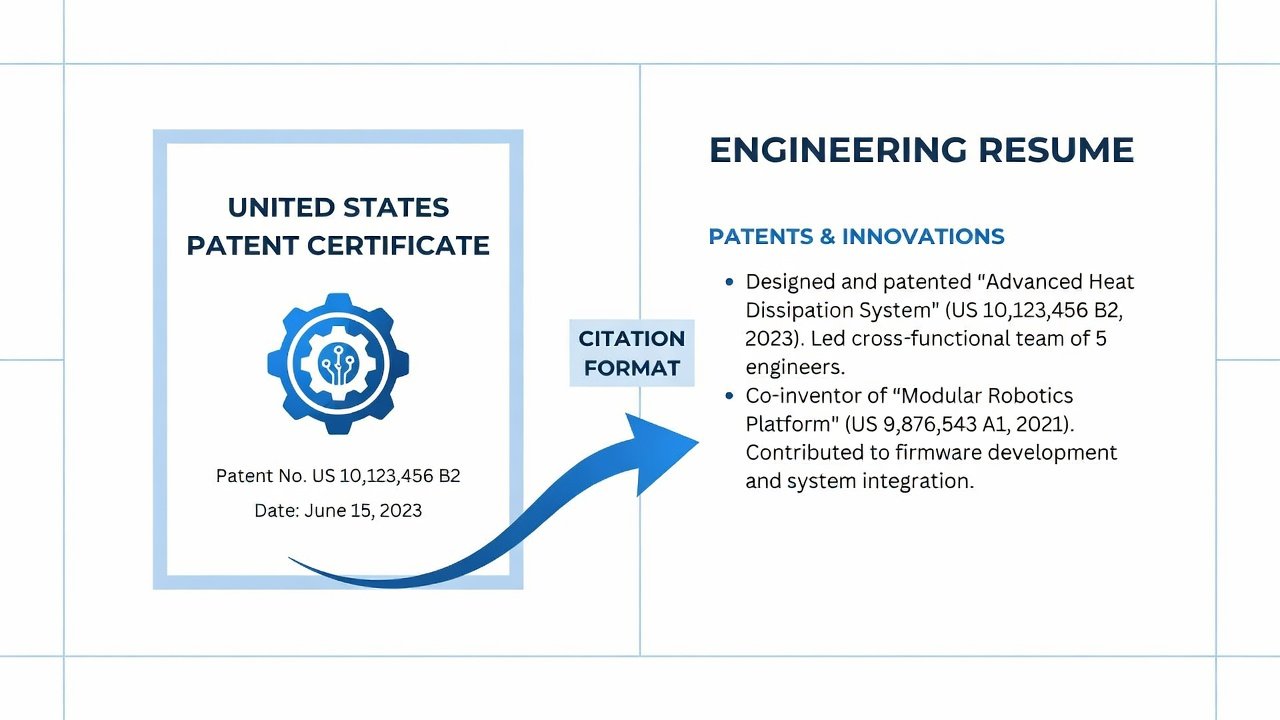
Use standard fonts like Arial or Calibri at 10-12 pt. Format each patent entry as: Patent Title, Patent Number, Issuing Authority, Issue Date, and a one-line impact statement. For tech roles, cite as "U.S. Patent No. XXXXXXX" to match common keyword searches. Avoid using special characters or tables that ATS systems struggle to parse. Include both granted patents and pending applications with clear status indicators. Expand each entry with a brief description of the technology involved and its commercial application to improve keyword density without sacrificing readability. This approach ensures your resume passes automated screening while remaining compelling to human reviewers.
USPTO provides official guidelines on patent documentation that can inform accurate resume citations. Similarly, international applicants benefit from consulting WIPO resources for standardized citation practices across jurisdictions.
Quantifying Impact and Transferable Skills
Instead of just listing titles, add metrics: "Patent reduced manufacturing costs by 15% through novel process." Highlight transferable skills like research methodology or cross-functional collaboration. Break down the patent's lifecycle from ideation to grant, noting any team leadership or problem-solving milestones. Transferable skills include analytical thinking, attention to detail, and the ability to communicate complex ideas to legal and business stakeholders. These elements appeal to recruiters across industries, not just technical ones.
Integration with Publications or Projects
Combine patents with related publications in one section titled "Intellectual Property & Publications." This keeps your resume concise while showing a full innovation portfolio. When patents stem from academic work or collaborative projects, cross-reference them with your experience bullets to create a cohesive narrative. For example, link a patent directly to a project that led to its filing, demonstrating continuity in your career achievements.
Checklists by Career Stage
Entry-Level
- Include pending patents if relevant to internships
- Focus on academic or co-op related filings
- Limit to 2-3 entries maximum
- Emphasize educational context and any mentorship received during the process
- Use simple language to explain technical concepts
Mid-Career
- Emphasize granted patents with business outcomes
- Include international filings where applicable
- Quantify team or revenue impact
- Show progression from individual contributor to team lead on filings
- Highlight any licensing or commercialization success
Senior/Leadership
- Showcase portfolio size and licensing revenue if available
- Highlight mentoring on patent filings
- Use a summary line: "Authored 12 patents generating significant IP value"
- Discuss strategic decisions around filing priorities and portfolio management
- Include examples of how patents influenced company direction or market position
Before-and-After Examples
Before: "Patent: Machine Learning Algorithm"
After: "U.S. Patent No. 12,345,678 – Adaptive Neural Network for Predictive Analytics, Issued March 2025. Improved model accuracy by 22%, adopted in three enterprise products. Collaborated with legal team to secure broad claims covering multiple use cases." Another example for a mechanical engineer: Before: "Listed patent on fluid dynamics device." After: "U.S. Patent No. 11,987,654 – High-Efficiency Turbine Blade Design, Issued January 2025. Increased energy output by 18% and reduced maintenance intervals, directly contributing to two new product lines."
Common Pitfalls to Avoid
Over-detailing legal language, listing expired patents without context, or ignoring confidentiality restrictions can harm your application. Always verify with legal counsel before disclosing sensitive details. Other mistakes include using inconsistent date formats, failing to update patent status after grants, and neglecting to tailor entries to the specific job posting. Avoid cramming too many patents into limited space; prioritize quality and relevance over quantity.
Optimizing for Keyword Density and Search Intent
Incorporate keywords naturally such as "patent filing," "intellectual property strategy," "innovation portfolio," and "technical invention." Analyze target job descriptions for recurring phrases and mirror them in your patent descriptions. This boosts ATS ranking while maintaining professional tone.
FAQs on Pending Patents and International Filings
How do I list pending patents? Use "Patent Application No. XXXXXXX (Pending)" and note filing date. Provide context on the technology and expected grant timeline if known.
Should I include international patents? Yes, if they demonstrate global impact; cite under PCT or specific jurisdictions. Reference the WIPO for proper formatting of multi-country filings.
Are there legal concerns? Consult your employer’s IP policy; many allow listing granted patents publicly. For pending applications, limit disclosure to non-confidential aspects.
What if a patent was assigned to a previous employer? List it with a note such as "Assigned to [Company Name]" to maintain transparency.
Conclusion
Mastering patent listings on your 2026 resume requires balancing detail with brevity while optimizing for both human readers and ATS systems. Follow the checklists and examples above to present your innovations effectively and boost your candidacy in competitive tech and engineering markets. Regular updates to your patent section as new grants occur will keep your professional profile current and compelling throughout the year.

No comments yet. Be the first!