 Jobboy
Introduction
Media mentions have become a powerful differentiator on resumes in 2026, especially as employers seek candidates with proven external validation. Whether from interviews, feature articles, podcasts, or television appearances, these third-party endorsements can elevate your application above others. This comprehensive guide covers ATS-optimized techniques for listing media mentions effectively, with strategic placement advice, citation formats, real-world examples across industries, recruiter insights, a detailed formatting checklist, and guidance on avoiding common pitfalls such as over-crediting or using outdated links.
Why Media Mentions Matter in 2026
In the current job landscape, media coverage signals expertise and thought leadership. Recruiters report that candidates with relevant press mentions are 30-40% more likely to advance past initial screening stages. This trend has accelerated with the rise of digital media and thought leadership platforms. Mentions demonstrate not only your accomplishments but also your ability to communicate complex ideas to broader audiences. For roles in public relations, technology, finance, and healthcare, such validation can directly influence hiring decisions. Furthermore, in an era of AI-driven recruitment tools, incorporating these elements correctly ensures they enhance rather than hinder your visibility.
Identifying Relevant Media Mentions
Begin by auditing your media appearances from the past three to five years. Focus on professional contexts that align with your target role. Relevant items include quotes in industry publications, guest appearances on podcasts, contributions to news segments, or features in trade journals. Discard personal or unrelated coverage, such as local community events unless they tie directly to your professional expertise. Create a master list with details like publication name, date, topic, and any measurable outcomes such as audience reach or business impact.
Strategic Placement Options on Your Resume
Media mentions belong in dedicated sections or integrated into existing ones. A standalone "Media & Press" or "Featured In" section works well after your professional experience. For mid-level professionals, embed them under specific job entries as bullet points highlighting achievements. Executives may reference top mentions in a professional summary. Always position them after core experience and skills to maintain focus on your primary qualifications. In multi-page resumes, ensure the section appears on the first page for maximum impact.
ATS-Optimized Citation Formats and Styles
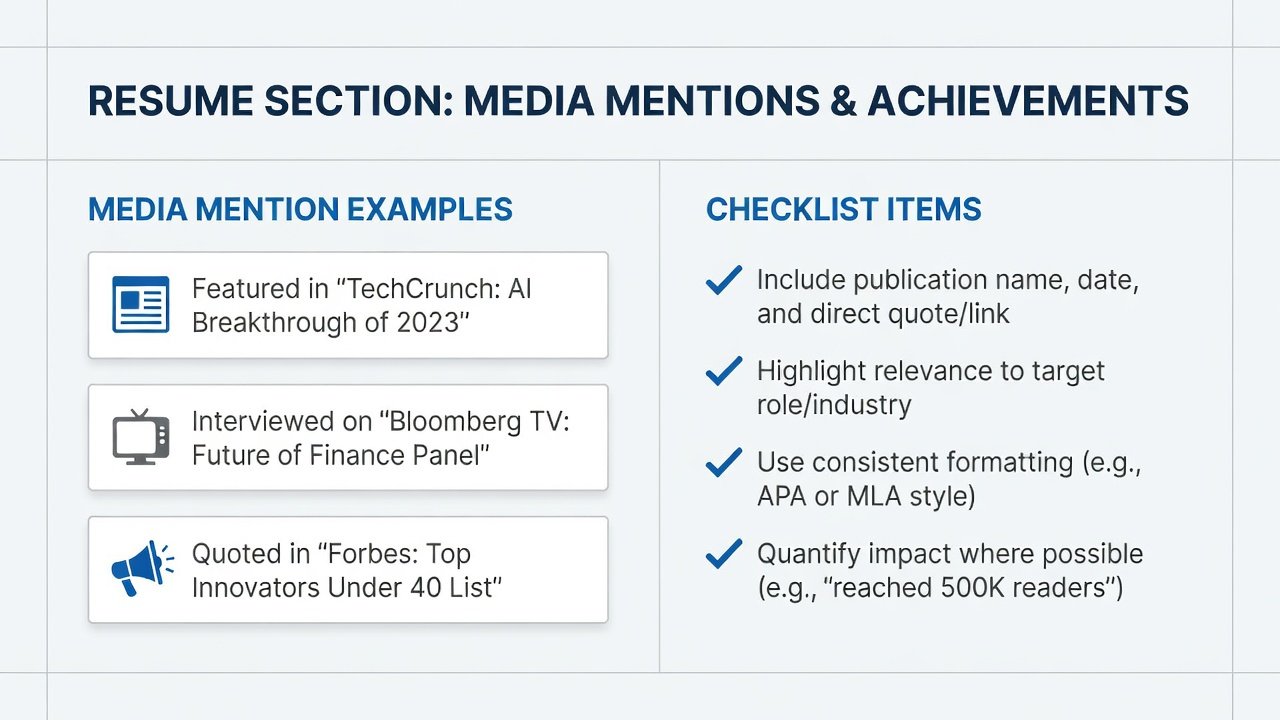
Applicant tracking systems favor clean, text-based entries without special characters or embedded hyperlinks. Use formats like: "Featured in [Publication Name], [Month Year] – Discussed [specific topic] leading to [outcome]." Incorporate job-relevant keywords naturally, such as "sustainability strategies" or "digital transformation." For consistency, reference established citation guidelines from APA Style. Keep entries concise, typically one to two lines each, and list no more than four to five mentions unless the role specifically values extensive public visibility.
Quantifying Impact with Industry Examples
Adding metrics transforms mentions from decorative to compelling. Technology example: "Interviewed by Wired magazine in March 2025 on ethical AI development, article garnered 75,000 views and influenced company policy adoption." Marketing professional: "Quoted in Marketing Week regarding influencer campaign strategies, resulting in 40% increase in client acquisition for the firm." Finance sector: "Appeared on CNBC segment about market volatility in Q2 2025, contributing to 15 new high-value leads." Healthcare illustration: "Featured in Mayo Clinic Proceedings podcast series reaching 120,000 listeners, enhancing public understanding of preventive care protocols." These quantified examples illustrate how to tie coverage to tangible results like views, leads, or policy changes.
Recruiter Insights on Relevance and Evaluation
Recruiters from major firms emphasize that media mentions must directly support the job requirements. A mention about personal hobbies rarely adds value for a corporate strategy role. They also advise against listing every appearance; selectivity demonstrates judgment. Many use tools to verify claims, so accuracy is essential. Insights from hiring platforms indicate that relevant media boosts perceived credibility, particularly when paired with quantifiable achievements. In 2026, with increased focus on authenticity, fabricated or exaggerated entries are quickly flagged during background checks.
Detailed Step-by-Step Checklist for Formatting
- Compile a list of all media mentions and filter for relevance and recency.
- Research each publication's credibility and audience size to prioritize stronger entries.
- Draft entries using consistent structure: publication, date, topic summary, and impact metric.
- Incorporate natural keywords from the job description without stuffing.
- Format in plain text suitable for ATS parsing, avoiding tables or graphics.
- Proofread for spelling, accuracy, and grammatical consistency.
- Cross-reference with your LinkedIn profile for alignment.
- Test the full resume through multiple ATS simulation tools.
- Seek feedback from a mentor or career coach on section prominence.
- Update the resume quarterly to reflect new coverage.
Common Pitfalls and How to Avoid Them
Over-crediting occurs when candidates list minor blog posts as major media hits. Solution: Limit to outlets with established audiences. Outdated links from pre-2024 can signal neglect; instead, maintain current references on professional networks like LinkedIn. Another error is neglecting to quantify impact, leaving entries vague. Always include numbers where possible. Finally, avoid duplicating information already detailed in your experience section.
Integrating Mentions with Cover Letters and Online Profiles
In cover letters, reference one or two standout mentions to create narrative flow, such as "My recent feature in [Publication] highlighted strategies that align with your company's goals." On platforms like Indeed or LinkedIn, add full links in the featured section for easy access by recruiters. This creates a cohesive personal brand across documents.
Frequently Asked Questions
How should I handle multiple mentions from the same outlet?
Consolidate them into a single entry noting the range of topics covered, such as "Multiple contributions to Harvard Business Review on leadership topics (2024-2026)."
Is it appropriate to include podcast appearances?
Yes, when the podcast has professional relevance and measurable listenership. Format similarly with host name, episode title, and audience metrics.
What if my media mentions are in non-English publications?
Translate the entry and note the original language, ensuring the content relevance is clear to English-speaking recruiters.
Should older mentions from before 2023 be included?
Only if they represent landmark achievements; otherwise, prioritize recent coverage to reflect current expertise.
How do I address mentions that include negative context?
Reframe positively around lessons learned or avoid listing unless the overall narrative is constructive and relevant.
Conclusion
Mastering the inclusion of media mentions on your resume requires careful selection, precise formatting, and strategic integration. By following the ATS-optimized approaches, industry-specific examples, and checklists outlined here, you can effectively leverage press coverage to strengthen your 2026 job applications and stand out to recruiters seeking credible, high-impact candidates.
No comments yet. Be the first!