 Jobboy

Why Leadership Skills Matter More Than Ever in 2026 Interviews
In today's competitive job market, recruiters prioritize candidates who can lead teams, drive initiatives, and adapt to change. Leadership isn't reserved for executives; entry-level and mid-career professionals can showcase it through everyday actions. The key is framing your experiences authentically to avoid sounding boastful. Search trends show rising queries around interview preparation and how to answer interview questions that probe soft skills. This guide delivers actionable job interview tips tailored to 2026 hiring trends, including remote collaboration and AI-driven decision-making.
Employers increasingly value emotional intelligence, adaptability, and the ability to inspire others amid hybrid work models and rapid technological shifts. According to recent industry reports, leadership demonstrations can differentiate candidates even when technical skills are comparable. Candidates who prepare thoroughly often report higher confidence and better outcomes during panel discussions or virtual interviews.
Identifying Transferable Leadership Examples from Any Role
Start by auditing your background for leadership moments, even in non-managerial positions. Consider times you mentored colleagues, coordinated projects, or resolved conflicts. Volunteer coordination at community events demonstrates initiative. Training new hires in retail or service roles highlights guidance skills. Leading cross-functional meetings in remote setups shows virtual leadership. Map these to the job description. For instance, if applying for a tech role, link your past project facilitation to agile team leadership.
Think broadly across life stages. A recent graduate might reference group project coordination in college, while a career changer could draw from volunteer board positions. Document specific instances with dates and outcomes to refresh your memory before the interview. This preparation prevents vague answers and builds a robust mental library of stories.
Practical Exercise: Leadership Audit Checklist
- List every role held in the past five years and note instances of influence without formal authority.
- Identify patterns such as problem-solving under pressure or fostering team morale.
- Connect each example to the target company's values or challenges mentioned in the job posting.
- Practice verbalizing these in under two minutes to build fluency.
Step-by-Step Framework for Structuring Responses
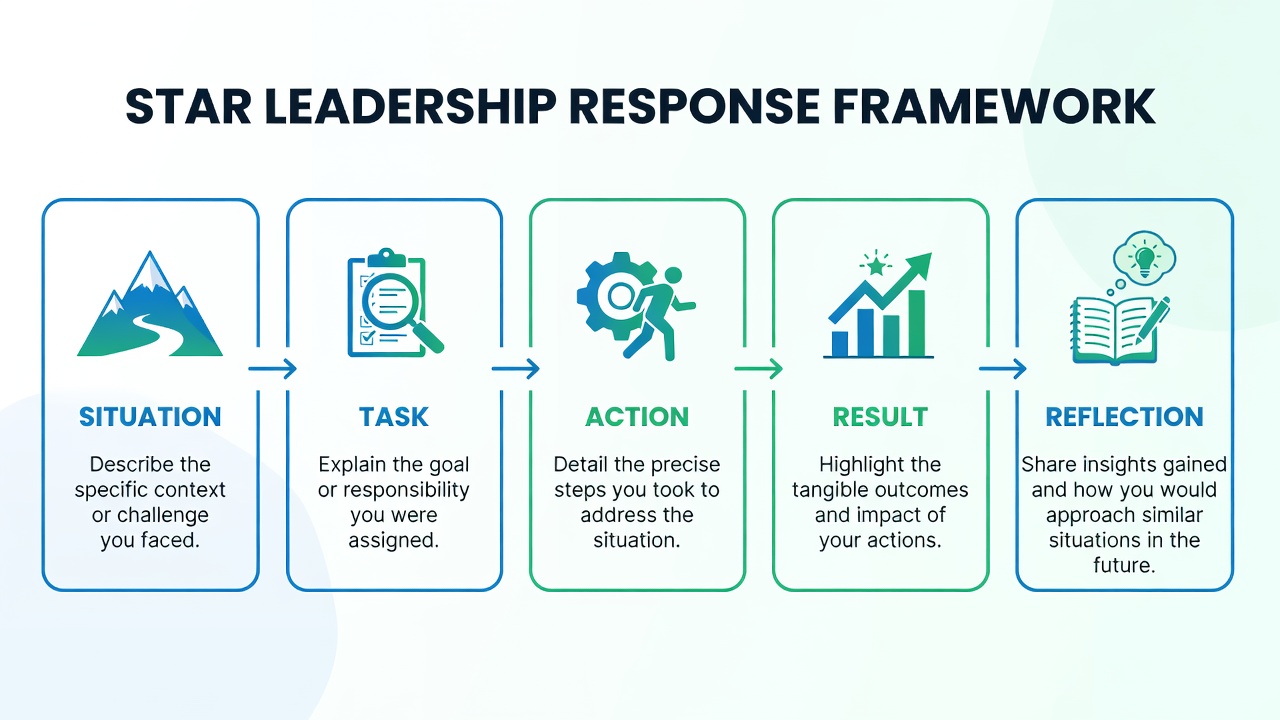
Use the enhanced STAR method: Situation, Task, Action, Result, plus Reflection. This keeps answers concise yet impactful. Describe the situation briefly. Outline your specific task or goal. Detail actions taken, emphasizing collaboration over solo efforts. Share measurable results. Reflect on lessons learned to show growth mindset. This framework prevents rambling and keeps focus on impact.
Apply it consistently across questions. For example, when discussing a challenging deadline, begin with context about team size and constraints, then move to your coordinating role, collaborative tactics, the successful delivery, and insights gained about communication tools.
Tailoring Answers to Common Behavioral Questions
Behavioral questions like "Tell me about a time you led a team" require preparation. Weave in 2026 trends such as hybrid work and sustainability initiatives. Effective Example: "In my previous role, our team faced a tight deadline on a client project. I organized weekly check-ins and delegated tasks based on strengths, resulting in on-time delivery and a 20% efficiency gain. I learned the value of inclusive decision-making." Ineffective Example: "I single-handedly saved the project by working overtime and telling everyone what to do." The difference lies in humility and team emphasis.
Prepare for variations including "Describe a time you influenced stakeholders without authority" or "How have you handled team conflict?" Research the company culture beforehand to align examples with values like innovation or inclusivity. Record yourself answering and review for tone and clarity.
Using Metrics and Stories to Prove Impact
Quantify achievements where possible. Stories make responses memorable. Prepare 3-5 narratives covering different leadership facets like conflict resolution or innovation. Real-world scenario: A marketing coordinator might share how they rallied a remote team to launch a campaign ahead of schedule by fostering open feedback loops. Another example involves a customer service representative who created a peer mentoring system that reduced onboarding time for new agents by 30 percent within six months.
When hard numbers are unavailable, use qualitative impact statements supported by feedback from supervisors or peers. Always tie metrics back to business outcomes such as revenue growth, cost savings, or improved retention rates.
Avoiding Arrogance While Demonstrating Confidence
Balance self-promotion with acknowledgment of team contributions. Use phrases like "with my team's support" or "I facilitated by..." rather than "I led the entire effort alone." Practice active listening during the interview and invite follow-up questions. This approach signals collaborative leadership rather than ego-driven control.
Watch for red flags in delivery such as interrupting or overstating personal credit. Role-play with a mentor to receive honest feedback on perceived tone.
Checklists for Interview Success
- Research company values and align stories accordingly.
- Practice with a friend to refine tone.
- Prepare questions that demonstrate strategic thinking, such as inquiries about upcoming leadership challenges the team faces.
- Follow up with a thank-you note highlighting key leadership points discussed.
- Review recent industry news for timely references that show awareness of 2026 trends.
- Prepare backup examples in case the interviewer probes deeper into specific areas.
Real-World Scenarios for 2026 Hiring Trends
Consider how leadership manifests in AI-assisted environments or fully remote teams. One scenario involves guiding a distributed group through implementing new collaboration software while maintaining productivity. Another centers on championing diversity initiatives that improved team innovation metrics. These stories resonate strongly with forward-thinking employers.
Short FAQ on Leadership in Interviews
How do I show leadership without management experience? Focus on influence and initiative in team settings, such as volunteering for process improvements or mentoring peers informally.
What if my example seems minor? Scale it with context and results; small wins often reveal big potential when explained with clear outcomes and reflections.
Is it okay to mention failures? Yes, when paired with lessons learned to illustrate resilience and continuous improvement.
How long should leadership examples be? Aim for 60-90 seconds per answer to maintain engagement while providing sufficient detail.
Should I prepare examples for every possible question? Prioritize the top five behavioral questions most relevant to the role and have flexible stories ready to adapt.
Conclusion
Mastering these job interview tips positions you as a confident leader ready for 2026 challenges. Practice consistently, stay genuine, and you'll stand out. For more resources, explore Indeed career advice and LinkedIn learning paths. Additional guidance is available through SHRM publications on talent development.


No comments yet. Be the first!