 Jobboy

Introduction to ESG Governance Interviews in 2026
ESG governance has become a critical focus for hiring managers in finance and technology sectors as companies navigate evolving regulations and stakeholder expectations. Candidates preparing for roles in sustainability, compliance, or executive leadership must demonstrate deep knowledge of board oversight, ethics compliance, and integrated risk management. This guide provides comprehensive frameworks, behavioral examples using the STAR method, and comparisons of weak versus strong responses to help you stand out in competitive interviews. In 2026, interviewers are increasingly looking for candidates who can bridge regulatory requirements with practical business outcomes, especially amid heightened scrutiny on climate disclosures and corporate accountability. Understanding these elements allows professionals to position themselves as strategic contributors rather than mere compliance officers.
Regulatory landscapes continue to shift, requiring alignment with frameworks such as the Corporate Sustainability Reporting Directive (CSRD) and Task Force on Climate-related Financial Disclosures (TCFD). Understanding these is essential for linking personal achievements to measurable governance outcomes. Preparation involves not only memorizing frameworks but also practicing how to articulate their application in real-world scenarios, including how boards oversee ESG integration and mitigate associated risks across global operations.
Core Pillars: Board Oversight, Ethics Compliance, and Risk Management
Interviewers typically probe three interconnected areas in depth. Board oversight involves how directors set ESG strategy and monitor progress through metrics like diversity targets or emissions reductions. Effective oversight includes establishing dedicated committees, setting clear KPIs, and ensuring regular reporting cycles that tie into executive performance reviews. Candidates should prepare to discuss how they have supported board education on emerging issues such as biodiversity loss or human rights in supply chains.
Ethics compliance covers anti-corruption policies, whistleblower protections, and supply chain due diligence. This pillar requires demonstrating familiarity with codes of conduct, third-party audits, and mechanisms for addressing conflicts of interest. Risk management requires identifying climate, social, and governance risks and integrating them into enterprise frameworks, often using tools like heat maps or scenario planning. Practical preparation includes reviewing company sustainability reports to identify specific metrics. For example, candidates can reference how a firm tracks Scope 3 emissions or board-level ESG committee frequency, and explain how these tie into broader enterprise risk management systems.
Deep Dive into Board Oversight Practices
Strong candidates illustrate oversight by describing processes such as quarterly ESG dashboards presented to the board or annual materiality assessments that inform strategic decisions. This demonstrates an ability to translate high-level governance into actionable insights that drive accountability at the highest levels.
Regulatory Alignment with CSRD and TCFD
The CSRD mandates detailed sustainability disclosures for EU companies and their global partners, emphasizing double materiality that considers both financial and impact perspectives. TCFD, now integrated into ISSB standards, focuses on climate scenario analysis and financial impacts, requiring organizations to disclose governance structures around climate risks. Strong answers demonstrate how candidates have supported compliance efforts, such as mapping internal data to European Commission CSRD guidelines or aligning reporting with IFRS sustainability standards. Interviewers value candidates who can explain translating these regulations into operational processes, such as updating risk registers or training programs for cross-functional teams. Additionally, reference alignment with SEC climate disclosure rules where applicable to show broader global awareness.
STAR Method Examples for ESG Questions
The STAR method (Situation, Task, Action, Result) structures responses effectively and helps candidates provide concrete, results-oriented answers. Consider this question: "Describe a time you influenced board-level ESG decisions."
- Weak answer: "I suggested some ESG ideas in meetings and the company improved its score." This lacks specificity, metrics, and personal impact.
- Strong answer: "In my previous role at a mid-sized asset manager (Situation), the board needed better climate risk integration following new regulatory signals (Task). I led a cross-functional team to develop a TCFD-aligned dashboard, presenting quarterly updates that quantified transition risks across portfolios (Action). This resulted in a 25% improvement in our internal governance rating, adoption of new oversight policies, and enhanced investor confidence as measured by subsequent engagement scores (Result)."
Another example on ethics: "How have you handled an ethical dilemma in governance?" A strong STAR response might detail identifying a supply chain violation, implementing enhanced due diligence protocols, and achieving a measurable reduction in compliance incidents. Prepare 3-4 such examples spanning finance and tech sectors to cover common question variations.
Weak vs. Strong Answer Comparisons
Behavioral questions reward specificity and evidence. Weak responses remain vague, use passive language, and lack quantifiable results or regulatory context. Strong responses quantify impact, reference specific regulations like CSRD or TCFD, and tie experience directly to the target company's industry challenges. Always prepare examples that highlight collaboration with legal, finance, and operations teams to show cross-functional governance expertise.
Real Company Case Studies from Finance and Tech
In finance, consider how JPMorgan Chase enhanced board oversight through dedicated ESG committees, linking executive compensation to sustainability KPIs and publishing detailed TCFD reports that improved stakeholder transparency. In tech, Microsoft’s integration of TCFD reporting into enterprise risk management demonstrates ethics compliance via transparent AI governance policies and supplier audits that reduced environmental incidents. 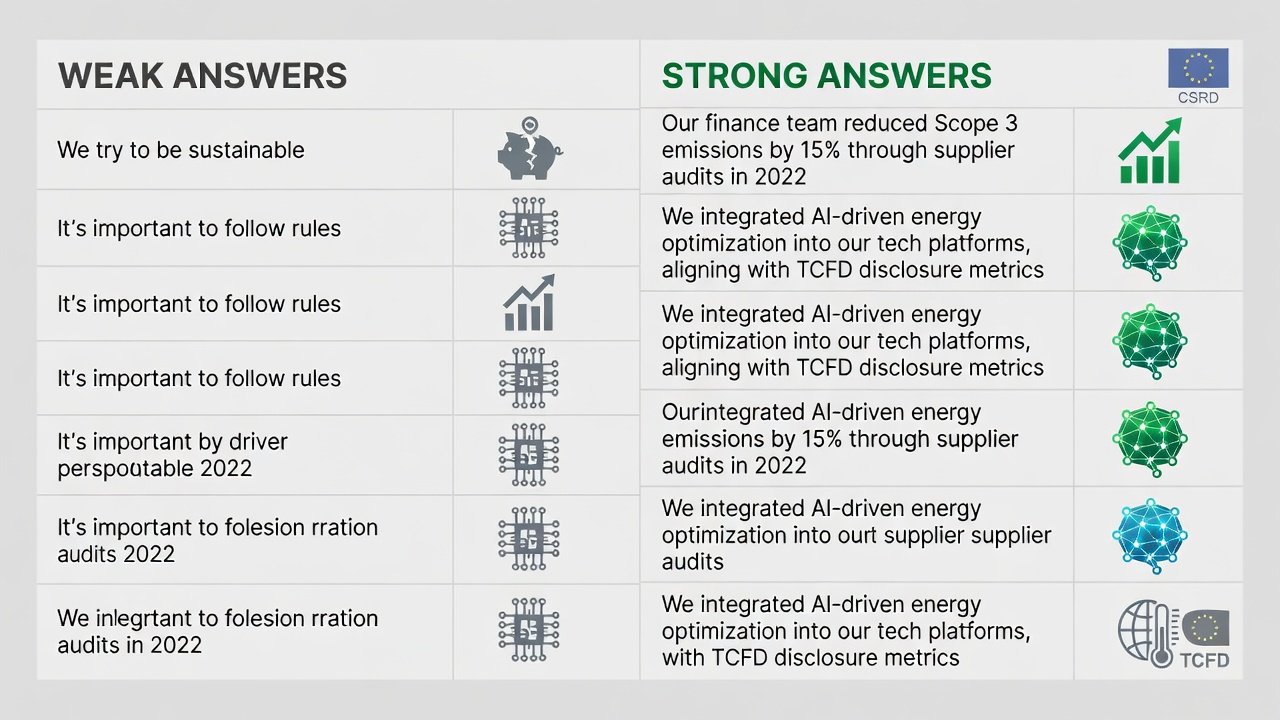
Practical Frameworks for Linking Experience to Metrics
Use a simple mapping framework: Identify a personal project, align it with a governance metric (e.g., board diversity percentages or audit frequency), reference CSRD or TCFD requirements, and quantify results with before-and-after data. This creates compelling narratives during interviews. Extend the framework by incorporating stakeholder mapping and scenario analysis to anticipate future regulatory changes expected in 2026 and beyond.
FAQs on Ethical Dilemmas and Data-Backed Responses
- How do I answer questions about ethical dilemmas? Frame responses around company values, stakeholder impact, and resolution outcomes while maintaining confidentiality and emphasizing preventive measures implemented afterward.
- What data should I include in responses? Reference verifiable metrics such as reduced compliance violations or improved ESG scores from reputable sources, always citing the time period and methodology for credibility.
- How to prepare for situational questions on risk management? Practice with recent regulatory updates and company-specific reports, preparing examples that show proactive identification of emerging risks like cyber governance or climate physical risks.
- Can I discuss failures in ESG governance? Yes, but always pivot to lessons learned and subsequent improvements, such as revised board reporting protocols that led to better outcomes.
- How do I quantify achievements without internal data access? Use publicly available benchmarks and describe your role in processes that contributed to reported improvements in annual filings.
Actionable Steps for Research and Quantifying Achievements
Begin by downloading the latest annual and sustainability reports from target companies. Cross-reference with regulatory databases and peer analyses. Quantify achievements using percentages, timelines, and before-after comparisons while noting specific governance improvements. Schedule mock interviews focusing on governance scenarios, including role-play of board presentations. Review industry reports on 2026 trends such as expanded double materiality assessments and enhanced ethics training requirements. This thorough preparation positions candidates as strategic thinkers ready for 2026 roles and demonstrates the ability to drive measurable ESG progress.
By mastering these elements through consistent practice and research, professionals can confidently navigate ESG governance interviews and contribute meaningfully to organizational sustainability goals in an increasingly regulated environment.

No comments yet. Be the first!