 Jobboy

Why Asking Questions in Job Interviews Matters in 2026
In the competitive job market of 2026, standing out during interviews isn't just about answering questions—it's about demonstrating curiosity, enthusiasm, and a genuine interest in the role and company. Asking smart questions shows interviewers that you've done your homework and are thinking about how you can contribute long-term. According to career experts, candidates who ask thoughtful questions are 40% more likely to receive offers, as it flips the script from passive interviewee to engaged collaborator.
This article dives deep into 15 curated questions designed to impress in 2026's evolving job landscape, where remote work, AI integration, and sustainability are key trends. We'll cover optimal timing (typically at the end, but weave in one or two earlier if natural), categorize questions for clarity, and provide explanations, real-world response examples, and comparisons of weak versus strong phrasing. Plus, get practical tips on customization, handling awkward moments, and follow-up strategies to seal the deal.
The Best Time to Ask Questions During an Interview
Timing is everything. Save most questions for the interview's close when the interviewer often asks, "Do you have any questions for us?" This avoids derailing the flow but shows preparation. If the conversation naturally leads to a topic, like company challenges, slip in a relevant question mid-interview to demonstrate attentiveness. In virtual 2026 interviews, where distractions abound, this keeps engagement high.
Avoid asking too early or about basics easily found on the company website— it signals laziness. Instead, build on the discussion to show insight. For instance, if they mention a recent product launch, follow up with a question tying it to the role.
Categories of Smart Questions to Ask
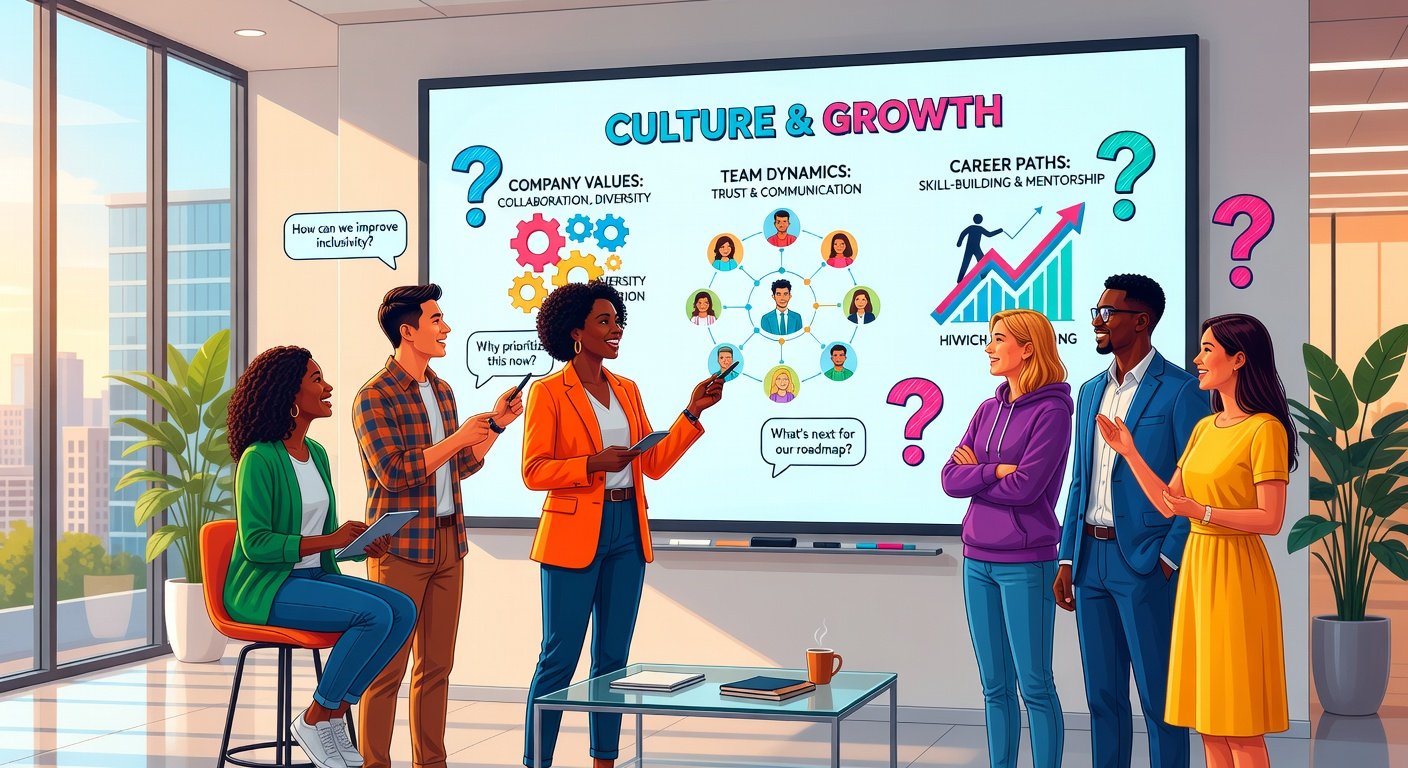
To structure your preparation, group questions into key categories: company culture, role specifics, team dynamics, career growth, and challenges. This ensures a well-rounded impression, covering personal fit, daily responsibilities, collaboration, advancement, and realism. Tailor based on research from sources like LinkedIn company pages or annual reports.
- Company Culture: Probes values and work environment.
- Role Specifics: Clarifies expectations and success metrics.
- Team Dynamics: Explores collaboration and support.
- Career Growth: Gauges development opportunities.
- Challenges: Uncovers potential hurdles and innovations.
15 Smart Questions to Ask in Job Interviews
Here are 15 SEO-optimized questions, each with an explanation of why it works, a real-world example response, and a comparison to a weaker version. These are crafted for 2026 relevance, incorporating trends like hybrid work and tech ethics.
1. Company Culture: "How does the company foster work-life balance in a hybrid environment?"
Why it works: This shows you're forward-thinking about 2026's blended work models and value sustainability. It invites insight into policies without prying into personal lives.
Weak vs. Strong: Weak: "Do you have flexible hours?" (Too basic, Googleable). Strong version builds on research, prompting deeper discussion.
Real-world example response: "We offer core hours from 10 AM to 3 PM, with async tools like Slack for flexibility. Our 'recharge days' every quarter allow unplugging, reducing burnout by 25% per our internal surveys." This reveals supportive culture.
2. Company Culture: "What initiatives is the company undertaking to promote diversity and inclusion this year?"
Why it works: DEI is a 2026 priority; this demonstrates alignment with modern values and research effort.
Weak vs. Strong: Weak: "Is the company diverse?" (Judgmental). Strong: Specific to initiatives, showing proactive interest.
Real-world example response: "We're expanding our ERGs and partnering with Indeed for targeted recruiting, aiming for 40% underrepresented hires by year-end."
3. Role Specifics: "What does success look like in this role during the first six months?"
Why it works: It aligns your goals with theirs, showing results-oriented mindset crucial in fast-paced 2026 industries.
Weak vs. Strong: Weak: "What do I do?" (Vague). Strong: Time-bound, actionable.
Real-world example response: "You'll onboard via our AI-driven portal, hit key KPIs like 80% project completion, and contribute to one cross-team initiative."
4. Role Specifics: "How is AI being integrated into this position's daily responsibilities?"
Why it works: Addresses 2026's AI boom, positioning you as tech-savvy.
Weak vs. Strong: Weak: "Do you use AI?" (Generic). Strong: Role-focused.
Real-world example response: "AI tools like ChatGPT assist in data analysis, freeing you for creative strategy—expect 20% time savings."
5. Team Dynamics: "Can you describe the team's collaboration style, especially in remote settings?"
Why it works: Highlights your teamwork interest in hybrid eras.
Weak vs. Strong: Weak: "Who will I work with?" (Surface-level). Strong: Style-specific.
Real-world example response: "We use Microsoft Teams for daily stand-ups and foster pair-programming via Zoom, ensuring inclusivity across time zones."
6. Team Dynamics: "How does the team handle feedback and continuous improvement?"
Why it works: Shows growth mindset and conflict resolution awareness.
Weak vs. Strong: Weak: "Is feedback regular?" (Yes/no). Strong: Process-oriented.
Real-world example response: "Bi-weekly retrospectives via tools like Retrium promote open dialogue, leading to 15% efficiency gains last quarter."
7. Career Growth: "What opportunities exist for professional development, like certifications or conferences?"
Why it works: Signals long-term commitment in a market valuing upskilling.
Weak vs. Strong: Weak: "Can I advance?" (Assumptive). Strong: Specific paths.
Real-world example response: "We cover AWS certifications and send top performers to Harvard Business Review-backed events annually."
8. Career Growth: "How has the company supported career progression for someone in this role?"
Why it works: Seeks evidence-based examples, building trust.
Weak vs. Strong: Weak: "What's the promotion track?" (Hypothetical). Strong: Historical proof.
Real-world example response: "Our last hire moved from analyst to manager in 18 months via mentorship programs."
9. Challenges: "What are the biggest challenges the team is facing right now?"
Why it works: Demonstrates realism and problem-solving eagerness.
Weak vs. Strong: Weak: "Any problems here?" (Negative). Strong: Team-focused.
Real-world example response: "Scaling our sustainable supply chain amid global disruptions—we're piloting blockchain for transparency."
10. Challenges: "How is the company adapting to 2026 regulatory changes in our industry?"
Why it works: Shows industry knowledge and foresight.
Weak vs. Strong: Weak: "Any new laws?" (Broad). Strong: Year-specific.
Real-world example response: "We're compliant with EU AI Act via ethics audits, training all staff quarterly."
11. Company Culture: "What values guide decision-making during tough times?"
Why it works: Uncovers resilience in volatile 2026 economies.
Weak vs. Strong: Weak: "What's your culture like?" (Cliché). Strong: Scenario-based.
Real-world example response: "Transparency and employee input, as seen in our 2025 layoff navigation without cuts."
12. Role Specifics: "How will performance be measured beyond quotas?"
Why it works: Balances metrics with qualitative impact.
Weak vs. Strong: Weak: "How am I evaluated?" (Standard). Strong: Holistic.
Real-world example response: "Through 360 feedback and innovation contributions, not just sales numbers."
13. Team Dynamics: "What tools or processes help remote team members stay connected?"
Why it works: Relevant for 2026's remote-heavy workforce.
Weak vs. Strong: Weak: "How do you communicate?" (Obvious). Strong: Connection-focused.
Real-world example response: "Donut app for virtual coffees and VR meetings for quarterly offsites."
14. Career Growth: "Are there mentorship programs pairing juniors with seniors?"
Why it works: Indicates investment in relationships.
Weak vs. Strong: Weak: "Is there training?" (Vague). Strong: Program-specific.
Real-world example response: "Yes, our 'shadowing' initiative matches you with a mentor from day one."
15. Challenges: "What emerging trends is the company excited to tackle next?"
Why it works: Ends positively, showing optimism.
Weak vs. Strong: Weak: "Future plans?" (Broad). Strong: Trend-oriented.
Real-world example response: "Web3 integration for decentralized workflows, with a pilot launching Q2 2026."
Practical Tips for Customizing and Delivering Questions
Customization is key—research via Glassdoor reviews or earnings calls to personalize. For example, if a company just acquired a startup, ask about integration challenges.
- Research Thoroughly: Spend 1-2 hours on the company's site, news, and Glassdoor for insider tips.
- Practice Delivery: Rehearse in mock interviews to sound natural, not scripted.
- Limit to 3-5: Choose based on interview flow; quality over quantity.
- Listen Actively: Build follow-ups on their answers, e.g., "You mentioned AI—how does that affect team roles?"
Handling 'No Questions' Scenarios
If you freeze, have backups ready. Politely say, "I've prepared several, but based on our discussion, I'd love to know more about..." This recovers gracefully. Never say "No"—it's a missed opportunity. In 2026's candidate-short market, it could cost you.
Follow-Up Strategies Post-Interview
Send a thank-you email within 24 hours, referencing a question and response: "Thank you for sharing about your DEI initiatives—I'm excited about contributing." Attach your resume if requested. Track in a spreadsheet for multiple applications.
Common Pitfalls and How to Avoid Them: FAQ
Q: What if my question backfires?
A: If it leads to a tough answer, pivot positively: "That's insightful—how can I help address it?" Avoid controversial topics like salary unless invited.
Q: Is it okay to ask about salary?
A: Wait for their cue, but if timing fits, try: "What's the range for this role?" Research via sites like Salary.com first.
Q: How many questions are too many?
A: 3-5 max; respect time. If virtual, watch for cues like closing screens.
Q: What if I'm interviewing for a senior role?
A: Focus on strategy: "How does this role influence company direction?"
Q: Can I prepare questions for panel interviews?
A: Yes, direct to individuals: "Sarah, from marketing—how does your team collaborate?"
Conclusion: Stand Out and Secure Your 2026 Dream Job
Mastering these 15 questions transforms interviews from interrogations to conversations, positioning you as a top candidate. Remember, enthusiasm shines through preparation. Download our free cheat sheet below for quick reference—print it for your next interview prep session. With these tools, you're ready to navigate 2026's job market confidently.


No comments yet. Be the first!