 Jobboy

Introduction to Hiring Models in the Gig Economy
In 2026, the gig economy has evolved into a dominant force in talent acquisition, reshaping how businesses build their teams. With remote work normalized and AI tools enhancing productivity, companies face a pivotal choice: freelance hiring for short-term projects or full-time employment for long-term stability. This comparison dives into key factors like costs, flexibility, and skill access, while offering HR tips for recruiters. We'll also examine how blending these models can boost employer branding and impact onboarding, job postings, and employee retention.
The gig economy, projected to encompass over 50% of the workforce by 2026 according to industry forecasts, empowers businesses to tap into global talent pools. However, selecting the right model requires balancing immediate needs with sustainable growth. Let's break it down.
Costs: Freelance vs Full-Time Hiring
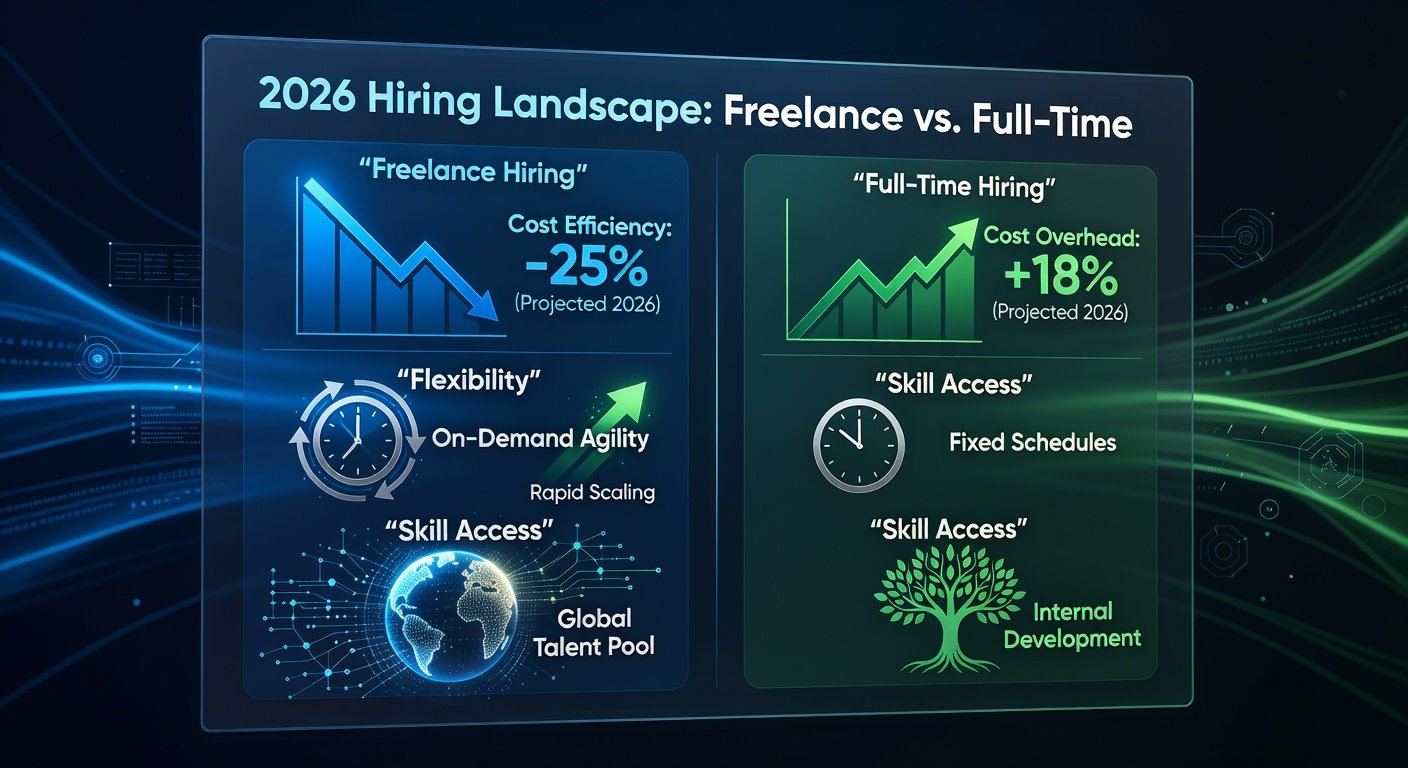
One of the most compelling aspects of freelance hiring is its cost efficiency. Freelancers typically charge per project or hour, eliminating overheads like health insurance, paid leave, or retirement contributions. In 2026, with inflation and economic uncertainties, this model can reduce hiring costs by up to 40-60%, especially for specialized tasks. For instance, a software development project might cost $5,000 via a freelancer on platforms like Upwork, compared to $100,000+ annually for a full-time developer including benefits.
Full-time hiring, while more expensive upfront, offers predictability. Salaries, bonuses, and benefits packages average $120,000 per year for mid-level roles in tech-heavy sectors, per U.S. Bureau of Labor Statistics data. Hidden costs include recruitment fees (15-25% of salary) and turnover expenses, which can exceed $15,000 per employee. In a volatile economy, full-time roles provide tax advantages and loyalty incentives, but freelancers allow scaling without long-term commitments.
- Freelance Pros: No benefits overhead; pay only for output.
- Freelance Cons: Potential for inconsistent quality or payment disputes.
- Full-Time Pros: Fixed budgeting; builds institutional knowledge.
- Full-Time Cons: Higher fixed costs during downturns.
For small businesses or startups, freelancing shines in cost savings, but enterprises may prefer full-time for compliance with labor laws evolving in the gig space.
Flexibility: Adapting to 2026's Dynamic Workforce
Flexibility is the gig economy's hallmark. Freelancers offer on-demand availability, ideal for seasonal peaks or experimental projects. By 2026, with AI-driven matching platforms, recruiters can hire talent in hours, not weeks. This agility suits industries like marketing or content creation, where trends shift rapidly.
Full-time employees provide deeper integration but less adaptability. Contracts often lock in 40-hour weeks, limiting pivots during market changes. However, they foster team cohesion and innovation through daily collaboration. In hybrid models, full-timers handle core operations while freelancers augment during surges—think e-commerce ramps during holidays.
HR leaders report that 70% of companies using mixed models see improved adaptability, per surveys from professional bodies. Balancing both ensures resilience in an era of economic flux.
Skill Access: Tapping into Global Talent Pools
The gig economy democratizes skill access. Freelancers bring niche expertise—like blockchain or sustainable design—without geographic limits. Platforms connect businesses to over 50 million global workers, enabling access to rare skills at competitive rates. In 2026, with VR interviews and skill-verification AI, vetting is seamless.
Full-time hiring excels in developing internal talent but struggles with scarcity in high-demand fields. Recruiting for AI specialists, for example, can take months and cost thousands. Freelancers fill gaps instantly, but full-timers build proprietary knowledge over time.
- Assess project needs: Short-term? Go freelance.
- Evaluate long-term fit: Core roles suit full-time.
- Leverage data: Use analytics to predict skill demands.
Integrating both expands your talent pipeline, crucial as skills evolve with tech advancements.
HR Tips for Selecting the Right Hiring Approach
For recruiters navigating 2026's landscape, strategic selection is key. Start by auditing your organization's goals: Are you scaling rapidly or stabilizing? Use tools like skills gap analyses to identify needs.
Tip 1: Define Clear Criteria. For freelancers, prioritize portfolios and reviews on vetted platforms. For full-time, focus on cultural fit and growth potential via behavioral interviews.
Tip 2: Hybrid Talent Acquisition. Blend models by starting projects with freelancers to test waters, then converting top performers to full-time. This reduces risk and attracts passive candidates impressed by innovative hiring.
Tip 3: Legal and Compliance Check. In the evolving gig regulations, consult resources from the Society for Human Resource Management (SHRM) to avoid misclassification pitfalls.
Tip 4: Measure ROI. Track metrics like time-to-hire (freelance: days; full-time: weeks) and cost-per-hire to refine strategies.
These tips empower HR teams to align hiring with business objectives, enhancing efficiency in talent acquisition.
Integrating Both Models to Enhance Employer Branding
Blending freelance and full-time hiring isn't just practical—it's a branding powerhouse. In 2026, forward-thinking companies showcase inclusive ecosystems on LinkedIn, attracting top talent eager for diverse opportunities. Freelancers act as brand ambassadors, sharing positive experiences that amplify your reputation.
This integration signals adaptability and innovation, differentiating you in competitive markets. For instance, tech firms like Google use freelancers for R&D while nurturing full-time innovators, boosting their appeal to millennials and Gen Z.
Impacts on Onboarding, Job Postings, and Retention
Onboarding differs starkly. Freelancers require minimal setup—often just access credentials and briefs—allowing quick ramps. Full-time processes involve orientation, training, and compliance, taking 1-3 months but fostering loyalty.
Job postings must adapt: Freelance ads emphasize project specs and autonomy on gig sites, while full-time listings highlight benefits and culture on traditional boards. Tailor language to draw the right pool; vague postings lead to mismatches.
Retention is the long game. Full-timers benefit from career paths and perks, with retention rates up to 85% in supportive environments. Freelancers, though transient, can be retained via repeat gigs, building a 'talent cloud' for ongoing needs. Mixed models improve overall retention by offering variety, reducing burnout.
Challenges include equity—ensure freelancers feel valued to avoid morale dips. Track engagement via feedback loops for sustained success.
Conclusion: Future-Proof Your Hiring Strategy
In 2026's gig economy, neither freelance nor full-time hiring stands alone; their synergy drives competitive advantage. By weighing costs, embracing flexibility, and accessing diverse skills, recruiters can craft robust talent strategies. Implement HR tips to select wisely, integrate models for branding wins, and optimize onboarding, postings, and retention. The result? A resilient workforce ready for tomorrow's challenges.

No comments yet. Be the first!