 Jobboy

Introduction: Making Bias-Resistant Career Choices in 2026
Navigating career decisions in 2026 requires tools that account for uncertainty and cognitive biases. The regret minimization framework, popularized by Jeff Bezos, encourages professionals to project themselves into the future and choose paths that minimize long-term regret. This approach proves especially valuable amid economic shifts, remote work evolution, and rapid skill obsolescence. Mid-career readers often encounter crossroads involving promotions, lateral moves, or investments in upskilling programs, where short-term fears can overshadow long-term potential.
Loss aversion—the tendency to fear losses more than value equivalent gains—frequently skews choices toward inaction. Regret minimization directly counters this by shifting focus from immediate discomfort to future self-reflection. In an era of AI disruption and hybrid work models, professionals need frameworks that promote proactive planning rather than reactive survival. This article explores the model in depth, offering exercises, comparisons, and integration strategies tailored for those seeking bias-resistant tools.
Understanding the Regret Minimization Framework
At its core, the framework asks: "In 10 or 20 years, which decision will I regret more?" This future-oriented lens promotes clarity by emphasizing emotional outcomes over immediate metrics like salary or title. Unlike traditional pros-and-cons lists that emphasize immediate risks, it prioritizes enduring fulfillment and growth. Key principles include projecting your older self's perspective, acknowledging that inaction often breeds greater regret than bold moves, and separating ego-driven fears from strategic considerations. Behavioral economics insights highlight how this method reduces decision fatigue by anchoring choices in personal narrative rather than external pressures.
The model draws from principles of prospective hindsight, where individuals simulate future scenarios to identify overlooked factors. For 2026 specifically, it helps address volatility in industries like tech, finance, and healthcare, where upskilling in emerging areas such as generative AI or sustainable practices can determine long-term relevance.
How Regret Minimization Counters Common Career Biases
Loss aversion leads many to reject lateral moves or skill-building programs due to perceived short-term costs like temporary income dips or learning curves. Status quo bias reinforces staying in comfortable but stagnant roles, while confirmation bias causes professionals to seek only data supporting their current path. The framework dismantles these by forcing a long-view evaluation that highlights hidden costs of inaction.
For instance, declining a promotion might feel safe today but could generate regret over missed leadership experience and network expansion by 2035. Similarly, avoiding upskilling in AI-adjacent skills risks future employability gaps as automation accelerates. By visualizing the 2036 version of yourself, these biases lose power, encouraging calculated risks backed by emotional foresight rather than fear.
Step-by-Step Application Exercises
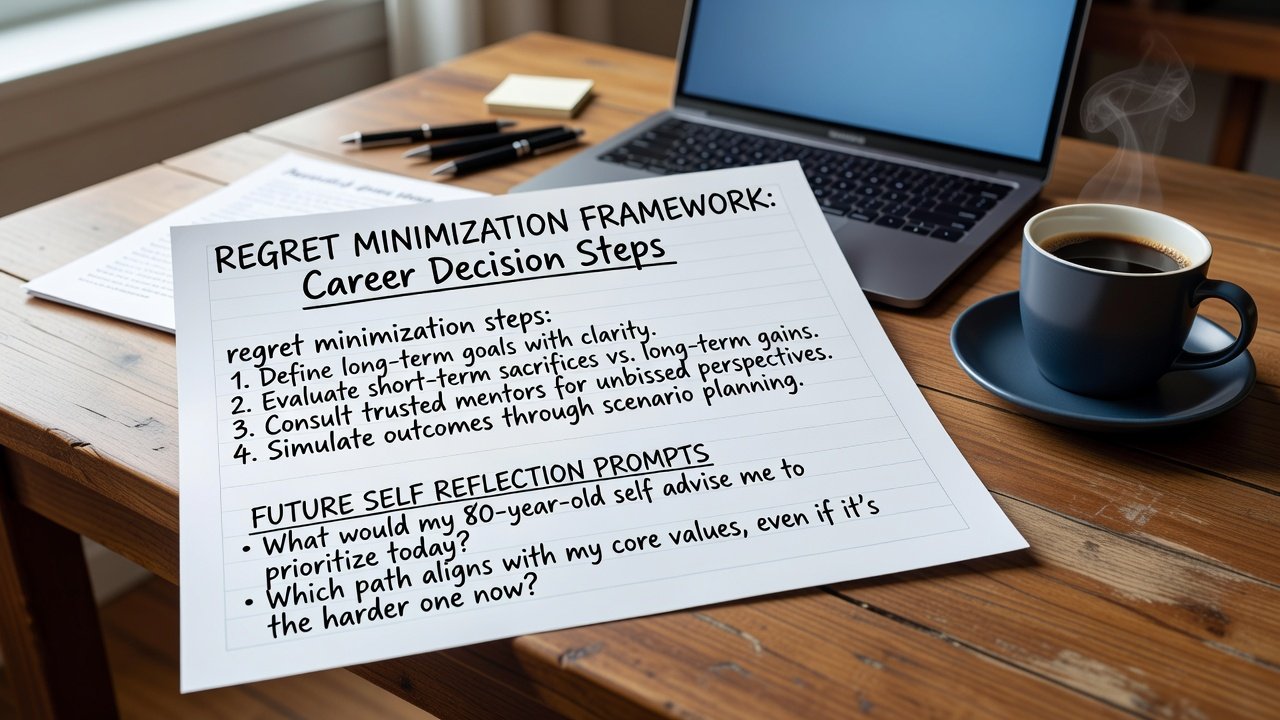
Apply the framework through structured exercises designed for repeatability. First, define your decision clearly, such as accepting a new role, pursuing certification, or negotiating a promotion. Second, imagine yourself at age 55 or 60 reflecting back on the choice. Third, write two detailed letters: one from the future self who took the action and one who did not, focusing on emotions, achievements, and relationships. Fourth, compare emotional tones and extract insights about which path aligns with core values. Fifth, commit to the lower-regret path with a 30-day action plan including milestones and accountability checks.
Enhance this with a practical worksheet: List three potential regrets for each option across categories like professional growth, financial stability, and personal well-being, then rank them by intensity. Revisit this quarterly to refine decisions. Add a visualization exercise where you spend 10 minutes journaling sensory details of your future life under each scenario. These steps transform abstract reflection into actionable strategy.
Real-World Professional Examples
Consider a marketing manager with 12 years of experience weighing a move to a startup versus staying at a stable corporation. Using regret minimization, she envisions 2035 and realizes missing entrepreneurial experience would weigh heavier than temporary pay variability or longer hours. She transitions, builds a portfolio of successful campaigns, and later credits the framework for her accelerated growth into a VP role. Her quarterly reviews now incorporate future-self letters to guide team expansions.
Another example involves a software engineer debating a pivot to data science amid rising demand for analytics expertise. Future reflection reveals regret over not adapting to industry trends, prompting enrollment in targeted courses despite initial time demands. Within 18 months, he secures a hybrid role with greater impact. A third case features an HR professional considering a return to full-time office work after remote flexibility; the framework reveals regret over lost autonomy, leading to a negotiated hybrid arrangement that sustains productivity.
Comparing Regret Minimization to the Inversion Model
Inversion, another powerful mental model, involves thinking about what to avoid rather than what to achieve, such as listing career failure modes like skill stagnation or toxic environments. While inversion excels at identifying pitfalls, regret minimization adds emotional depth by centering personal narrative and long-term satisfaction. Combine both for superior results: Use inversion to list potential career pitfalls, then apply regret minimization to weigh which avoided path creates the most future dissatisfaction. This hybrid yields robust planning superior to either model alone, as seen in leadership development programs that blend avoidance tactics with aspirational visioning.
Mistakes to Avoid When Using the Framework
Common pitfalls include over-focusing on negative regrets without balancing positive outcomes, which can lead to overly conservative choices. Another error is applying the model too rigidly without updating projections as circumstances evolve, such as family changes or market shifts. Avoid isolating the exercise; discuss insights with mentors for external perspectives. Finally, do not neglect implementation—future reflection loses value without concrete next steps like skill audits or networking goals.
Integrating Regret Minimization into Quarterly Career Audits
Build the framework into routine reviews for sustained impact. Schedule 90-minute sessions each quarter to review past decisions through the future-self lens, update skill gap analyses, and adjust goals accordingly. Track progress with a simple dashboard noting key metrics like new competencies gained and alignment scores with long-term vision.
Frequently Asked Questions
How often should I revisit decisions with this framework? Quarterly audits provide balance without overthinking daily fluctuations, allowing time for real-world feedback while maintaining momentum.
Does it work for team-based career planning? Yes—facilitate group exercises where colleagues share projected regrets to surface collective blind spots and foster collaborative growth strategies.
What if multiple paths seem low-regret? Prioritize the option aligning most with core values identified in your future-self letters, then test small pilots before full commitment.
Can this framework address financial considerations in career moves? Absolutely; incorporate specific future financial scenarios into your reflection letters to weigh stability against growth opportunities holistically.
Conclusion
The regret minimization framework equips mid-career professionals with a bias-resistant compass for 2026 and beyond. By consistently applying future-self reflection through structured exercises and audits, individuals navigate promotions, transitions, and learning investments with greater confidence and fewer missed opportunities. Start your first exercise today to build momentum toward a regret-minimized career trajectory that prioritizes lasting fulfillment over fleeting security.

No comments yet. Be the first!