 Jobboy

Introduction: Navigating Career Growth in 2026
In today's dynamic job market, professionals face a critical decision between pursuing internal promotions and exploring opportunities through job hopping. Both strategies offer unique pathways to advancement, but the optimal choice depends on individual goals, industry trends, experience level, and priorities such as work-life balance. As the economy continues to evolve with remote work norms and skill-based hiring, understanding the trade-offs becomes essential. This guide examines the latest insights to help you make an informed decision that supports long-term success.
Understanding Internal Promotions
Internal promotions involve advancing within your current organization by taking on greater responsibilities or moving into higher-level roles. This path rewards loyalty, institutional knowledge, and consistent performance while often providing structured growth opportunities through established career ladders and performance review cycles.
Pros of Internal Promotions
- Deeper company integration and stronger professional networks that can lead to mentorship and sponsorship opportunities from senior leaders
- Potentially smoother transition with familiar processes, reducing the learning curve associated with new environments and teams
- Access to internal leadership development programs and increased visibility with senior decision-makers who already know your contributions
- Preservation of accrued benefits such as retirement contributions, stock vesting schedules, and paid time off balances that accumulate over years
Cons of Internal Promotions
- Slower salary progression compared to external moves in many competitive industries where budgets for external hires are often higher
- Limited exposure to new skills, technologies, or diverse industry perspectives that come from working across multiple organizations
- Possible influence of office politics or favoritism on advancement decisions, which can delay or derail well-deserved promotions
- Risk of stagnation if the organization lacks clear promotion pathways or faces budget constraints during economic shifts
For example, a marketing manager at a mid-sized tech company might receive a promotion to director after leading successful campaigns, but the salary adjustment could be modest compared to switching employers for a similar title elsewhere.
Exploring Job Hopping
Job hopping refers to strategically changing employers every one to three years to accelerate career milestones. This approach has gained broader acceptance across sectors as a legitimate tactic for rapid growth when executed thoughtfully and with clear professional objectives in mind.
Pros of Job Hopping
- Access to significantly higher compensation packages and better role alignment with evolving skills and market demands
- Broadened skill sets through exposure to diverse work environments, tools, methodologies, and team dynamics across companies
- Faster title advancements and expanded responsibilities that enhance your professional brand and resume strength
- Opportunities to reset work-life balance by selecting employers with stronger cultures, flexible policies, or better support structures
Cons of Job Hopping
- Potential perception of instability by conservative employers or in traditional industries that value long tenure
- Loss of long-term benefits like seniority-based perks, fully vested retirement matches, or equity that builds over multiple years
- The recurring need to adapt to new company cultures, processes, and expectations, which can temporarily reduce productivity
- Possible gaps in deep institutional expertise that some specialized or leadership roles require for maximum effectiveness
Consider a software engineer who hops from a startup to a large enterprise and secures a senior title with broader project scope and leadership duties within just two years of strategic moves.
Salary Data and Job Satisfaction Stats
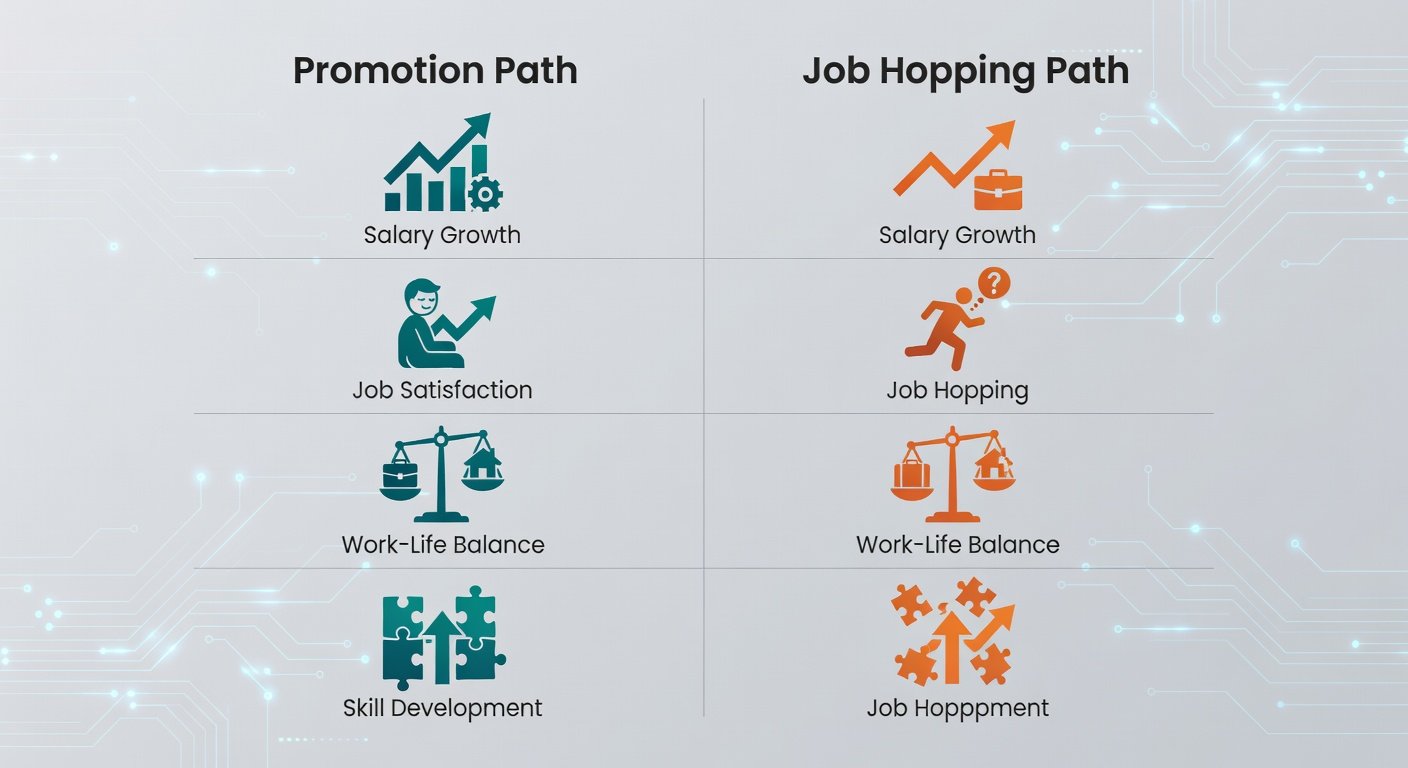
Compensation trends reveal that external moves frequently deliver larger increases than typical internal raises. Qualitative patterns from recent 2026 analyses indicate that job hoppers often achieve stronger financial outcomes when they research market rates thoroughly and time their transitions well. Meanwhile, employees who secure promotions within the same company report higher long-term satisfaction tied to stability, recognition from peers, and improved work-life balance. Studies referenced by the Bureau of Labor Statistics show varying satisfaction levels depending on whether moves align with personal values and career stage. Similarly, insights from Harvard Business Review emphasize that both paths can succeed when professionals track progress against clear benchmarks and avoid reactive decisions.
Choosing the Best Path Based on Key Factors
Selecting between promotion and job hopping requires evaluating your industry, years of experience, and specific goals. In fast-paced fields like technology and finance, hopping often accelerates advancement and skill diversification, while government, education, or healthcare may reward sustained internal tenure with greater security and influence. Mid-career professionals with five to ten years of experience should assess whether their current role offers sufficient challenge or if external opportunities better support work-life balance through flexible schedules or reduced stress. Early-career individuals might benefit from staying longer to build foundational skills and credibility, whereas senior leaders often leverage hopping for executive roles that demand fresh perspectives. Always factor in personal priorities such as family needs, commute preferences, remote work desires, or long-term financial planning to ensure the chosen path remains sustainable.
Actionable Steps for Negotiating a Promotion
Follow these detailed steps to increase your chances of internal advancement and demonstrate strategic value:
- Document achievements with quantifiable metrics over the past 12 to 18 months, including revenue impact, team growth percentages, process improvements, or customer satisfaction gains
- Schedule a dedicated career discussion with your manager well before annual review cycles to set expectations early
- Research internal salary bands and comparable external roles using professional networks and reliable compensation data sources
- Prepare a compelling case that ties your contributions directly to current business objectives and future company goals
- Propose a realistic timeline, required support resources, and a personal development plan showing how you will grow in the new role
- Follow up in writing to create a clear record of the conversation, agreed milestones, and next steps for accountability
Success often comes from combining persistence with solid evidence rather than simply requesting more responsibility without context.
Actionable Steps for Tailoring Your Resume for Seamless Job Changes
When preparing to hop, use these targeted techniques to stand out and minimize transition friction:
- Lead with transferable skills and recent accomplishments that directly match the target job description and required qualifications
- Customize each application by incorporating exact keywords from the posting to optimize for applicant tracking systems
- Quantify results in every role description using percentages, project scale, or measurable outcomes to showcase impact
- Include a brief professional summary that highlights your career trajectory, unique value proposition, and adaptability
- Prepare concise stories for interviews that demonstrate impact, problem-solving, and quick adaptation in previous positions
- Network on platforms like LinkedIn to gain referrals and insider insights before submitting applications
Potential Pitfalls to Avoid
Common mistakes include hopping too frequently without clear strategic reasons, neglecting to negotiate salary and benefits during promotions, or failing to maintain positive relationships with former colleagues and managers. Always evaluate offers holistically, considering culture fit, long-term growth potential, and alignment with personal values rather than focusing solely on title changes or immediate compensation. Another frequent error is ignoring non-financial factors such as team dynamics or professional development resources that affect daily satisfaction.
Conclusion: Building Your Personalized Career Roadmap
Whether you pursue an internal promotion or strategic job changes, success in 2026 hinges on intentional planning, regular self-assessment, and proactive skill development. Combine elements of both approaches by staying long enough to develop meaningful expertise while remaining open to external moves that accelerate progress when opportunities align. Seek ongoing mentorship, monitor market trends through reliable sources, and prioritize sustainable growth that supports both professional achievement and personal well-being for lasting career fulfillment.


No comments yet. Be the first!