 Jobboy

Introduction: Why Career Decisions Feel Overwhelming in 2026
Many mid-career professionals face decision paralysis when weighing upskilling options, networking strategies, or promotion paths. Economic shifts, rapid technological change, and evolving workplace dynamics amplify this uncertainty. Professionals often feel stuck between staying in familiar roles or pursuing new directions that require significant personal investment. Mental models offer structured ways to cut through noise and make confident choices by focusing on reasoning rather than endless pros-and-cons lists.
In 2026, the job market demands continuous adaptation. Remote work options and AI-driven roles add layers of complexity to every decision. Traditional goal-setting methods frequently fall short because they emphasize surface-level targets without addressing underlying thought processes that lead to better long-term outcomes.
Understanding Career Decision Paralysis
Analysis paralysis occurs when too many variables—market trends, personal values, family needs, and skill requirements—create inaction. Mid-career individuals, typically with 10 to 20 years of experience, often juggle established responsibilities with desires for growth. This leads to prolonged deliberation that delays promotions or necessary pivots. Real-world triggers include fear of financial instability during transitions and uncertainty about which skills will remain relevant.
Without frameworks to evaluate options systematically, professionals waste months researching without action. Mental models provide clarity by breaking decisions into manageable components and revealing hidden assumptions.
Mental Model 1: Inversion
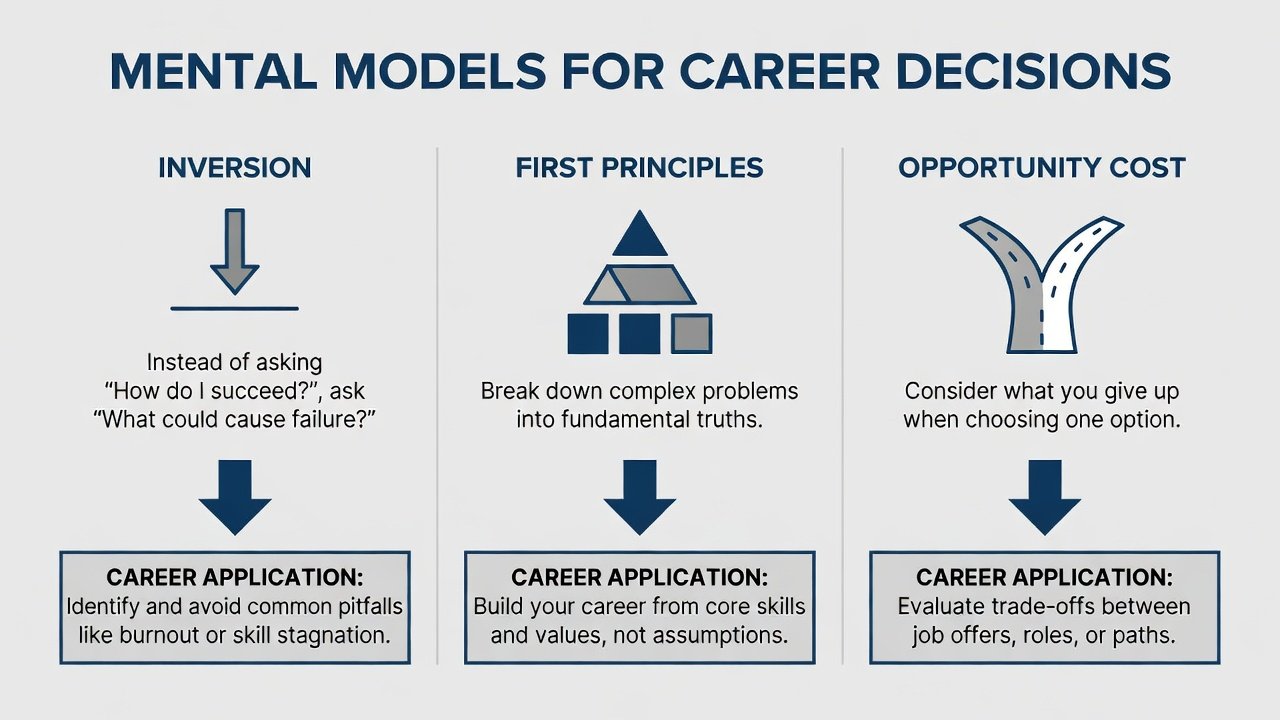
Inversion asks what to avoid instead of what to achieve. For career pivots, list actions that guarantee regret, such as ignoring skill gaps or staying in toxic environments. This flips perspective and reveals hidden risks that positive thinking overlooks. By focusing on failure prevention, individuals make more robust plans that withstand unexpected challenges.
Step-by-Step Application
- Identify your current career goal clearly and specifically.
- List everything that would make the opposite outcome certain, including behaviors and external factors.
- Eliminate those behaviors from your plan and replace them with protective actions.
- Review the inverted list monthly to adjust for new information.
Real-world example: A marketing manager avoided stagnation by inverting her networking approach. Instead of attending every event, she focused on quality connections that aligned with her target industry, leading to two strong referral opportunities within three months.
Mental Model 2: First Principles
Break problems into fundamental truths instead of analogies. In upskilling, question assumptions like “everyone needs a certification” and examine core skills required by employers in your field. This approach strips away conventional wisdom and rebuilds solutions from basic elements that truly matter.
Step-by-Step Application
- Define the core problem without industry jargon or borrowed language.
- Strip away assumptions borrowed from peers or past experiences.
- Rebuild solutions from basic elements such as required competencies and market needs.
- Test the rebuilt plan against real job postings and feedback from trusted contacts.
A project manager used first principles to redesign his promotion path. He realized leadership experience and cross-functional collaboration mattered more than another advanced degree, so he volunteered for stretch assignments instead of enrolling in expensive courses.
Mental Model 3: Opportunity Cost
Every choice carries the cost of the next best alternative. When evaluating networking or side projects, calculate time and energy traded away from family, health, or rest. This model encourages deliberate trade-offs that align with personal priorities rather than defaulting to busyness.
Daily Integration Routine
- Morning: Review top three priorities and their opportunity costs before committing time.
- Evening: Journal one decision made that day and the hidden trade-offs involved.
- Weekly: Adjust plans based on realized costs and emerging opportunities.
- Monthly: Compare actual time spent against initial opportunity cost estimates.
Comparison to Traditional Goal-Setting
SMART goals emphasize measurable targets but ignore reasoning quality. Mental models improve the thinking behind goals, leading to faster promotions and fewer regrets. Professionals who apply these frameworks report clearer decision criteria and reduced second-guessing. According to the U.S. Bureau of Labor Statistics, structured approaches to career planning correlate with higher mobility rates. In contrast, pure goal-setting often results in rigid plans that ignore changing circumstances.
Key differences include mental models' focus on process over outcomes and their ability to handle uncertainty better than linear goal frameworks.
Checklists for Practical Use
- Inversion checklist: What would cause failure in this career move? Have I removed those risks? What safeguards can I add?
- First principles checklist: What are the undeniable facts about this role or skill? What assumptions am I questioning? Have I rebuilt the plan from basics?
- Opportunity cost checklist: What am I giving up with this choice? Is the trade-off aligned with my values? How will I measure the cost over time?
Case Studies of Successful Applications
Case 1: A software engineer applied inversion to avoid burnout by identifying habits that led to previous exhaustion. She eliminated late-night coding sessions and prioritized boundary-setting, resulting in a targeted pivot to management within six months and improved work-life balance.
Case 2: An HR specialist used opportunity cost analysis to decline excessive networking events. She freed time for high-impact certifications and earned a promotion by focusing on strategic internal projects instead.
Case 3: A finance professional broke down a potential career switch using first principles, discovering that core analytical skills transferred better than expected. This led to a successful move into data analytics with minimal additional training.
Integrating Mental Models into Daily Life
Start small by applying one model to minor decisions like meeting attendance. Over time, scale to major choices such as job offers. Track outcomes in a simple journal to refine your approach. Combine models for complex situations, using inversion to spot risks and opportunity cost to weigh benefits.
Common Pitfalls and How to Avoid Them
Many professionals fall into confirmation bias by only seeking supporting evidence for preferred paths. Inversion directly counters this by forcing examination of failure scenarios. Another pitfall is over-analysis without action; set time limits on model application to maintain momentum. Finally, ignoring personal values leads to decisions that feel hollow even when logically sound.
FAQ: Addressing Common Biases
How does confirmation bias affect career choices?
It leads professionals to seek only confirming evidence for desired moves. Inversion counters this by deliberately exploring failure modes and worst-case scenarios.
Can these models replace mentors or career counselors?
No. They complement advice from sources like the Department of Labor by sharpening personal analysis before seeking external input. Use them as preparation tools.
What if I still feel stuck after trying these models?
Start with one model for a single small decision. Small wins build confidence and momentum toward larger career moves. Consider combining with resources from CareerOneStop for additional structure.
Conclusion
Mental models transform vague anxiety into actionable clarity. By practicing inversion, first principles, and opportunity cost daily, mid-career professionals in 2026 can navigate upskilling, networking, and promotions with reduced regret and measurable progress. Begin today with one small decision to experience the difference and build lasting decision-making skills.

No comments yet. Be the first!