 Jobboy

Introduction: Why Career Pivots Fail in 2026
Career transitions in 2026 demand agility amid rapid AI integration and economic shifts, yet many professionals sabotage their own moves through cognitive biases. Behavioral economics reveals how these mental shortcuts distort judgment, leading talented individuals to stay in misaligned roles or chase unsuitable opportunities. Understanding these patterns equips you with clearer decision-making tools grounded in neuroscience. The modern workplace evolves quickly, with hybrid models and automation reshaping entire industries, making unbiased thinking essential for long-term success. Without intervention, even experienced leaders repeat the same decision errors year after year.
Confirmation Bias in Career Exploration
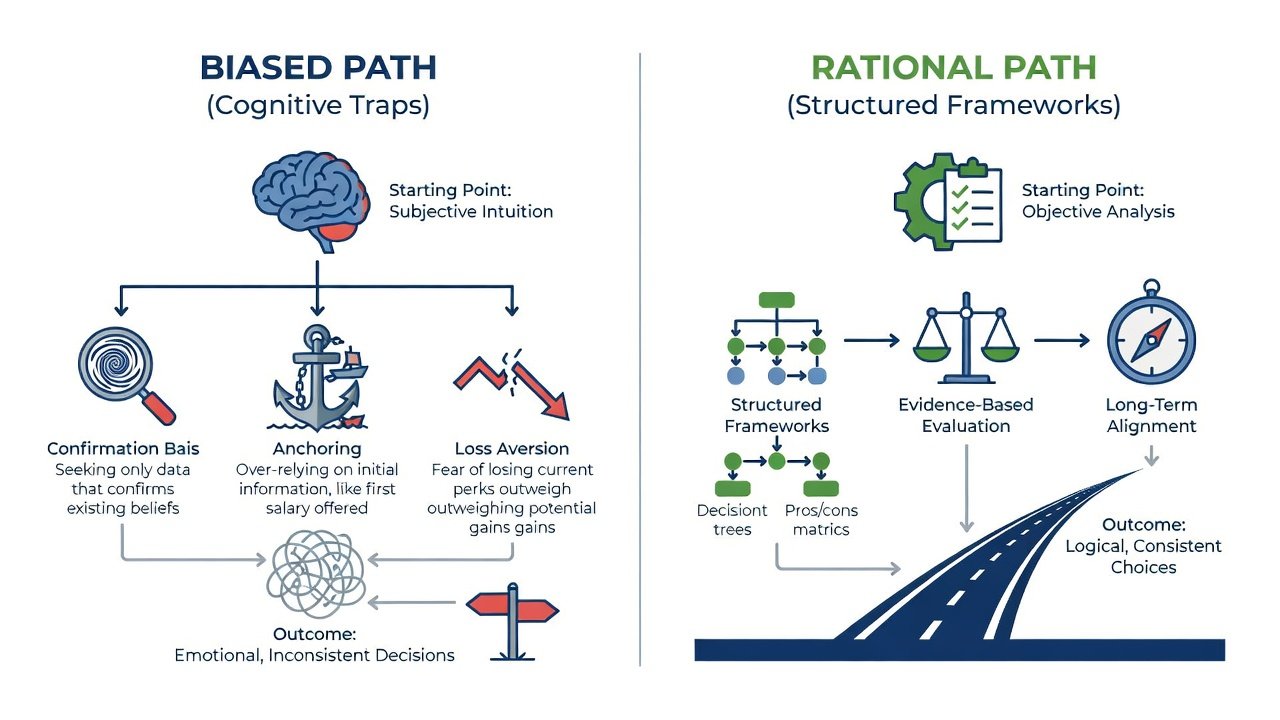
Confirmation bias drives individuals to seek information that validates existing beliefs while ignoring contradictory evidence. In career pivots, this might mean only reading success stories from one industry while dismissing data on market saturation. Professionals often scroll LinkedIn feeds that reinforce their current path, missing signals for emerging fields like sustainable tech or health informatics. This bias strengthens when individuals follow echo chambers of like-minded peers who share similar career histories. Over time, the brain filters out disconfirming data to reduce cognitive dissonance, creating a false sense of certainty about the chosen direction.
Real-world example: A marketing manager considering a switch to data analysis repeatedly followed only optimistic career changers on social platforms, overlooking reports of entry-level barriers. After applying a structured review of diverse sources, she identified skill gaps and successfully transitioned within nine months. Another professional in finance ignored regulatory changes in her sector because they contradicted her plan to stay put, resulting in a delayed pivot that cost her two years of potential advancement.
Anchoring Bias and Salary Negotiations
Anchoring occurs when the first piece of information encountered disproportionately influences subsequent judgments. During 2026 job searches, initial salary figures from past roles or early offers can anchor expectations unrealistically low or high. This bias frequently appears in promotion planning when professionals fixate on their current compensation band instead of researching updated market rates. The effect is particularly strong in virtual interviews where the first number mentioned sets the tone for the entire discussion.
Neuroscience research shows the brain’s reward centers activate strongly around anchor points, making deviation emotionally taxing. To counter this, conduct blind market scans before any negotiation discussions. Prepare multiple scenarios and practice reframing the conversation around value delivered rather than historical numbers.
Loss Aversion and Fear of Change
Loss aversion, famously studied by Kahneman and Tversky, makes losses feel twice as painful as equivalent gains. Career pivots trigger this when professionals overvalue the security of their current job—benefits, relationships, status—relative to potential future rewards. Many delay upskilling because the immediate discomfort of courses outweighs long-term career growth in their perception. This aversion can manifest in subtle ways, such as repeatedly postponing networking events or rejecting stretch assignments that might reveal new paths.
Example: An operations director avoided a tech pivot for two years due to perceived loss of industry expertise, only to regret it after peers advanced faster using targeted certifications. Teams that implement regular loss-framing exercises report higher rates of proactive career exploration within six months.
Behavioral economics insights help quantify these distortions and provide evidence-based countermeasures.
Pre-Mortem Analysis Framework
A pre-mortem exercise imagines your pivot has failed and works backward to identify causes. This prospective hindsight reduces overconfidence. Steps include: assemble a small review group of trusted colleagues, state the failure scenario in vivid detail, list every possible reason for failure without judgment, then develop mitigation plans for each item. Apply this quarterly during career planning cycles and revisit outcomes after six months to refine the process. Organizations that train employees in pre-mortems see measurable improvements in project success rates.
Step-by-Step Bias Detection Exercises
LinkedIn Networking Exercise: 1. List your top 10 connections and note their industries. 2. Categorize their roles and shared content themes. 3. Identify patterns confirming your current assumptions. 4. Deliberately connect with three professionals outside those patterns weekly. 5. Journal contradictions that emerge and track how your perspective shifts over 30 days. 6. Schedule one informational interview per new connection to gather unfiltered insights.
Promotion Planning Exercise: 1. Write your ideal next role in detail. 2. List supporting evidence and counter-evidence equally. 3. Assign probability weights to each data point. 4. Revisit after two weeks with fresh sources from government labor statistics. 5. Adjust goals based on balanced input and create a 90-day action plan with milestones.
Biased vs Rational Decision Paths Comparison
| Scenario | Biased Path | Rational Path |
|---|---|---|
| Evaluating new role | Seeks only positive testimonials from similar backgrounds | Reviews both success and failure cases from multiple sectors and company sizes |
| Salary discussion | Fixates on first offer received or past salary | Researches 2026 market data from at least three sources before responding |
| Upskilling choice | Chooses familiar topics to avoid discomfort | Conducts pre-mortem on skill investment outcomes and future demand |
| Networking strategy | Stays within existing industry circles | Actively expands to adjacent fields with structured outreach |
Neuroscience-Backed Tools for Clearer Planning
Techniques such as mindfulness meditation strengthen prefrontal cortex activity, improving bias recognition during high-stakes decisions. Apps delivering spaced repetition for decision journaling help rewire habitual thinking patterns over time. Combine these with weekly reflection sessions focused on recent career choices and track emotional responses to new information. Studies from leading research institutions demonstrate that consistent practice reduces anchoring effects by up to 40 percent in simulated scenarios.
Real-World Case Studies of Successful Pivots
Consider the journey of a healthcare administrator who used pre-mortem analysis to navigate into health tech product management. By listing potential failure points such as skill gaps and network limitations early, she built a targeted learning plan and secured a role within eight months. A software engineer overcame loss aversion by reframing her departure from a stable company as protecting long-term employability rather than risking current stability. She documented weekly progress and consulted external mentors to maintain perspective. These examples illustrate how structured bias detection accelerates transitions.
FAQ: Applying These Insights to Upskilling Choices
How do I detect confirmation bias when selecting courses? Actively seek negative reviews of popular programs and compare completion rates across providers using independent platforms.
What if loss aversion blocks enrollment? Frame the decision as protecting future options rather than risking current stability; calculate opportunity costs over a five-year horizon and discuss with a mentor.
Can anchoring affect certification value perception? Yes—always benchmark new credentials against recent job postings rather than past experiences or initial price points.
How often should I run bias detection exercises? Integrate them into quarterly career reviews and after any major professional milestone or setback.
Conclusion: Building Bias-Resistant Career Strategies
Overcoming these cognitive traps transforms career pivots from reactive gambles into deliberate, evidence-driven moves. Regular application of pre-mortems and bias audits, supported by neuroscience tools, positions professionals for sustainable success in 2026 and beyond. Start with one exercise this week to build momentum toward clearer decisions and revisit your progress monthly.

No comments yet. Be the first!