 Jobboy

Introduction
Many professionals evaluate job offers based solely on base salary, but this approach often overlooks the full value of total compensation. Understanding your effective hourly rate helps you compare offers accurately, negotiate better, and make informed career decisions. This guide breaks down the process into clear, actionable steps suitable for beginners while providing the depth needed for practical application across various career stages.
What Is Effective Hourly Rate?
The effective hourly rate represents the true hourly value of your entire compensation package after accounting for all monetary and non-monetary benefits. It provides a standardized metric for comparing different roles, industries, and work arrangements. Unlike base salary alone, this figure incorporates every element that contributes to your financial well-being, from retirement matching to wellness stipends. By calculating it, you gain clarity on whether a new opportunity truly advances your earnings potential or merely appears attractive on the surface.
Step-by-Step Formula
Follow these expanded steps to calculate your effective hourly rate with precision:
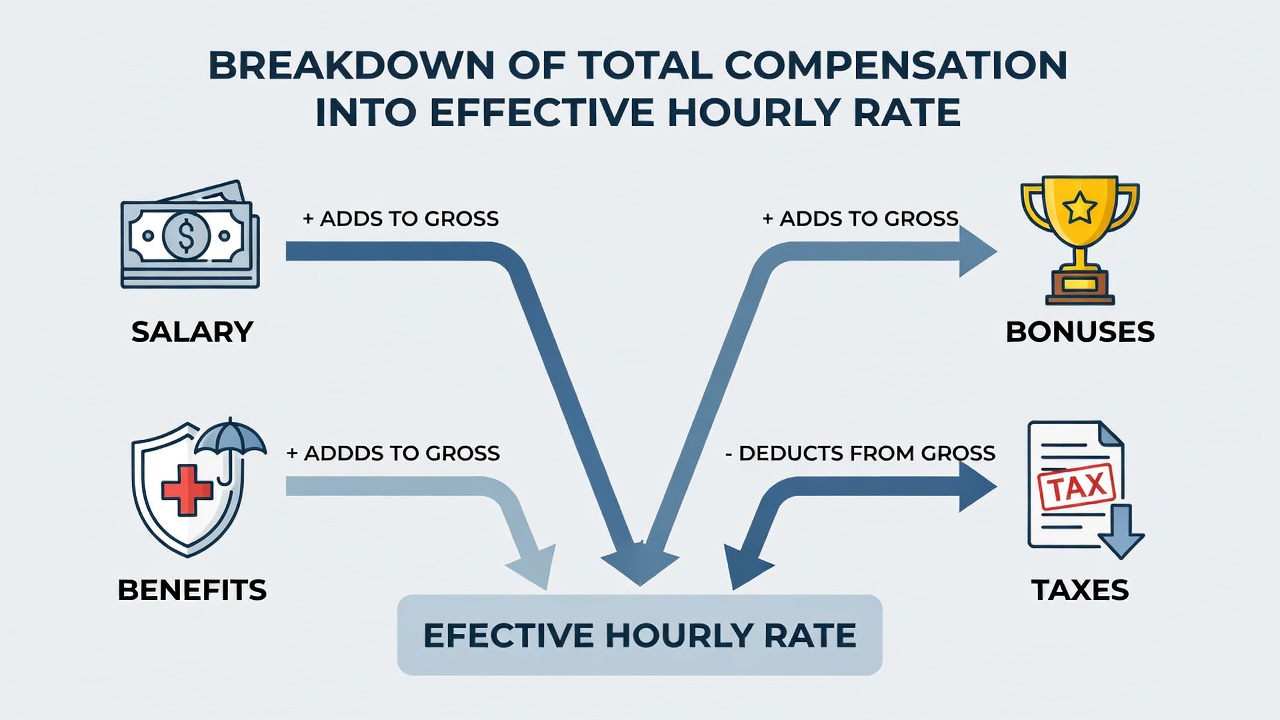
- Determine your annual total compensation by summing base salary, bonuses, equity grants, and the monetary value of benefits. Start with verifiable numbers from your offer letter or current pay stubs.
- Subtract estimated taxes and mandatory deductions to arrive at net compensation. Use progressive tax brackets and account for federal, state, and local obligations.
- Divide the net figure by the total number of hours worked annually, including unpaid overtime and commuting time if relevant. Adjust for actual hours rather than assuming a standard 2,080-hour work year.
- Factor in non-cash perks by assigning reasonable market values, such as the cost of employer-provided health insurance or professional development allowances.
Real-World Example
Consider a mid-level marketing professional receiving a competitive base salary plus performance bonuses, employer-matched retirement contributions, and comprehensive health coverage. After adding these elements and adjusting for taxes, the calculation yields an effective hourly rate that may exceed the base-salary equivalent by a substantial margin. Another example involves a software engineer whose equity grants represent a large portion of compensation; conservative valuation of vested shares over multiple years produces a realistic hourly figure that reflects both risk and reward. A third scenario features a teacher who receives loan forgiveness benefits and pension contributions, which when annualized dramatically increase the effective rate compared with salary alone.
Industry-Specific Adjustments
Technology and finance sectors often include substantial equity components that require valuation adjustments for vesting schedules and market volatility. Healthcare and education fields emphasize benefits such as loan forgiveness or tuition reimbursement, which should be annualized and included in the total. Manufacturing roles may feature overtime premiums and safety bonuses, while creative industries frequently offer freelance opportunities or royalty structures that demand separate tracking. Always research sector norms using authoritative labor data before finalizing adjustments.
Tax Implications
Taxes significantly affect net compensation. Consult official resources such as the IRS website for current federal and state withholding guidelines. Factor in payroll taxes and potential deductions for retirement contributions to refine your net calculation. State-specific rules can further alter outcomes, so cross-reference with local tax authorities. Failing to account for taxes can inflate your perceived hourly rate by 20-30 percent or more depending on your bracket.
Remote Versus Traditional Roles
Remote positions may reduce commuting costs and time but can alter benefit structures. Traditional office roles sometimes provide higher base pay to offset location-based expenses. Compare both scenarios by including the dollar value of time saved or additional expenses incurred. Remote workers often save on transportation, meals, and wardrobe but may face higher home utility costs or need to self-fund ergonomic equipment. Traditional employees might receive on-site perks like subsidized cafeterias or transit passes that add measurable value. Weigh these factors carefully when evaluating offers.
Practical Worksheet
Create a simple spreadsheet with columns for each compensation component. Input annual figures, apply tax adjustments, and divide by actual hours worked rather than a generic standard. Update the worksheet whenever you receive a new offer or raise. Include rows for one-time payments prorated over the expected tenure, and add formulas that automatically recalculate the hourly rate when inputs change. Print or save multiple versions to track progress over time and identify trends in your compensation growth.
Common Pitfalls to Avoid
- Ignoring vesting schedules for equity grants, which can lead to overestimating immediate value
- Overlooking the value of paid time off and flexible work policies that effectively increase your hourly earnings
- Failing to annualize one-time signing bonuses across the expected employment period
- Neglecting location-based cost-of-living differences that affect real purchasing power
- Excluding professional development stipends or wellness benefits that have clear market equivalents
Using Calculations for Negotiations
Armed with your effective hourly rate, you can approach salary discussions with concrete data. Prepare a breakdown showing how proposed adjustments improve the hourly figure, and reference market benchmarks from the U.S. Bureau of Labor Statistics. Practice presenting your case calmly, focusing on mutual value rather than demands. Document all elements of the offer in writing before accepting to avoid misunderstandings later.
FAQ
How much should I ask for during negotiations?
Research market rates using data from the U.S. Bureau of Labor Statistics and aim for a total compensation package that exceeds your current effective hourly rate by a meaningful percentage. Present your request with supporting calculations rather than round numbers.
Should equity be included in the calculation?
Yes, but apply a conservative discount for risk and vesting periods. Treat unvested shares as probabilistic rather than guaranteed income.
How often should I recalculate my rate?
Recalculate after every compensation change, promotion, or job offer to maintain an accurate benchmark. Annual reviews are also recommended even without changes.
What if my benefits are difficult to value?
Use average market costs for similar plans or ask your HR department for the employer contribution amount. Conservative estimates are preferable to inflated figures.
Does this method apply to freelancers?
Absolutely. Freelancers should include all billable and non-billable hours plus self-employment tax adjustments to arrive at a true effective rate.
Conclusion
Calculating your effective hourly rate transforms opaque compensation packages into transparent, comparable figures. By following the steps outlined above and avoiding common pitfalls, you can maximize the value of every offer and make data-driven decisions that support long-term financial growth. Regular use of this method empowers you to advocate effectively for raises and choose opportunities that truly align with your financial goals.


No comments yet. Be the first!