 Jobboy

Introduction to Technical Interview Preparation in 2026
Technical interviews continue to evolve rapidly, placing equal weight on deep coding proficiency, architectural thinking, and the ability to articulate solutions under pressure. Job seekers targeting software engineering, data science, machine learning, and infrastructure roles must prepare for multi-stage assessments that probe algorithms, data structures, system design, and behavioral competencies. This comprehensive guide delivers detailed, actionable strategies to master coding tests while differentiating yourself through exceptional communication and problem-solving clarity. Whether you are a recent graduate or an experienced professional pivoting into new technology stacks, the following sections provide frameworks that have helped thousands succeed in competitive hiring processes.
Common Question Formats in Coding Assessments
Most technical interviews follow predictable yet challenging formats. Algorithm and data-structure questions dominate the first round and typically include problems on arrays, strings, linked lists, trees, graphs, dynamic programming, and sorting techniques. Candidates may encounter classic challenges such as finding the longest substring without repeating characters or detecting cycles in a graph. System design questions appear in later rounds and require candidates to sketch high-level architectures for products like a real-time chat application, a video streaming service, or a distributed rate limiter.
Live coding sessions usually run 45 to 60 minutes. Interviewers evaluate not only correctness but also code readability, time and space complexity analysis, and handling of edge cases such as empty inputs, maximum constraints, and invalid data. Behavioral and situational questions often interleave with technical ones, asking candidates to describe past projects or resolve hypothetical team conflicts while maintaining technical depth.
Step-by-Step Practice Routines
Effective preparation follows a structured six-week timeline. Weeks one and two focus exclusively on fundamentals: master arrays, hash maps, stacks, queues, and basic recursion. Dedicate each day to one pattern—two pointers on Monday, sliding window on Tuesday, and so on—solving five problems before reviewing optimal solutions. Weeks three and four introduce medium and hard problems on platforms such as LeetCode, emphasizing timed sessions of 30 minutes per problem. Record yourself explaining each solution aloud to simulate interview conditions.
Week five shifts to system design. Study established references and practice drawing diagrams for at least two new systems daily. Week six consists of full-length mock interviews three times per week, followed by detailed self-review. Maintain a digital error log documenting every mistake, the correct approach, and the underlying concept. This log becomes invaluable for last-minute review.
Tools for Mock Testing and Platform Comparison
Choosing the right practice environment dramatically accelerates progress. Top platforms differ in problem volume, interview realism, and feedback quality. The comparison below highlights key strengths to help you select a balanced stack.
- LeetCode offers over 2,500 problems with company-specific tags and weekly contests; best for targeted algorithm drilling.
- HackerRank provides curated tracks and certification assessments; excellent for beginners establishing core skills.
- Pramp delivers free peer-to-peer mock interviews focused on communication and collaborative problem-solving.
- interviewing.io supplies anonymous sessions with professional interviewers plus detailed performance analytics and playback features.
Combine at least two platforms: use LeetCode for volume and interviewing.io for realistic pressure. Schedule mocks at the same time of day as your actual interviews to train circadian focus.
Blending Technical Proficiency with Communication Skills
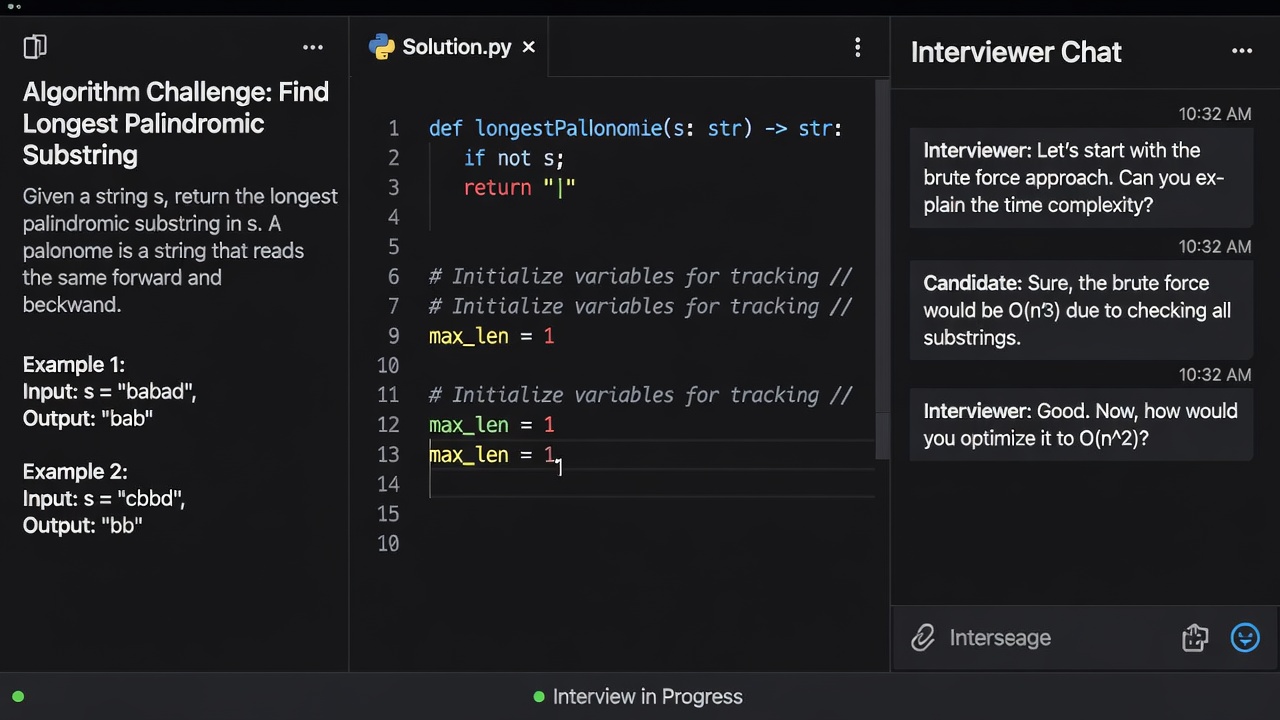
Technical correctness accounts for roughly half of the evaluation. The remainder hinges on how clearly you convey reasoning, ask clarifying questions, and discuss trade-offs. Adopt the “think-aloud” protocol from the first minute: state assumptions, outline your high-level plan, then code incrementally while narrating each decision. When you encounter ambiguity, explicitly ask about constraints such as input size or required latency. This demonstrates both technical maturity and leadership potential. After finishing a solution, always discuss alternative approaches and their complexity implications even if the interviewer does not prompt you.
Avoiding Pitfalls in Live Coding Sessions
Common failure modes include diving into code without clarifying requirements, neglecting edge cases, and freezing when stuck. Counter these habits with deliberate safeguards. Always spend the first two minutes restating the problem and confirming constraints. Write helper functions for repetitive tasks rather than duplicating logic. If you reach an impasse, verbalize the blocker and propose a simplified version or ask for a hint. Interviewers frequently value collaborative debugging more than flawless first attempts. Finally, reserve the last five minutes to test your code with multiple inputs, including boundary conditions, and to summarize time and space complexity.
Adapting to Evolving Tech Trends
Staying current with 2026 trends gives candidates a competitive edge. Expect questions involving AI-assisted development workflows, serverless architectures, and sustainable computing practices. Practice designing systems that incorporate large language models for content moderation or recommendation engines. Study emerging patterns such as event-driven microservices and edge computing deployments. Review recent white papers from major cloud providers and incorporate relevant terminology into your system-design vocabulary without overcomplicating explanations.
Real-World Examples of Strong Responses
Consider the classic “reverse a linked list” problem. A high-scoring candidate first confirms whether the list is singly or doubly linked and whether the reversal should be in-place. They sketch both iterative and recursive approaches on the whiteboard, implement the iterative solution with clear variable names, then optimize to constant space. They test the code with an empty list, a single-node list, and a multi-node list before discussing the O(n) time complexity. Another strong example involves designing a URL shortener: the candidate begins by defining requirements around read-heavy traffic and 100-character keys, proposes a base-62 encoding scheme, discusses database sharding strategies, and concludes with caching layers using consistent hashing.
Final Preparation Checklist
Use this checklist 48 hours before any interview: review your error log, complete one full mock interview, prepare three concise stories demonstrating impact, test your development environment and internet connection, and gather questions for the interviewer about team structure and technical challenges.
FAQ: Handling Pressure During Evaluations
- How do I calm nerves before an interview? Complete at least three full mock interviews the preceding week, practice box-breathing techniques for two minutes before the call, and remind yourself that the interviewer wants you to succeed.
- What if I get stuck midway through a problem? Communicate your current thinking, state the specific obstacle, and propose a simplified path or request a hint. Interviewers routinely provide guidance when candidates show collaborative intent.
- Should I mention emerging technologies like AI tooling? Only when directly relevant to the question; otherwise prioritize fundamentals and demonstrate how you would evaluate new tools if the role required it.
- How long should I spend on each problem in a 60-minute session? Allocate roughly 10 minutes for clarification and planning, 35 minutes for implementation and testing, and 15 minutes for optimization discussion and questions.
Conclusion
Success in 2026 technical interviews demands deliberate, multi-dimensional preparation that integrates rigorous algorithm practice, realistic mock sessions, and polished communication. By following the structured routines, leveraging complementary platforms, and consistently applying the think-aloud method, candidates can approach every evaluation with confidence and clarity. The investment in these skills pays dividends not only in securing offers but also in building lasting professional capabilities.


No comments yet. Be the first!