 Jobboy

Introduction: Why Storytelling Wins Interviews in 2026
In today's competitive job market, generic responses no longer cut it. Recruiters and hiring managers seek candidates who can weave compelling narratives that demonstrate skills, achievements, and cultural fit. Storytelling transforms routine answers into memorable experiences that resonate long after the interview ends. This guide explores advanced frameworks to help you answer any question with confidence and authenticity. Whether you are facing a panel interview, a virtual screening, or a high-stakes executive discussion, the ability to deliver stories that feel both personal and professional sets top candidates apart. Research from career platforms shows that narrative-driven responses increase recall by up to 70 percent compared with bullet-point lists of achievements.
Identifying Core Story Arcs for Interview Success
Every strong interview story follows a clear arc: situation, challenge, action, and result (SCAR). Unlike basic STAR, SCAR emphasizes emotional stakes and personal growth. Start by mapping your career highlights to these elements. For instance, identify a project where you overcame resource constraints to deliver results 20 percent ahead of schedule. Break each story into its components: describe the situation with enough context for an outsider to understand the stakes, outline the specific challenge including any interpersonal or technical hurdles, detail the actions you personally took, and close with measurable results plus the lessons you internalized. This framework prevents rambling while ensuring your answers remain structured and impactful.
Building a Versatile Story Bank
Collect 8 to 10 core stories from your past roles, volunteer work, and educational experiences. Tag each story by the skills it showcases such as leadership, problem-solving, or innovation. Update the bank quarterly to include recent wins. This preparation allows rapid retrieval during interviews rather than scrambling for examples on the spot.
Adapting Stories to Common and Unexpected Questions
Behavioral questions like "Tell me about a time you led a team" are perfect for SCAR. Unexpected questions require quick pivots—reframe them to your prepared arcs. Practice by listing 5-7 core stories and matching them to 20-plus question variations. For example, a story about launching a new product can answer queries about creativity, deadline management, stakeholder communication, or handling failure. When faced with curveballs such as "What is your greatest weakness?" pivot to a story that shows how you turned a skill gap into a strength through deliberate practice and mentorship.
Integrating Job Description Keywords Naturally
Scan the job posting for terms like "cross-functional collaboration" or "data-driven decisions." Weave them into your stories without forcing them. A natural example: "In leading cross-functional collaboration on our Q3 launch, I used data-driven decisions to prioritize features that increased user retention by 35 percent." This technique improves ATS compatibility while keeping responses conversational. Avoid stuffing keywords; instead, let them emerge organically from authentic experiences.
Step-by-Step: Transforming Generic Answers into Stories
- Identify the question's core skill being tested.
- Select your matching SCAR story from your bank.
- Infuse sensory details and emotions to make the narrative vivid.
- End with measurable impact and lessons learned.
- Rehearse aloud for natural flow and timing.
- Adjust emphasis based on the interviewer's follow-up questions.
Consider a generic answer to "Describe a challenge you overcame": "I worked on a difficult project." The transformed version: "During my role at a mid-sized tech firm, our team lost key data two weeks before a client deadline. I coordinated with engineering to rebuild the dataset overnight, communicated transparently with the client, and ultimately delivered a solution that exceeded expectations, resulting in a contract renewal."
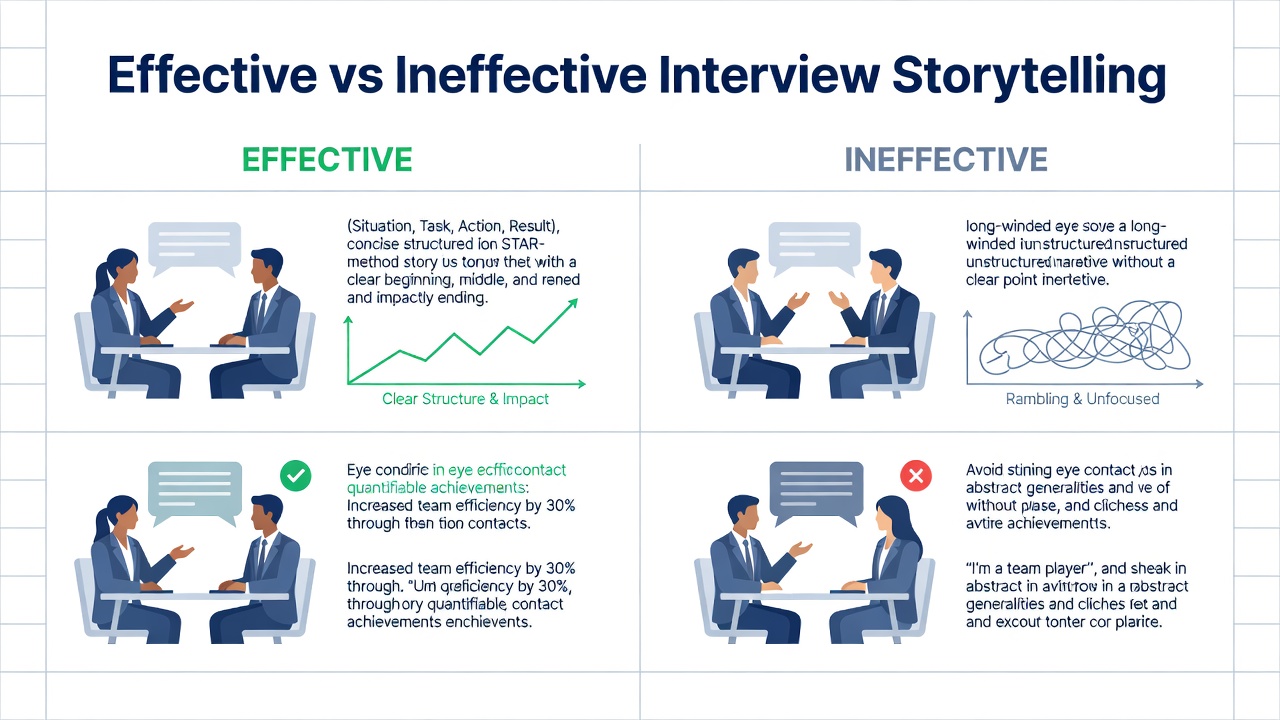
Effective vs. Ineffective Approaches: A Comparison
Ineffective: "I managed a project successfully." This lacks specificity and emotional connection.
Effective: "When our team faced a tight deadline after losing two members, I rallied everyone with clear priorities and daily stand-ups. We delivered the client presentation two days early, securing a contract extension that generated substantial additional revenue." Multiple side-by-side examples like this help candidates see the difference between surface-level replies and memorable narratives.
Practical Checklist for Interview Storytelling
- Prepare 5-7 versatile stories in advance covering leadership, conflict, innovation, and resilience.
- Quantify results wherever possible using percentages, dollar amounts, or time savings.
- Practice with a timer limiting answers to 2-3 minutes.
- Record yourself to refine tone, pacing, and body language.
- Align stories with company values listed on their career page.
- Prepare one-sentence transitions to move smoothly between stories.
- Anticipate follow-up questions and have supporting micro-stories ready.
Real-World Case Studies
Consider Sarah, a marketing manager who used a story about a failed campaign pivot to land a role at a Fortune 500 firm. By highlighting resilience and quick learning, she stood out among 200 applicants and received an offer within ten days. Engineer Raj adapted a technical troubleshooting tale to answer both behavioral and situational questions during a series of five interviews, earning an offer within one week. Marketing coordinator Lena repurposed a customer complaint resolution story across three different companies, tailoring the emphasis each time to match the role's stated priorities around empathy and metrics.
Mistakes to Avoid When Using Storytelling
Common pitfalls include over-embellishing facts, which can be exposed during reference checks; speaking for too long without checking interviewer engagement; neglecting to mention your specific contribution; and failing to connect the story back to the target role. Always end stories by explicitly linking the outcome to skills required in the new position.
Short FAQ: Common Storytelling Pitfalls
How long should my stories be?
Aim for 90-180 seconds to maintain engagement without rambling. Use the SCAR framework to stay concise.
What if I don't have dramatic examples?
Focus on everyday challenges solved creatively—hiring managers value consistency and steady improvement over heroics.
Can I reuse the same story multiple times?
Yes, but adapt the emphasis and opening hook to match each question's focus.
How do I handle stories involving team failures?
Own your role honestly while highlighting what you learned and how you contributed to the recovery.
Conclusion
Mastering these storytelling secrets positions you as a thoughtful, results-oriented candidate ready for any interview format in 2026. Start building your story bank today to transform your next interview into a career-defining moment. For additional guidance, explore Indeed, LinkedIn, Harvard Business Review, and Glassdoor.


No comments yet. Be the first!