 Jobboy

Introduction to Contract-to-Hire and Direct Hire Models
In 2026, HR leaders face increasing pressure to optimize talent acquisition amid evolving workforce dynamics. Choosing between contract-to-hire and direct hire approaches can significantly impact recruiting outcomes, employee retention, and organizational agility. This guide provides an in-depth comparison to help you select the right model for your needs.
Both models serve distinct purposes in talent acquisition. Contract-to-hire allows employers to evaluate candidates on a temporary basis before offering permanent roles, while direct hire involves immediate permanent employment. Understanding their nuances is essential for strategic hiring in competitive markets where skill shortages persist across technology, healthcare, and finance sectors.
Defining Contract-to-Hire in Detail
Contract-to-hire positions start as temporary contracts, typically lasting three to twelve months, with the potential to convert to full-time roles. This model reduces initial commitment while providing time to assess cultural fit and performance. Employers often partner with staffing agencies to source candidates, which streamlines onboarding but adds layers of coordination.
Real-world examples include growing SaaS companies that use contract-to-hire for software engineers. One mid-sized firm in Austin reported converting 65 percent of contractors after six months, leading to stronger team cohesion and reduced turnover compared to previous direct hires who left within the first year.
Defining Direct Hire in Detail
Direct hire refers to the traditional permanent employment model where candidates are hired outright without a trial period. It emphasizes long-term investment from day one, including immediate access to benefits, equity, and professional development programs. This approach suits roles where immediate stability is critical, such as leadership positions or highly regulated industries.
Side-by-Side Comparison Table
| Factor | Contract-to-Hire | Direct Hire |
|---|---|---|
| Time to Productivity | Shorter ramp-up for evaluation, often 30-60 days to assess output | Faster integration for committed talent, with full productivity expected within 90 days |
| Flexibility | High for scaling teams during project peaks or market shifts | Lower, more permanent commitment that can limit rapid adjustments |
| Legal Risks | Moderate, involves contractor classification laws and potential misclassification audits | Standard employment regulations with focus on compliance around benefits and terminations |
| Cost Structures | Variable, often lower upfront due to agency fees offset by trial periods | Higher initial onboarding costs including benefits enrollment and training investments |
| Retention Impact | Improved long-term fit through extended evaluation | Stronger initial loyalty but higher risk if mismatch occurs early |
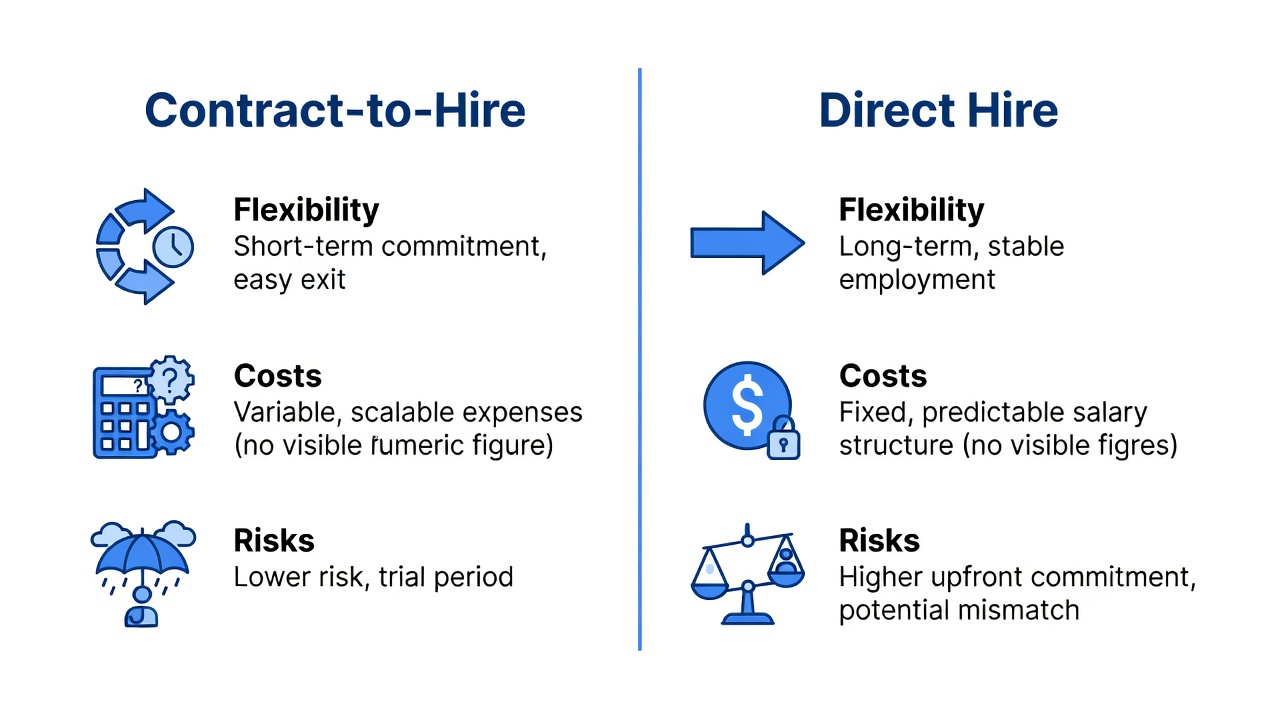
Cost Structures: A Deeper Analysis
Understanding cost differences helps HR teams allocate budgets effectively. Contract-to-hire typically involves agency markups ranging from 20 to 40 percent on hourly rates, but avoids full benefits payouts during the contract phase. In contrast, direct hire requires immediate investment in salaries, health insurance, retirement contributions, and payroll taxes. Growing companies often track total cost of ownership over 12 months to compare outcomes, revealing that contract-to-hire can lower risk-adjusted expenses when conversion rates exceed 50 percent.
Time-to-Productivity Analysis
Productivity timelines vary by role complexity. Contract-to-hire accelerates evaluation in fast-paced environments like digital marketing, where teams can measure campaign performance within weeks. Direct hire may delay full output if extensive training is needed, but provides dedicated resources sooner for core operations. Case studies from logistics firms show contract-to-hire reducing time-to-productivity by 25 percent in seasonal roles.
Legal Risks and Compliance Considerations
Legal risks in contract-to-hire center on worker classification under IRS and DOL guidelines. Misclassifying employees as contractors can result in back taxes and penalties. Direct hire carries standard risks around discrimination claims and severance obligations. Employers should consult resources from the U.S. Department of Labor and maintain clear documentation of contract terms to mitigate exposure. Recent enforcement trends emphasize joint employer liability when staffing agencies are involved.
Flexibility Benefits for Employers and Candidates
Flexibility stands out as a primary advantage of contract-to-hire, enabling companies to respond to economic fluctuations without lengthy severance processes. Candidates benefit from exposure to multiple organizations and skill-building opportunities. Direct hire offers predictability for both parties but can lock organizations into commitments that hinder pivots. In 2026, remote and hybrid work trends amplify these flexibility needs across industries.
Decision Framework for HR Leaders
HR leaders should follow a structured framework when choosing between models. First, assess role urgency and skill scarcity. Second, evaluate budget constraints and conversion likelihood. Third, review legal and compliance requirements. Fourth, define success metrics such as time-to-fill and retention rates. Fifth, pilot the approach on a small scale before full rollout. This framework helps avoid common mistakes like over-relying on one model without data.
Transition Best Practices and Case Examples
Successful transitions require defined criteria, regular feedback sessions, and transparent communication about conversion timelines. Growing companies in the fintech sector have documented 80 percent conversion success by implementing structured performance reviews at 30-, 60-, and 90-day marks. Actionable steps include aligning contract terms with company policies early and involving hiring managers in the evaluation process. Mistakes to avoid include vague conversion promises that erode candidate trust.
Success Metrics to Track
Effective measurement includes tracking conversion rates, quality of hire scores, and post-conversion retention at six and twelve months. Organizations achieving conversion rates above 70 percent typically report higher overall recruiting ROI. Incorporate candidate satisfaction surveys and manager feedback loops to refine future hiring decisions.
Actionable Steps for Choosing the Right Approach
- Map open roles against business goals and project timelines.
- Calculate projected costs for both models using internal benchmarks.
- Consult legal counsel on classification rules specific to your state.
- Develop clear evaluation criteria and share them with candidates upfront.
- Review outcomes quarterly and adjust strategies accordingly.
FAQs Addressing Common Concerns
What legal risks exist in contract-to-hire? Misclassification can lead to penalties; consult employment law experts and reference guidelines from the U.S. Equal Employment Opportunity Commission.
How does flexibility differ between the models? Contract-to-hire allows easier scaling during uncertain periods, while direct hire supports deeper cultural integration from the outset.
Which model improves retention more effectively? Contract-to-hire often yields better long-term fits when evaluation periods are used rigorously, reducing early departures.
Learn more about recruiting best practices from the Society for Human Resource Management.
Conclusion
Selecting between contract-to-hire and direct hire depends on your 2026 strategic goals around agility, cost control, and talent quality. Apply the frameworks, metrics, and best practices outlined to optimize your hiring outcomes effectively and build resilient teams.


No comments yet. Be the first!