 Jobboy

Introduction: Why Design Thinking Transforms Career Planning
In 2026, professionals face rapidly evolving job markets driven by AI, remote work shifts, and economic uncertainty. Traditional linear career paths often fall short, leading many to seek more adaptive strategies. Design thinking offers a human-centered, iterative framework that turns career planning into an innovative experiment rather than a rigid roadmap. This approach, originally popularized by firms like IDEO, helps individuals empathize with their own needs, define clear goals, and test possibilities through low-risk prototypes.
By reframing career change as a series of experiments, you can reduce fear of failure and build momentum. This guide explores the five stages with career-specific examples, compares traditional versus design-led planning, shares real-world case studies, and provides actionable steps. Whether you are a recent graduate, mid-career professional, or executive seeking reinvention, these principles scale across experience levels and industries. The methodology draws from design principles used in product development but applies them to personal and professional growth, emphasizing empathy as the foundation for sustainable decisions.
The Five Stages of Design Thinking Applied to Careers
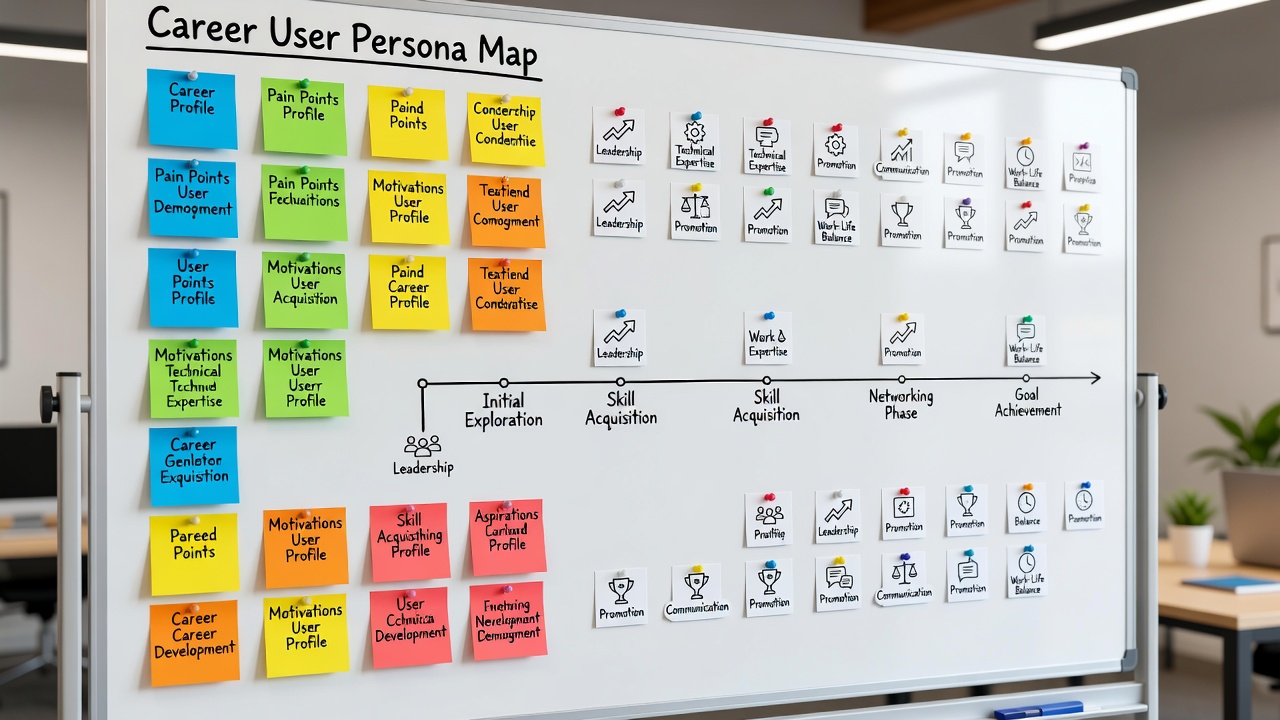
Empathize: Mapping Your Career User Persona
Start by treating yourself as the primary user. Conduct self-interviews or journal about daily work frustrations, values, and aspirations. Create a persona document including skills, pain points, and ideal role attributes. For instance, a mid-level marketer might discover a hidden passion for sustainability through empathy exercises, revealing misalignment with current corporate goals. Expand this by interviewing colleagues, family members, or former managers to gather external perspectives on your strengths. Record observations in a dedicated notebook or digital tool, noting emotional triggers during work tasks. This stage typically requires two to four weeks of consistent reflection to uncover patterns that surface-level assessments miss. Professionals who invest time here report clearer alignment between personal values and professional trajectories.
Define: Clarifying Your Career Problem Statement
Turn insights into a focused problem statement like: "How might I transition into a role that combines marketing expertise with environmental impact by mid-2026?" This stage narrows vague dissatisfaction into actionable challenges. Refine the statement through iterative questioning, ensuring it remains specific yet open to creative solutions. Avoid broad statements such as "I want a better job" and instead anchor them to measurable outcomes like skill acquisition or industry shift. Many find it helpful to create multiple problem statements and select the one that resonates most deeply after review.
Ideate: Brainstorming Innovative Career Paths
Generate dozens of options without judgment. Use mind mapping or SCAMPER techniques to explore side hustles, certifications, or role pivots. One professional ideated 50 variations before narrowing to three viable paths. Encourage wild ideas during this phase, including unconventional combinations such as merging technical expertise with creative consulting. Collaborate with a small trusted group for additional perspectives, hosting a virtual ideation session to expand possibilities. Document every idea, even those that initially seem impractical, as they often evolve into viable options during later stages.
Prototype: Rapid Testing Through Side Projects
Build quick experiments such as freelance gigs, informational interviews, or online courses. These low-commitment prototypes validate assumptions fast. For example, volunteering on a nonprofit board can prototype leadership skills before a full career shift. Set clear parameters for each prototype, including time investment and success metrics, to maintain focus. Common prototypes include creating a personal website showcasing new skills, shadowing professionals in target roles, or launching a small-scale project on platforms like GitHub. Track results systematically to identify what resonates most.
Test: Iterating Based on Feedback Loops
Seek input from mentors, peers, and even LinkedIn polls. Adjust based on real reactions, creating continuous improvement cycles. This mirrors agile methodologies used in tech but applied personally. Schedule regular check-ins, such as quarterly reviews, to analyze what worked and what requires adjustment. Incorporate both quantitative data like application response rates and qualitative insights from conversations. Over time, these loops build resilience and refine your career direction with precision.
Traditional Career Planning vs. Design-Led Approaches
Traditional planning often involves one-time assessments like StrengthsFinder followed by a five-year plan. It assumes stability and linear progression. In contrast, design-led planning emphasizes iteration, user empathy, and experimentation, making it ideal for 2026's volatile landscape. A comparison table shows design thinking reduces regret by fostering adaptability. Key differences include:
- Traditional: Fixed goals, high stakes decisions, annual reviews only
- Design-led: Flexible hypotheses, low-risk tests, weekly feedback loops
- Traditional: Relies on past performance data alone
- Design-led: Incorporates ongoing user research and real-world validation
- Traditional: Limited room for pivots without major disruption
- Design-led: Built-in mechanisms for rapid course correction
Resources from Stanford d.school further illustrate these distinctions through case examples from various sectors.
Real-World Case Studies
Sarah, a software engineer, used persona mapping to pivot into product design. After three prototypes including a UX bootcamp and freelance redesigns, she landed a role with significantly higher satisfaction. Another case involves a teacher who ideated edtech ventures, prototyped a tutoring app, and iterated based on parent feedback to secure initial funding. A third example features a finance professional who empathized through networking events, defined a shift toward sustainable investing, and tested ideas via a personal blog that attracted industry attention, leading to a new position within nine months. These stories demonstrate how the process adapts across fields.
Practical Steps to Get Started Today
- Block time for empathy journaling this week, aiming for at least three sessions of 30 minutes each.
- Define your problem statement and share it with one trusted contact for initial feedback.
- Ideate 20 career options in a single focused session, categorizing them by feasibility.
- Launch one prototype within 30 days, documenting assumptions beforehand.
- Establish monthly feedback rituals with a mentor or peer group.
- Review progress quarterly and adjust prototypes accordingly.
Tools and Resources for Implementation
Digital tools such as Miro for journey mapping, Notion for persona documentation, and Trello for tracking prototypes streamline the process. Free templates from established design organizations can accelerate setup. Combine these with offline methods like physical whiteboards for visual thinkers.
Overcoming Common Obstacles: FAQ
How do I handle fear of failure?
Reframe failure as data. Each prototype provides insights, lowering emotional stakes through small experiments. Start with prototypes that require minimal financial or time investment.
What if I lack time for side projects?
Integrate micro-tests into your current role, such as leading a new initiative at work or dedicating 15 minutes daily to skill-building activities.
Can design thinking work for non-creative fields?
Absolutely—engineers, accountants, and healthcare workers have successfully applied it to specialize or transition roles with measurable results.
How long does the full process typically take?
Most professionals see meaningful progress within three to six months when committing consistently to each stage.
Conclusion
Design thinking equips professionals with tools for resilient, fulfilling careers in 2026. By embracing empathy, iteration, and experimentation, you move from reactive planning to proactive innovation. Begin with one stage today to unlock smarter growth paths and create a career that evolves alongside your aspirations.


No comments yet. Be the first!