 Jobboy

Behavioral Economics in Career Planning: Smarter Choices for 2026
In 2026, career planning stands as one of the most high-stakes processes professionals navigate, yet hidden cognitive biases frequently lead to suboptimal paths. Behavioral economics integrates insights from psychology and economics to explain why talented individuals remain in unfulfilling roles or overlook promising opportunities. This comprehensive guide equips you with in-depth knowledge of key biases, detailed auditing methods, comparison frameworks, and step-by-step strategies to foster rational decision-making throughout your professional journey.
Understanding Core Biases in Career Contexts
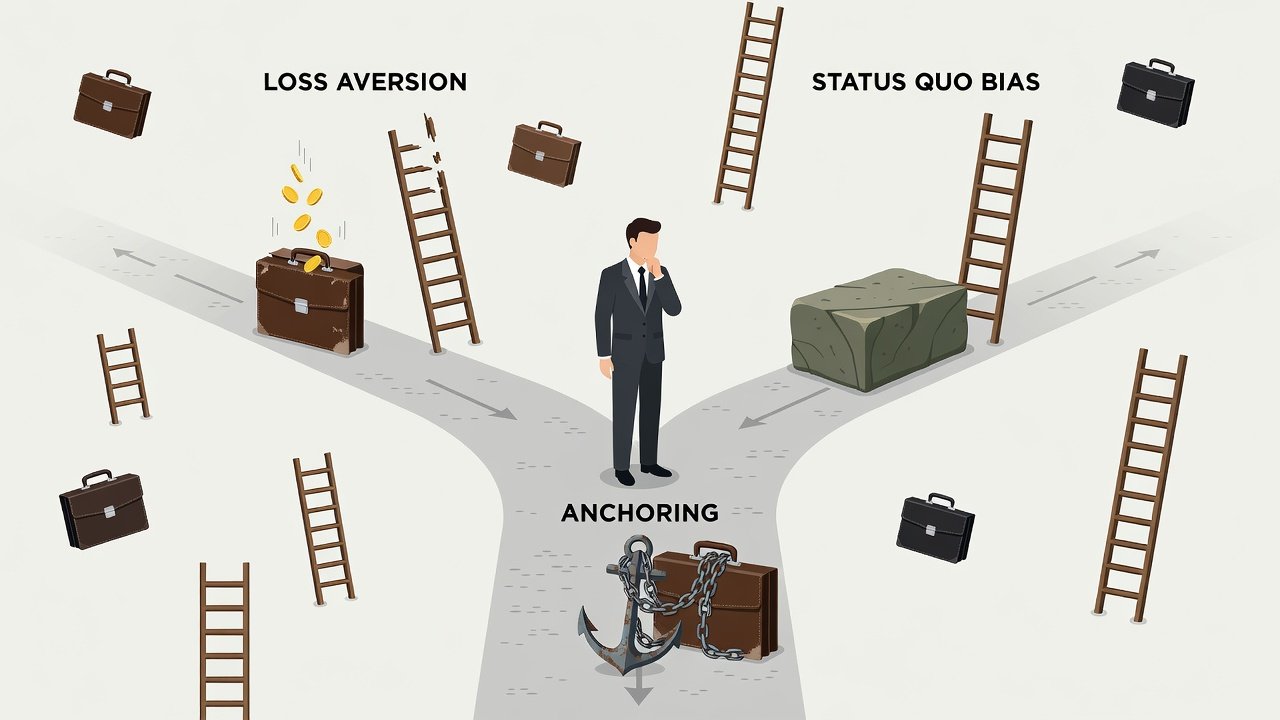
Loss aversion, a foundational concept from prospect theory, causes individuals to weigh potential losses roughly twice as heavily as equivalent gains. In career terms, this manifests when the fear of losing stable benefits or familiar routines overshadows the projected advantages of a new position with greater long-term potential. Status quo bias compounds this by creating inertia, making professionals default to their current situation even when objective indicators point toward needed change. Anchoring bias further distorts judgment when initial salary figures, job titles, or past experiences set an arbitrary reference point that skews future evaluations.
Consider a real-world scenario involving a software engineer who anchored expectations to a role secured in 2022. Despite industry shifts toward specialized AI skills, the individual declined two advancement opportunities because they appeared to deviate from the established compensation anchor, ultimately delaying career acceleration by several years. Another example involves a marketing professional exhibiting strong status quo bias by remaining at a mid-sized firm despite repeated internal rejections for leadership tracks; external data later revealed faster promotion rates at comparable organizations.
The Role of Prospect Theory and Additional Cognitive Factors
Prospect theory extends beyond loss aversion to include probability weighting, where people overemphasize low-probability events such as sudden layoffs while underestimating steady career growth trajectories. Overconfidence bias also plays a role, leading professionals to overestimate their market value without sufficient external validation. These factors interact during pivotal moments like considering relocation for a role or investing time in upskilling programs. Understanding these dynamics enables proactive countermeasures rather than reactive corrections.
Auditing Your Personal Decision Patterns
Conducting a thorough personal audit reveals entrenched patterns and creates space for improvement. Begin by compiling a detailed timeline of your last five career-related decisions, categorizing each as driven primarily by emotion, habit, or data. Next, quantify the outcomes using metrics such as salary progression, skill acquisition, and job satisfaction scores collected at six-month intervals. Incorporate reflective journaling where you document avoided opportunities and the underlying reasons, paying special attention to instances of loss framing or anchoring language in your notes.
Expand the process with these actionable steps:
- Map emotional triggers by reviewing emails or notes from decision periods to identify recurring phrases indicating fear of change.
- Compare your choices against publicly available labor statistics to test for anchoring effects.
- Simulate alternative scenarios using simple spreadsheets that model three-year and five-year outcomes under biased versus debiased assumptions.
- Seek structured feedback from mentors or peers who can challenge status quo justifications.
- Revisit the audit quarterly to track improvements in decision quality over time.
This methodical approach transforms vague self-awareness into measurable behavioral shifts.
Biased vs Rational Approaches: Comparison Table
| Scenario | Biased Approach | Rational Approach |
|---|---|---|
| Job Offer Negotiation | Anchoring strictly to the first number presented without counter-research | Gathering multiple market data points and presenting a well-supported counter-range |
| Considering a Career Pivot | Overemphasizing short-term losses in benefits or title prestige | Modeling cumulative earnings, skill development, and fulfillment across a decade-long horizon |
| Upskilling Investment | Defaulting to free or familiar resources due to status quo preference | Evaluating specific programs against projected advancement metrics and opportunity costs |
| Networking Engagement | Avoiding new contacts because of perceived social risk or time loss | Scheduling targeted interactions with measurable follow-up goals tied to career objectives |
Actionable Frameworks for Job Changes and Promotions
Adopt the comprehensive Bias Audit Framework consisting of four integrated phases. Phase one involves a pre-decision checklist that explicitly flags anchoring, loss aversion, and status quo tendencies through targeted questions. Phase two requires reframing exercises where potential losses are restated as forgone gains to neutralize emotional weighting. Phase three mandates a 90-day post-decision review incorporating both quantitative outcomes and qualitative reflections. Phase four focuses on iterative refinement by updating personal decision logs with lessons learned.
When applying these to job changes, integrate networking by establishing quarterly goals for informational interviews with professionals at target organizations. For promotions, combine the framework with upskilling plans that prioritize high-ROI certifications aligned with emerging 2026 skill demands such as ethical AI implementation and cross-functional data interpretation.
Integration with Networking and Upskilling Strategies
Behavioral economics principles enhance networking effectiveness by countering the tendency to undervalue weak ties. Schedule deliberate outreach beyond immediate circles and track response rates to refine approaches. Upskilling decisions benefit from debiasing through pilot testing small learning modules before committing to larger programs. This combined strategy creates compounding advantages as improved networks provide external data that challenges internal biases.
Common Pitfalls and How to Avoid Them
One frequent pitfall involves over-reliance on intuitive judgments during high-pressure periods such as sudden job offers. Mitigate this by enforcing mandatory cooling-off periods paired with data collection. Another issue arises from neglecting compound effects, where minor biases accumulate across multiple decisions and significantly alter long-term trajectories. Regular audits and external accountability partners help surface these patterns early. Finally, failing to update reference points as market conditions evolve can perpetuate outdated anchors; schedule annual recalibrations using authoritative labor resources.
FAQs on Implementing These Strategies
How long until I see results from bias-aware planning?
Most professionals report noticeable improvements in decision clarity and reduced regret within 30 to 60 days of consistent application, with more substantial career milestones appearing after six to twelve months of sustained practice.
Can these principles apply to remote career moves?
Absolutely. Remote opportunities often intensify status quo bias due to limited physical cues of progress; applying anchoring checks against location-independent benchmarks helps maintain objectivity.
What resources support ongoing development?
Consult established research repositories at behavioraleconomics.com and labor market data from bls.gov. Additional insights appear in working papers hosted by nber.org.
How do I maintain momentum after the initial audit?
Build accountability through peer groups or digital tools that prompt regular bias checks and celebrate incremental wins in rational decision-making.
Conclusion
Systematically addressing loss aversion, status quo bias, anchoring, and related cognitive tendencies equips professionals for resilient growth in 2026 and subsequent years. Begin your structured personal audit today to convert career planning from a reactive process into a strategically rational endeavor that maximizes both opportunity and satisfaction.


No comments yet. Be the first!