 Jobboy

Introduction: Why 2026 Demands a Fresh Approach to Veteran Compensation
Transitioning from military service to civilian employment in 2026 presents unique opportunities for veterans to secure compensation packages that fully reflect their leadership, discipline, and specialized skills. This guide delivers practical, up-to-date strategies tailored to current market conditions, helping veterans move beyond base salary to maximize total rewards such as benefits, bonuses, and flexible arrangements. The civilian job market continues to evolve with new technologies and shifting workforce priorities, making it essential for veterans to position their military backgrounds as direct assets rather than simply listing past duties. Many service members enter negotiations without a clear plan for highlighting quantifiable achievements, which can result in offers that undervalue years of high-stakes decision-making and team management. By understanding industry benchmarks, converting military pay grades accurately, and mastering scripted conversations, you can confidently advocate for packages that include tuition assistance, deployment differentials, and long-term growth incentives. Preparation begins well before any interview, involving research into specific sectors and the creation of supporting documents that translate service experience into civilian language hiring managers understand immediately.
Benchmarking Average Salaries by Industry in 2026
Start your preparation by researching compensation trends across sectors that actively recruit veterans. Defense contracting, logistics, cybersecurity, healthcare, and project management consistently value military backgrounds. Use government and industry resources to compare roles rather than relying on generalized online calculators that may not account for veteran-specific advantages. In defense-related fields, veterans often bring immediate credibility due to security clearances and operational knowledge that can accelerate project timelines. Logistics roles reward the ability to manage complex supply chains under pressure, while cybersecurity positions benefit from veterans trained in threat assessment and secure communications. Healthcare organizations seek former medics and corpsmen for roles requiring rapid problem-solving in high-stress environments. Focus on total compensation rather than base pay alone. Factors like health benefits, retirement matching, and professional development stipends often add substantial value. Cross-reference data from official sources such as the Bureau of Labor Statistics to understand regional variations and role-specific medians. Consider how cost of living in different metropolitan areas affects the real value of an offer, and factor in potential for overtime, shift differentials, or performance-based incentives that many civilian employers provide but rarely advertise upfront.
Converting Military Pay Grades to Civilian Equivalents
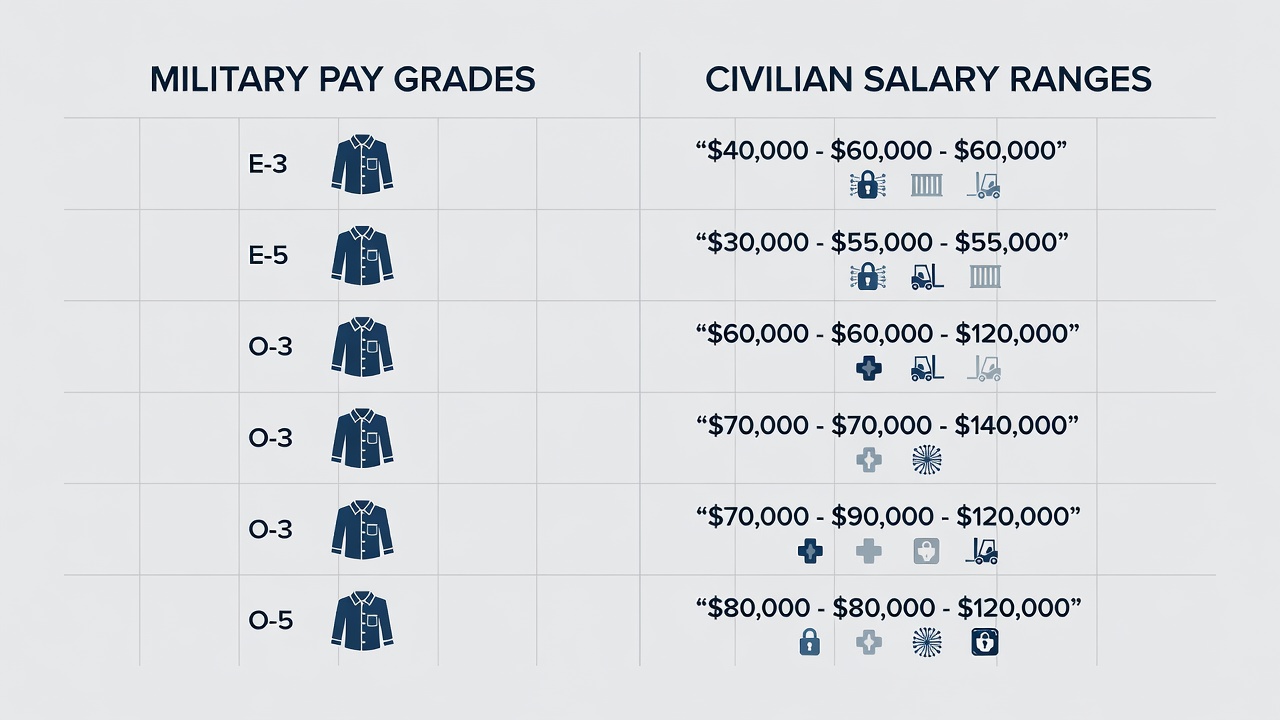
One of the most effective negotiation tools is a clear mapping of your military rank and responsibilities to civilian titles and salary bands. An E-6 with leadership experience in operations may align with mid-level management or senior specialist roles, while O-3 officers frequently translate to program or department leadership positions. To create this mapping, review job descriptions from target companies and identify overlapping responsibilities such as budget oversight, personnel supervision, or strategic planning. Create a one-page equivalency document that lists your key achievements alongside civilian job descriptions. This helps hiring managers quickly grasp your value and reduces the chance of being under-leveled. Include quantifiable outcomes such as team sizes managed, budgets overseen, or process improvements delivered. For instance, a veteran who coordinated logistics for a 200-person unit during deployments can frame that experience as supply chain management expertise applicable to manufacturing or distribution firms. Update the document for each application to match the language used in the job posting, which improves both ATS compatibility and recruiter understanding.
Step-by-Step Negotiation Strategies and Scripts
Follow these practical steps when an offer arrives or during final interview stages. First, express genuine enthusiasm for the role and the organization to establish rapport. Next, present your research-backed counter in a collaborative tone that emphasizes mutual benefit rather than confrontation. Bundle requests for base salary, signing bonus, and benefits together so the employer sees the full picture of what you seek. Always request time to review the complete package before responding, allowing you to consult mentors or compare multiple offers. Sample script: “I’m excited about the opportunity to bring my deployment coordination experience to your team. Based on my research and the scope of responsibilities, I was hoping we could discuss a total compensation package in the range of X, including the tuition assistance benefit you mentioned earlier.” Another scenario involves responding to a low initial offer by saying, “I appreciate the offer and see strong alignment with my background in leading cross-functional teams. To make this work, I would need the base compensation adjusted upward along with consideration for remote work flexibility two days per week.” Practice these scripts aloud to ensure they sound natural and confident.
Valuing Unique Military Perks Like Deployment Differentials
Deployment pay, hazard differentials, and tax advantages from service do not automatically disappear in civilian roles. Highlight these during negotiations by requesting equivalent structures such as performance bonuses, relocation stipends, or hardship assignment premiums. Some employers in 2026 offer veteran-specific retention incentives that mirror these benefits, including additional paid time off for military obligations or matching contributions to education savings plans. Document your past differentials and propose creative alternatives like quarterly performance awards or professional certification reimbursements that provide similar financial upside. For example, if you previously received extra compensation for overseas assignments, ask about opportunities for travel-based roles or international project leadership that carry similar premiums. This approach demonstrates forward-thinking while keeping the conversation focused on value rather than entitlement.
Corporate Versus Government Veteran Pay Comparisons
Private sector roles often provide higher base salaries but may vary in stability and benefits compared to federal positions. Government roles through agencies frequently include structured pay scales, robust retirement plans, and explicit veteran preference programs. Compare total rewards using official resources such as the Department of Veterans Affairs transition tools and the Department of Labor Veterans’ Employment and Training Service. Corporate environments may accelerate earnings through bonuses and equity but can involve more variable hours and less predictable advancement. Federal positions typically offer clearer pathways for promotion and strong protections for work-life balance. Many veterans find hybrid paths—starting in corporate roles for accelerated earnings then moving into government positions for long-term security—yield the strongest overall outcomes. Evaluate each option against your personal priorities such as location flexibility, family considerations, and long-term career goals.
Handling Salary History Disclosure and Common Challenges
In 2026, several states prohibit employers from asking about salary history. Prepare a response that redirects the conversation: “I’m focused on the value I can bring to this role and the market rate for similar positions in our area.” Prepare for pushback by having three data points ready: industry benchmarks, your documented achievements, and alternative compensation elements you’re willing to trade. If an employer insists on history, provide a range based on your total military compensation including allowances rather than base pay alone. This maintains transparency while protecting your negotiating position.
Real-World Examples of Successful Veteran Negotiations
One Army veteran transitioning into a logistics management role used a detailed equivalency document to demonstrate how her deployment supply coordination experience matched the company’s needs for process optimization. She successfully negotiated a 12 percent increase over the initial offer plus tuition reimbursement for an MBA program. In another case, a Navy veteran entering cybersecurity requested and received both a higher base salary and a one-time bonus equivalent to prior hazard pay, citing specific clearance maintenance costs. These examples illustrate the power of preparation and framing military experience in civilian terms.
Frequently Asked Questions
How much should I ask for during the first interview?
Defer specific numbers until you receive an offer. Use the second or third conversation to share researched ranges based on the role’s responsibilities and your mapped experience.
Can I negotiate tuition assistance as a veteran?
Yes. Many employers offer education benefits; request matching contributions or direct reimbursement for certifications relevant to the role, and reference GI Bill coordination where applicable.
What if the offer is below my expectations?
Politely counter with a written proposal that includes total compensation adjustments rather than rejecting outright. Provide specific alternatives such as increased bonus potential or additional leave.
Conclusion
Successful salary negotiation in 2026 requires preparation, data, and clear communication of your military-to-civilian value. By benchmarking thoroughly, converting your experience accurately, and using targeted scripts, you can secure compensation that reflects your full contributions. Start today by building your equivalency document and researching target employers’ veteran programs to position yourself for the strongest possible outcome.


No comments yet. Be the first!