 Jobboy
Introduction
Conference presentations demonstrate expertise, communication skills, and thought leadership that employers value in 2026. Whether you are a recent graduate or a mid-career professional pivoting industries, properly showcasing these achievements on your resume can differentiate you from other candidates. This guide covers ATS-friendly formatting, proper citation styles, methods to quantify impact, and strategies to reframe academic work for industry roles. In today's competitive landscape, where hiring managers review hundreds of applications weekly, highlighting presentations effectively can showcase your ability to engage audiences and drive discussions forward. Many professionals overlook this section, but when done correctly it adds substantial credibility, especially for roles requiring public speaking or research synthesis.
Why Include Conference Presentations on Your Resume?
Presentations at conferences highlight your ability to research, synthesize information, and present complex ideas clearly. Recruiters and hiring managers scan resumes for evidence of these transferable skills. In competitive job markets, including them strategically signals initiative and domain knowledge. Beyond basic visibility, these entries reveal your commitment to continuous learning and professional networking. For instance, participating in events allows you to stay updated on industry trends, which directly translates to value for employers seeking forward-thinking candidates. Including them also provides natural talking points for interviews, allowing you to expand on challenges overcome or insights gained during the preparation process.
ATS-Optimized Formatting for 2026
Applicant Tracking Systems parse resumes using keywords and standard section headings. Use clear headings like "Professional Presentations" or "Selected Conference Presentations." Format entries consistently with the job title or presentation title first, followed by the conference name, location, and date. Avoid tables, graphics, or columns that ATS software struggles to read. In 2026, many systems incorporate advanced parsing for virtual events, so always include delivery format when it adds context such as "virtual" or "hybrid." Standard fonts like Arial or Calibri at 10-12 point size ensure readability. Place this section after work experience but before education if presentations are recent and relevant, or near the top for academic transitions. Test your resume by submitting to free ATS simulators available through career sites to verify clean extraction of text.
Choosing the Right Citation Style
Match the citation style to your industry. Academic and research roles often prefer APA or MLA, while corporate positions benefit from simplified, readable formats. For example, an APA-style entry might read: Smith, J. (2025, March). Advancements in AI Ethics. Paper presented at the International Tech Summit, San Francisco, CA. Always verify the latest guidelines from authoritative sources such as Purdue OWL. In business contexts, a shorter format works better: "Keynote Speaker, International Tech Summit – AI Ethics in Practice (March 2025)." For scientific fields, consider incorporating DOI links if available, but only if the resume allows hyperlinks. Consistency across all entries prevents confusion and maintains a polished appearance that stands out during manual reviews.
Quantifying Impact and Results
Go beyond listing the event by adding metrics. Instead of "Presented at XYZ Conference," write "Presented research on sustainable supply chains to 450+ attendees, resulting in two follow-up collaborations." This approach demonstrates value and outcomes. Quantify where possible by noting audience size, number of questions received, media coverage generated, or post-event partnerships formed. If exact numbers are unavailable, use ranges such as "over 200 professionals" or "multiple industry stakeholders." Employers appreciate seeing tangible results because they indicate your presentations moved beyond theory into actionable influence. Track these details in a personal log after each event to make future resume updates easier and more accurate.
Reframing Academic Work for Industry Roles
Career changers should translate academic language into business benefits. Replace "Delivered paper on theoretical models" with "Presented data-driven strategies that improved process efficiency by 30%." Focus on problem-solving, leadership, and measurable results that align with the target job description. Academic presentations often involve deep analysis; reframe them to emphasize collaboration with diverse teams, adaptation of findings for practical use, and influence on decision-making processes. For example, a literature review presentation can become "Synthesized 50+ sources to recommend evidence-based marketing approaches adopted by three departments." This reframing bridges the gap between scholarly achievement and corporate needs, helping hiring managers quickly see your fit.
Real Examples from Career Changers
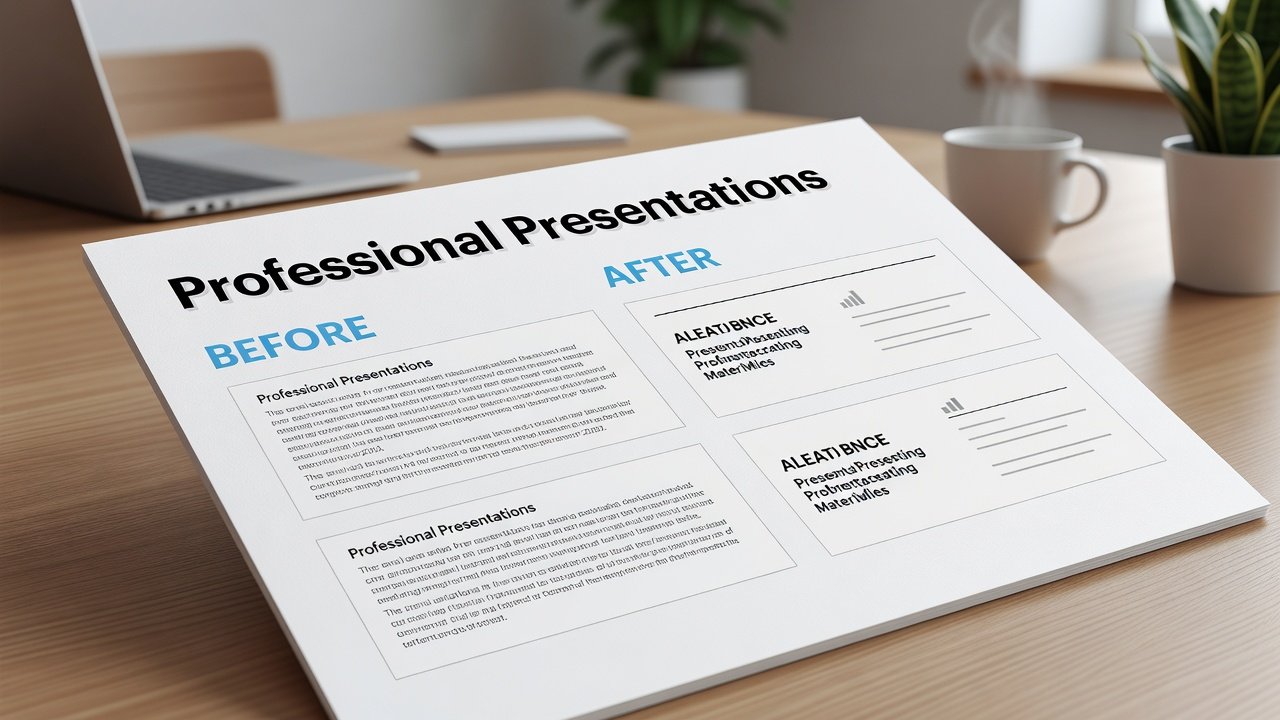
Before: "Presented at 2025 Global Health Conference."
After: "Delivered keynote on public health data analytics at the 2025 Global Health Conference, influencing policy recommendations adopted by three organizations."
Another example for a marketing professional: "Presented case study on content strategy at Content Marketing World 2025, generating 1,200 new leads for the company." A software engineer pivoting to consulting might list: "Led workshop on scalable cloud architectures at AWS re:Invent 2025, training 150 attendees and securing two new client engagements." These transformations show how to shift focus from the event itself to the professional outcomes achieved.
Keyword Integration Tips
Review target job postings for keywords such as "public speaking," "thought leadership," "research presentation," and "industry conference." Naturally incorporate these terms into bullet points and your professional summary. Tools like LinkedIn job alerts help identify trending phrases. Integrate keywords without stuffing by weaving them into achievement statements, such as "Utilized advanced data visualization techniques during thought leadership presentation at regional analytics conference." Update your LinkedIn profile simultaneously with matching language to create consistency across platforms, boosting visibility in recruiter searches.
Step-by-Step Checklist
- Identify 3–5 most relevant presentations for the role.
- Choose the appropriate section heading based on experience level.
- Apply consistent formatting and citation style throughout.
- Add quantifiable achievements where possible, including audience reach and outcomes.
- Proofread for grammar, spelling, and ATS compatibility using multiple tools.
- Tailor entries to each application by prioritizing relevance.
- Cross-reference with your LinkedIn and portfolio for alignment.
- Seek feedback from a mentor or career coach on clarity and impact.
Before-and-After Samples
Before sample entry:
Conference Presentation
Annual Data Science Summit, 2025
After sample entry:
Featured Presenter, Annual Data Science Summit
Presented machine learning optimization techniques to 300 industry professionals, leading to two published case studies (2025).
Additional before-and-after for education sector: Before – "Conference talk on curriculum design." After – "Facilitated interactive session on innovative curriculum design at National Education Summit 2025, resulting in adoption by five school districts."
Common Pitfalls to Avoid
- Listing every presentation without relevance filtering, which dilutes focus.
- Using overly academic jargon that hiring managers may not understand.
- Omitting dates, conference names, or locations that provide necessary context.
- Placing presentations in the wrong section of the resume, such as mixing with unrelated volunteer work.
- Failing to update entries for virtual or hybrid events, missing opportunities to highlight adaptability.
- Exaggerating impact without evidence, which can be flagged during background checks.
Mid-Career Pivots and Transferable Skills
Professionals changing careers should emphasize skills like stakeholder communication, project leadership, and cross-functional collaboration demonstrated through presentations. Highlight how conference experience prepared you for client-facing or training responsibilities in the new industry. For example, a former teacher entering corporate training can stress audience engagement metrics and content customization abilities. Mid-career individuals often have a rich history of events; prioritize those that demonstrate evolution in expertise over time. This angle not only strengthens the resume but also prepares you for behavioral interview questions about adaptability and growth.
Conclusion
Effectively listing conference presentations requires strategic selection, precise formatting, and a focus on measurable impact. By following the steps outlined, you can transform these experiences into powerful resume assets that support your career goals in 2026 and beyond.
FAQ
How should I list virtual versus in-person conference presentations?
Treat both formats similarly but note the delivery method when relevant: "Presented virtually at the 2026 Remote Work Summit" or "Delivered in-person session at the 2025 Marketing Expo, Chicago." Virtual events can highlight technical proficiency with platforms like Zoom or Hopin, adding another layer of modern skill demonstration.
Which citation tools are recommended for resume entries?
Popular options include Zotero, Mendeley, and the built-in citation features in Microsoft Word. For quick formatting, reference LinkedIn Learning courses on professional writing. These tools ensure accuracy and save time when updating multiple entries across applications.
Should I include poster presentations?
Yes, if space allows and they demonstrate relevant expertise. List them under a subheading like "Poster Presentations" to keep the main section focused on oral presentations. Posters often involve one-on-one interactions that showcase your ability to explain concepts conversationally.
How many presentations should appear on a resume?
Limit to the most recent and impactful 3–6 entries unless you are applying for academic or research-intensive roles where a longer list may be appropriate. Quality always outweighs quantity, so select those most aligned with the job's required competencies.

No comments yet. Be the first!