 Jobboy

Introduction
In the evolving job market of 2026, professional certifications serve as powerful differentiators that can elevate a resume above the competition. Job seekers face increasing scrutiny from both automated applicant tracking systems (ATS) and human recruiters who seek evidence of up-to-date skills and dedication to continuous learning. This comprehensive guide explores optimal strategies for showcasing certifications to maximize visibility, improve ATS scoring, and capture recruiter attention. We will examine placement decisions, formatting best practices, industry-specific examples, and common mistakes to avoid, providing actionable advice tailored to 2026 hiring trends.
Why Certifications Matter More Than Ever in 2026
Certifications validate specialized expertise and signal to employers that a candidate has invested time and effort in mastering current industry standards. With rapid technological advancements and shifting workplace demands, employers prioritize verified skills over general experience alone. Data from labor market analyses indicate that candidates listing relevant certifications often experience improved response rates during application reviews. These credentials help bridge gaps for career changers and demonstrate readiness for specialized or leadership positions. In fields like technology, healthcare, and project management, certifications frequently appear as preferred or required qualifications in job postings, making them essential tools for standing out.
Prioritizing the Right Certifications for Your Target Role
Selecting which certifications to include requires careful analysis of the job description and industry requirements. Begin by extracting key skills and keywords from multiple postings for your desired position. Focus on credentials that directly align with those needs rather than including every certificate earned. For example, a software developer might emphasize cloud computing certifications while deprioritizing unrelated project management ones. Limit the total to three to five entries to maintain focus and avoid overwhelming readers. Consider recency, issuing body reputation, and ongoing relevance when ranking options. This targeted approach ensures your resume remains concise yet impactful.
Strategic Placement: Dedicated Section Versus Integration with Experience
The decision between a standalone certifications section and integration within your professional experience depends on your career level and the credential's context. A dedicated section titled "Certifications" or "Professional Credentials" works effectively for entry-level candidates, recent graduates, or professionals holding multiple relevant qualifications. This placement allows quick scanning by recruiters and ATS software. Conversely, integrating certifications beneath specific job entries provides valuable context, such as noting how a certification supported achievements in a particular role. Mid-career professionals often benefit from this method when highlighting on-the-job learning. Hybrid approaches, such as a brief certifications section supplemented by inline mentions, can also work for complex profiles. Always use standard headings to ensure ATS compatibility and test your resume layout with sample applications.
Formatting Best Practices for Readability and ATS Success
Effective formatting enhances both human readability and machine parsing. List each certification with the full name, issuing organization, completion date, and any identification numbers if relevant. Use consistent date formats such as "Month Year" and avoid abbreviations unless widely recognized. Bullet points under each entry can highlight related skills or projects, but keep descriptions brief. Steer clear of tables, columns, or images that may confuse ATS parsers. Incorporate keywords naturally from the job posting to improve matching scores. Professional fonts like Arial or Calibri in 10-12 point size maintain clarity across digital and printed versions.
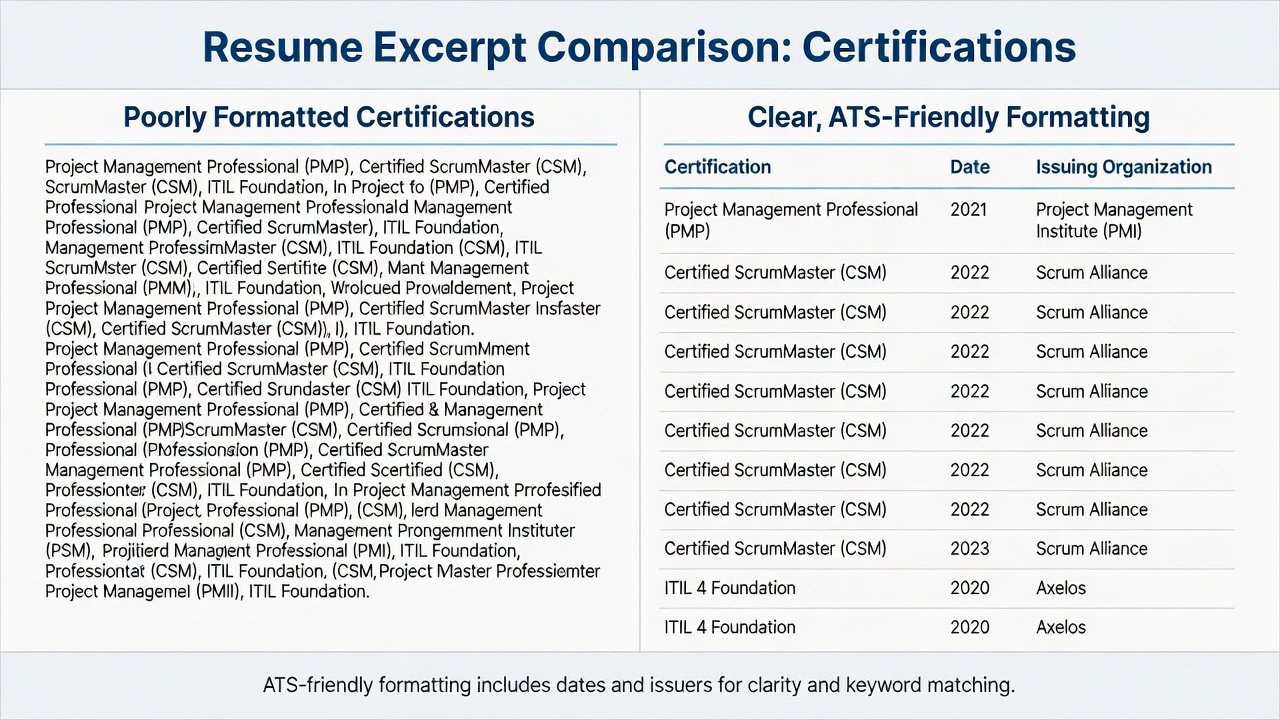
Real-World Examples Across Multiple Industries
Consider an IT professional applying for a cybersecurity role: a strong entry would read "CompTIA Security+ – CompTIA, Issued June 2024, Credential ID: ABC123" placed in a dedicated section, followed by a note on how it supported network defense projects. In healthcare, a nurse might integrate BLS certification under a clinical experience bullet, stating "Maintained BLS certification to ensure emergency response readiness during patient care." Marketing specialists can feature Google Analytics certification near campaign results, showing measurable improvements in traffic analytics. Poor examples include vague listings like "Got certified" without dates or issuers, which fail to convey credibility. Across industries, the strongest resumes tie certifications directly to tangible outcomes or required skills listed in the target job.
Step-by-Step Guide to Adding Certifications Effectively
- Collect all earned certifications and verify current status through issuing organizations.
- Analyze target job descriptions to identify matching keywords and required skills.
- Rank certifications by relevance and recency, selecting only the strongest three to five.
- Decide on placement strategy based on your experience level and credential context.
- Format each entry consistently with full names, dates, and issuers for ATS optimization.
- Incorporate supporting details such as how the certification contributed to past achievements.
- Review the full resume for balance, ensuring certifications complement rather than overshadow core experience.
- Run the document through free ATS checking tools and request feedback from industry peers.
Common Pitfalls and How to Avoid Them
- Including expired or outdated certifications without context can raise questions about current competency.
- Overloading the document with too many entries dilutes the impact of the most relevant ones.
- Using non-standard abbreviations or incomplete names confuses both ATS systems and recruiters.
- Placing certifications in unconventional locations, such as footers or sidebars, reduces visibility.
- Failing to connect credentials to job requirements misses opportunities to demonstrate direct value.
Handling Expired Certifications: Expanded FAQ
Q: Should expired certifications still appear on my resume? A: Include them selectively when they remain relevant to the role, clearly noting the original issue date and any plans for renewal to maintain transparency.
Q: What is the best way to update a resume after a certification lapses? A: Remove the entry if it no longer adds value, or move it to a brief "Additional Training" section if space permits and the credential retains some recognition.
Q: How do recruiters view lapsed credentials in 2026? A: Most understand that certifications require periodic renewal; honesty paired with evidence of ongoing professional development builds trust more effectively than omission.
Conclusion
Mastering the presentation of certifications on your resume positions you strongly in the 2026 job market. By thoughtfully prioritizing relevant credentials, choosing optimal placement, and applying consistent formatting, you enhance both ATS performance and recruiter engagement. Apply the step-by-step recommendations and avoid common pitfalls to create a compelling document that highlights your qualifications effectively. For additional career guidance, explore resources from Bureau of Labor Statistics, CareerOneStop, LinkedIn, and Indeed.


No comments yet. Be the first!