 Jobboy

Introduction
Applying for jobs can feel overwhelming, especially when you're casting a wide net across multiple positions. But here's a game-changing tip: one-size-fits-all resumes rarely cut it in today's competitive job market. Tailoring your resume for each application isn't just a nice-to-have—it's essential for standing out to recruiters and applicant tracking systems (ATS). By customizing your document to align with the specific job description, you demonstrate genuine interest and relevance, increasing your chances of landing an interview.
In this comprehensive guide, we'll dive deep into why tailoring matters, how to analyze job postings effectively, and practical steps to revamp your resume. We'll also explore real-world examples across industries like tech, marketing, and healthcare. Whether you're a recent graduate or a seasoned professional switching careers, these strategies will help you craft a resume that speaks directly to the employer's needs. Let's get started on transforming your generic resume into a targeted powerhouse.
Why Tailoring Your Resume is Essential
Imagine submitting the same resume to a software engineering role and a sales position—recruiters would immediately spot the mismatch. Tailoring shows you've done your homework and positions you as the ideal candidate. Studies from the LinkedIn platform reveal that customized resumes are 40% more likely to result in callbacks. Here's why it works:
- Beats ATS Filters: Many companies use automated systems to screen resumes. By incorporating keywords from the job description, your resume passes these initial hurdles.
- Highlights Relevance: Recruiters spend an average of 7-10 seconds scanning a resume. Tailoring ensures the most pertinent info jumps out first.
- Demonstrates Fit: It proves you understand the role and company, making you memorable in a sea of applicants.
- Boosts Confidence: A well-tailored resume aligns your experiences with the job, helping you feel more prepared for interviews.
Without customization, even a stellar resume risks being overlooked. The effort pays off: tailored applications can shorten your job search by weeks or months.
Step 1: Analyze the Job Description Thoroughly
The foundation of tailoring starts with dissecting the job posting. Don't skim—treat it like a treasure map for your resume keywords and themes. Begin by identifying the core requirements:
- Key Responsibilities: Note action verbs like 'manage,' 'develop,' or 'analyze.' Mirror these in your experience bullets.
- Required Skills: List technical (e.g., Python, SEO tools) and soft skills (e.g., leadership, communication). Prioritize those you possess.
- Qualifications: Match your education, certifications, or years of experience to what's asked.
- Company Culture: Research the employer's values via their website or Glassdoor reviews to infuse subtle alignments, like emphasizing teamwork for collaborative environments.
For instance, if the job emphasizes 'cross-functional collaboration,' weave that phrase into your professional summary. Tools like Jobscan or Resunate can help scan your resume against the description for keyword matches, ensuring ATS compatibility. Spend 15-20 minutes per job on this analysis—it's time well invested.
Step 2: Customize Your Professional Summary
Your resume's opening act, the professional summary (or objective), sets the tone. This 3-5 sentence paragraph should be a mini-pitch tailored to the role. Avoid generic statements like 'Hardworking professional seeking opportunities.' Instead, lead with the job title and key qualifications.
Example for a Marketing Coordinator role: 'Dynamic Marketing Coordinator with 4+ years in digital campaigns and content strategy. Proven track record in boosting engagement by 30% through SEO-optimized content at XYZ Agency. Eager to leverage analytics skills to drive Brand ABC's growth initiatives.'
For a Project Manager position: 'Results-oriented Project Manager skilled in Agile methodologies and stakeholder communication. Led cross-team projects delivering $500K in savings at Tech Firm Inc. Passionate about optimizing processes for innovative solutions at Global Corp.'
This section hooks the reader immediately, so revise it for every application to reflect the job's essence.
Step 3: Highlight Relevant Work Experience and Skills
Now, the meat of your resume: work history and skills sections. Prioritize experiences that align with the job—don't list everything chronologically if it's irrelevant.
Revamping Work Experience
Under each job, use 4-6 bullet points focusing on achievements, quantified where possible (e.g., 'Increased sales by 25%' vs. 'Handled sales'). Tailor by:
- Selecting Roles: Feature recent or relevant positions first. For a career changer, emphasize transferable skills from older jobs.
- Using Keywords: Incorporate job-specific terms naturally, like 'data visualization' for analytics roles.
- Quantifying Impact: Numbers make your contributions tangible and memorable.
Avoid fluff; every bullet should answer, 'How does this make me perfect for this job?'
Optimizing the Skills Section
List 8-12 skills in a bulleted or columnar format, prioritizing those from the job description. For a tech job, lead with 'JavaScript, React, SQL'; for sales, 'CRM software, negotiation, lead generation.' Include both hard and soft skills to show well-roundedness.
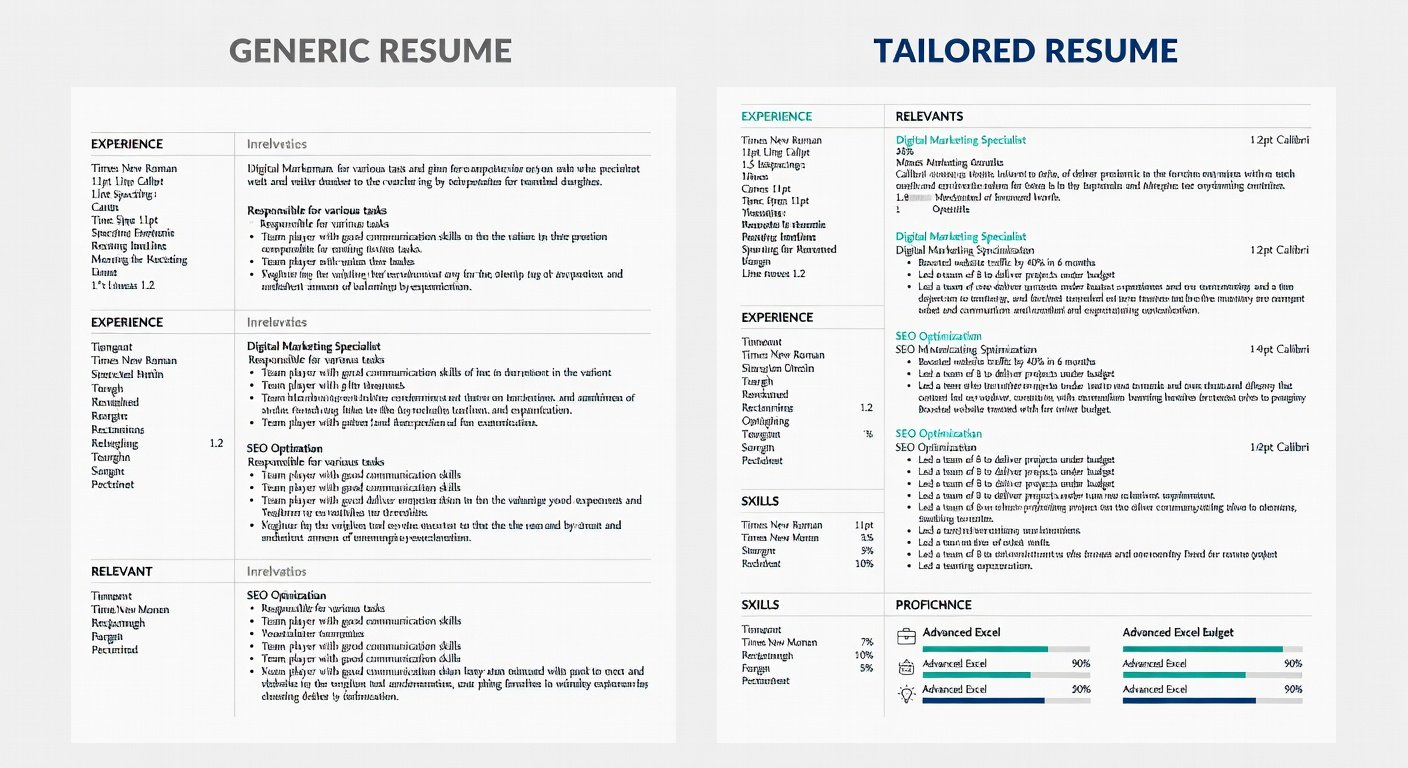
As shown in the visual above, a tailored skills section can transform a generic list into a targeted toolkit. Remember, honesty is key—only include skills you can discuss in an interview.
Industry-Specific Examples of Tailored Resumes
To make this concrete, let's examine how tailoring varies by industry. We'll use a fictional candidate, Alex Johnson, with a background in communications and project coordination.
Tech Industry: Software Developer Role
For a developer position at a startup, Alex emphasizes coding projects and tools. Professional Summary: 'Full-Stack Developer with expertise in JavaScript and cloud services. Built scalable web apps at Innovate Labs, reducing load times by 40%.'
Work Experience Bullet: 'Developed RESTful APIs using Node.js, integrating with AWS for seamless data flow—directly relevant to the job's backend focus.'
Skills: JavaScript, Python, Docker, Git.
This version buries unrelated marketing experience at the bottom or omits it entirely.
Marketing Industry: Digital Marketer Role
Shifting to marketing, Alex highlights campaign metrics. Summary: 'Creative Digital Marketer skilled in SEO and social media strategy. Drove 50% traffic growth via targeted campaigns at Media Co.'
Bullet: 'Managed Google Ads budgets exceeding $10K/month, achieving 15% ROI improvement—aligning with the role's performance marketing needs.'
Skills: Google Analytics, HubSpot, Content Creation, A/B Testing.
Tech jargon takes a backseat to creative and analytical prowess.
Healthcare Industry: Administrative Coordinator Role
In healthcare, compliance and patient focus shine. Summary: 'Detail-oriented Administrative Coordinator with HIPAA training and experience in patient scheduling. Streamlined operations at Health Clinic, cutting wait times by 20%.'
Bullet: 'Coordinated multidisciplinary teams for 200+ patient cases weekly, ensuring regulatory compliance—mirroring the job's emphasis on efficient care delivery.'
Skills: EHR Systems, Microsoft Office, Customer Service, Regulatory Knowledge.
Here, soft skills like empathy are amplified alongside administrative tools.
These examples illustrate flexibility: always adapt to the sector's language and priorities. For more templates, check resources from the Indeed career advice hub.
Common Mistakes to Avoid When Tailoring
Even with good intentions, pitfalls can undermine your efforts. Steer clear of these:
- Overloading with Keywords: Stuffing feels robotic; integrate naturally.
- Ignoring Formatting: Use clean, ATS-friendly fonts like Arial (10-12 pt) and standard headings. Avoid tables or images that confuse parsers.
- Being Too Lengthy: Keep it to one page for most roles; two max for senior positions.
- Neglecting Proofreading: Typos scream carelessness—use tools like Grammarly.
- Copy-Pasting Blindly: Ensure changes make sense in context; a mismatched bullet can backfire in interviews.
Finally, track your versions with filenames like 'Resume_MarketingRole_v1.pdf' to avoid mix-ups.
Tools and Additional Tips for Efficiency
Tailoring doesn't have to be tedious. Leverage these:
- Resume Builders: Platforms like Canva or Novoresume offer customizable templates.
- Keyword Tools: Free ATS scanners from Jobscan help optimize quickly.
- Version Control: Maintain a 'master resume' with all experiences, then trim for each app.
Tip: Tailor your LinkedIn profile similarly for recruiter visibility. And always follow up with a customized cover letter to reinforce your fit. For official career guidance, visit the U.S. Department of Labor website.
Conclusion
Tailoring your resume is a strategic investment that pays dividends in interviews and offers. By analyzing job descriptions, customizing key sections, and learning from industry examples, you'll create documents that resonate with hiring managers. Remember, the goal is authenticity—showcase your unique value without exaggeration. Start with your next application today, and watch how this small effort amplifies your job search success. With persistence and precision, your dream role is within reach.


No comments yet. Be the first!