 Jobboy

Introduction to Succession Planning for Retention
In 2026, organizations face intense competition for talent, making succession planning a critical component of talent acquisition and HR strategies. Rather than treating it as a reactive measure for leadership gaps, forward-thinking companies use it as a proactive retention tool. This guide provides HR leaders with comprehensive frameworks to identify high-potential employees, build development pathways, and integrate succession plans with hiring processes for long-term workforce stability.
Effective succession planning goes beyond standard onboarding or referral programs by fostering internal mobility and career growth. Research from the Society for Human Resource Management highlights how structured plans reduce turnover among key talent pools. Companies that invest in these strategies often experience stronger organizational resilience, especially amid economic shifts and evolving workforce expectations.
Why Succession Planning Drives Retention in 2026
Employees who see clear advancement opportunities are significantly more likely to stay with their organizations. Succession planning signals investment in internal talent, which strengthens loyalty and reduces voluntary exits. It also aligns workforce development with business goals, creating a pipeline of ready leaders who understand company culture and operations deeply.
Key benefits include higher engagement, knowledge retention, and cost savings from reduced external recruitment. By prioritizing internal development, companies build resilience against market disruptions. In practice, this approach helps mitigate risks associated with sudden departures of key personnel, ensuring continuity in critical functions such as operations, innovation, and client relations.
Step-by-Step Implementation Framework
Implementing succession planning requires a structured approach. Follow these phases for success:
- Assess Organizational Needs: Conduct a talent audit to map critical roles and future skill requirements. Involve department heads to forecast needs over the next three to five years.
- Identify High-Potential Employees: Use performance data, leadership assessments, and 360-degree feedback to spot emerging leaders. Incorporate behavioral interviews and potential evaluations.
- Create Individual Development Plans: Design personalized pathways including mentorship, training, and stretch assignments tailored to each candidate's strengths and gaps.
- Integrate with Hiring Processes: Align succession data with talent acquisition to balance internal promotions and external hires effectively.
- Monitor and Adjust: Review plans quarterly and update based on business changes, performance outcomes, and emerging skill demands.
This framework ensures scalability while addressing compliance with employment laws. Organizations should document every stage to support transparency and legal defensibility.
Identifying High-Potential Employees
High-potential identification relies on objective criteria such as consistent performance, learning agility, and leadership behaviors. Tools like competency models and predictive analytics help HR teams make data-driven selections. Avoid bias by incorporating diverse evaluators and structured interviews that focus on observable evidence rather than subjective impressions.
Real-world examples include tech firms using AI-powered talent platforms to flag rising stars early, leading to improved retention rates. Mid-sized manufacturers have also succeeded by combining manager nominations with formal assessment centers that simulate real leadership challenges.
Creating Development Pathways
Development pathways should combine formal training with experiential learning. Examples include rotational programs, executive coaching, and cross-functional projects that expose employees to different parts of the business. Pair these with regular check-ins to track progress and adjust goals dynamically.
Successful pathways emphasize both technical skills and soft skills like strategic thinking, preparing employees for senior roles. Companies often layer in sponsorship programs where senior leaders advocate for high-potentials during talent reviews, accelerating visibility and opportunities.
Integrating Succession Plans with Hiring Processes
Succession planning complements talent acquisition by reducing reliance on external hires for leadership positions. When integrated, it creates a seamless flow from identification to promotion, minimizing disruptions. HR teams should share succession data with recruiters so external searches only target roles without ready internal candidates.
Internal Promotion vs External Hiring: A Comparison
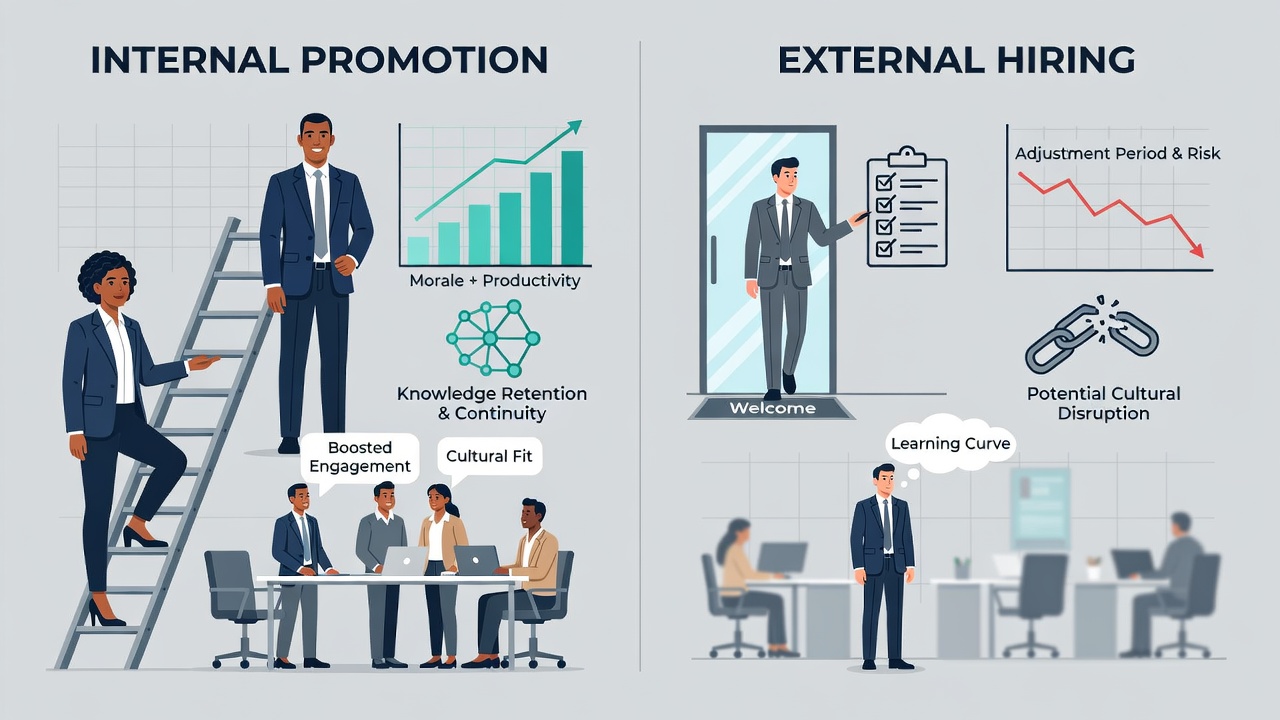
Internal promotions often yield faster onboarding and cultural fit, boosting retention. External hiring brings fresh perspectives but can increase costs and time-to-productivity. A balanced approach—typically favoring a majority of internal moves for key roles—optimizes both stability and innovation.
- Internal Promotion Impacts: Higher engagement, lower turnover, preserved institutional knowledge, and quicker productivity ramps.
- External Hiring Impacts: New ideas and specialized expertise, but potential cultural clashes and longer ramp-up periods that affect team dynamics.
Many organizations aim for a 60-80% internal fill rate on leadership vacancies to maintain momentum while still injecting external talent strategically.
Metrics for Tracking Success
Measure effectiveness with KPIs such as internal promotion rates, retention of high-potentials, time-to-fill leadership roles, and employee engagement scores. Track these quarterly to demonstrate ROI and refine strategies. Additional metrics include succession plan coverage ratios (percentage of critical roles with at least two ready successors) and development plan completion rates.
Regular reporting to leadership helps maintain accountability and secures ongoing resources for the program.
Common Pitfalls to Avoid
Many organizations fail by neglecting regular updates, overlooking diversity, or treating plans as static documents. Other mistakes include insufficient communication with employees and lack of executive buy-in. Mitigate these through ongoing training and transparent processes that encourage feedback from all levels.
Another frequent issue is focusing only on top leadership while ignoring mid-level and specialized roles that are equally vital to operations. Expanding the scope gradually prevents bottlenecks when multiple key employees depart simultaneously.
Practical Checklists for HR Leaders
- ☐ Conduct annual talent reviews with cross-functional input
- ☐ Document development plans for all identified successors
- ☐ Align plans with diversity and inclusion goals
- ☐ Test plans through scenario simulations and tabletop exercises
- ☐ Review compliance with labor regulations from the U.S. Department of Labor
- ☐ Communicate expectations clearly to participants without creating entitlement
- ☐ Update plans after major organizational changes or restructurings
- ☐ Provide resources for managers to support development conversations
Real-World Company Examples
Companies like General Electric have long used robust succession systems to maintain leadership continuity across decades. Modern examples from consulting firms show how digital tools enhance tracking and scalability in 2026 environments. Retail organizations have applied similar models to store manager pipelines, resulting in lower turnover and stronger customer satisfaction scores.
Technology's Role in 2026 Succession Planning
Advanced HR platforms now incorporate machine learning to predict flight risks and recommend personalized development activities. Integration with performance management systems allows real-time updates to successor readiness ratings, making the process more agile and data-informed.
FAQ on Compliance and Scalability in 2026
How does succession planning address legal compliance?
Ensure plans comply with equal employment opportunity laws by documenting objective criteria and avoiding discriminatory practices. Consult legal experts for jurisdiction-specific requirements and maintain thorough records.
Can succession planning scale for small to mid-sized businesses?
Yes, start with core roles and use affordable HR software. Focus on simplicity before expanding to full organizational coverage. Many SMBs begin with a single department and grow the program over two to three years.
What role does technology play in 2026?
AI and analytics platforms enable real-time tracking, predictive modeling, and personalized development recommendations for scalable execution across global teams.
How often should succession plans be reviewed?
Quarterly reviews are recommended, with deeper annual audits that incorporate strategic planning cycles and workforce analytics.
Conclusion
Succession planning in 2026 transforms retention by creating visible career paths and building internal capability. By following the frameworks outlined, HR leaders can achieve sustainable workforce stability and competitive advantage. Begin with a pilot program focused on critical roles to demonstrate quick wins and build momentum across the organization.

No comments yet. Be the first!