 Jobboy

Introduction to Internal Talent Marketplaces and ROI Tracking
In 2026, internal talent marketplaces have become essential tools for organizations seeking to optimize workforce agility without heavy external hiring costs. These platforms connect employees with internal opportunities, projects, and skill-building roles, fostering mobility and reducing turnover. HR teams must demonstrate clear business value through precise ROI metrics to secure ongoing investment and leadership buy-in. As companies navigate evolving talent landscapes, the ability to quantify returns on these platforms separates strategic HR functions from administrative ones.
Quantifying impact involves tracking indicators such as internal mobility rates, retention improvements, and skill gap closures. This article provides step-by-step guidance on leveraging existing ATS and HRIS data for dashboards, real-world calculation examples, and strategies to avoid common tracking errors. By building robust measurement frameworks, teams can link marketplace activity directly to productivity enhancements and financial outcomes.
Key Performance Indicators for Measuring Impact
Effective ROI assessment starts with selecting the right KPIs. Internal mobility rate measures the percentage of roles filled by current employees versus external hires. Retention lift tracks reductions in voluntary turnover among marketplace participants compared to non-participants. Skill gap reduction quantifies how quickly employees acquire in-demand competencies through internal assignments.
Additional metrics include time-to-productivity for new internal roles and cost savings from avoided external recruitment. Align these with company objectives like productivity gains by correlating mobility data with performance reviews. For instance, calculate mobility rate as (internal placements / total placements) x 100. Retention lift can be derived by comparing annual turnover percentages: if marketplace users show 12% turnover versus 22% for others, the lift equals a 45% relative improvement.
Further KPIs encompass employee engagement scores post-assignment and net promoter scores for the marketplace itself. These provide a holistic view when combined with core metrics, allowing HR to demonstrate multifaceted value.
Setting Up Dashboards Using ATS and HRIS Data
Begin by auditing your Applicant Tracking System (ATS) and Human Resource Information System (HRIS) for relevant fields such as job postings, employee movements, and training records. Integrate these via APIs or export tools to create unified views. Many organizations start with systems like Workday or Greenhouse, exporting CSV files for initial analysis before moving to live connections.
Step 1: Define baseline data from the prior year, pulling historical mobility and retention figures. Step 2: Map marketplace activity fields to standard reports, ensuring every internal application and placement is tagged accurately. Step 3: Build automated dashboards in tools like Power BI or Tableau pulling live data, incorporating filters for department, role level, and tenure. Step 4: Schedule monthly refreshes to monitor trends and set alerts for significant deviations.
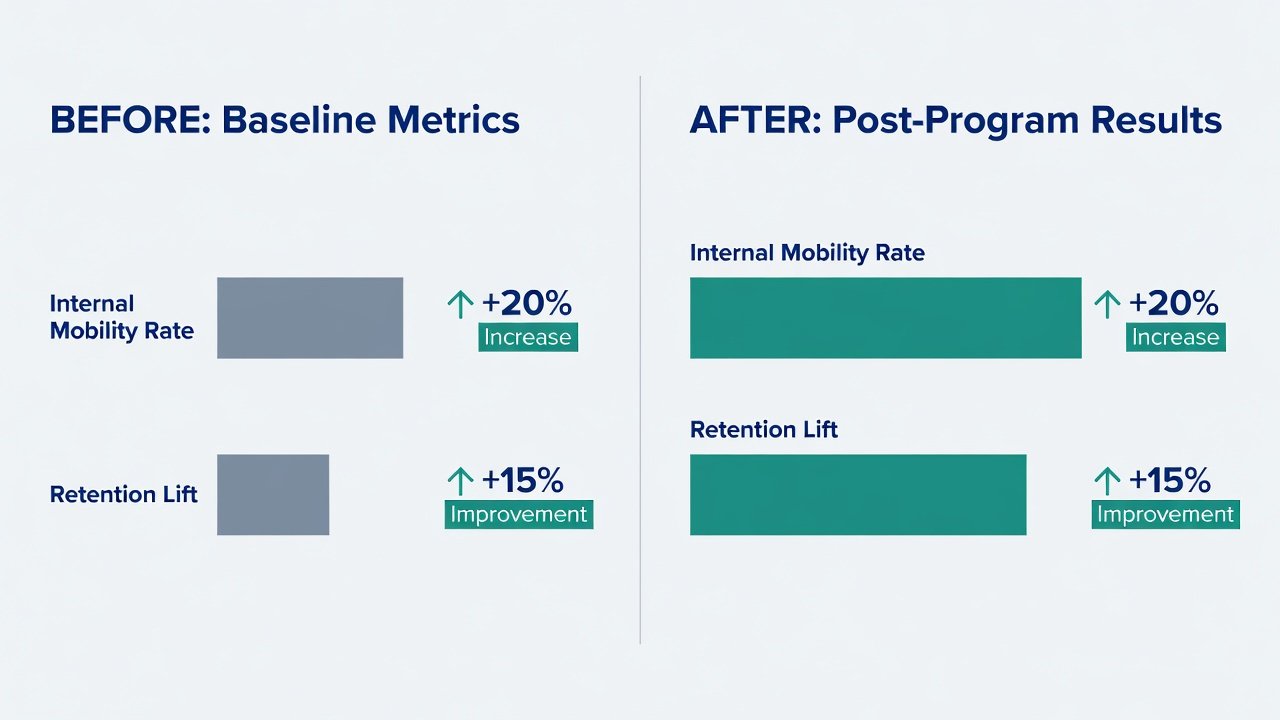
Before-and-after example: Pre-implementation mobility rate stood at 18% in Q4 2025. Post-launch in early 2026, it rose to 32%, representing a 78% relative increase calculated as (32-18)/18. Another example involves skill gaps: a baseline assessment showed 45% of critical roles had gaps; after six months of marketplace-driven assignments, this dropped to 28%, a 38% reduction.
Expand this setup by incorporating data validation checks to prevent duplicates and training HR analysts on query building for custom reports.
Common Pitfalls in ROI Tracking and How to Avoid Them
Many teams over-rely on vanity metrics without context, such as total platform logins instead of actual placements. Another issue is failing to control for external factors like economic shifts affecting retention. Ensure data segmentation by department and tenure to isolate marketplace effects. A frequent error involves ignoring selection bias, where high performers self-select into the platform, inflating results.
Advanced analytics approaches use predictive modeling for future ROI projections, while simple methods rely on basic spreadsheets. The former offers deeper insights but requires more resources; compare both for balanced reporting. To mitigate pitfalls, conduct regular audits and cross-reference with qualitative employee surveys. SHRM provides frameworks for ethical metric use that can guide these processes.
Advanced methods might integrate AI to forecast long-term retention based on mobility patterns, whereas simple approaches focus on quarterly snapshots.
Aligning Metrics with Broader Company Goals
Connect talent marketplace outcomes to cost savings by calculating reduced recruiting spend and productivity boosts via faster role fulfillment. For example, link mobility improvements to goals around innovation by measuring how many new projects are staffed internally. Report these to leadership using templates that include executive summaries, trend charts, and recommended actions.
Practical reporting template structure: Overview slide with top KPIs, detailed calculations section, benchmark comparisons against industry standards, and next-quarter forecasts. Align specifically with productivity by tracking output metrics pre- and post-assignment for participants. This ensures metrics support strategic priorities like digital transformation or market expansion.
Simple vs. Advanced Analytics Approaches
- Simple: Manual Excel tracking of mobility counts and basic retention percentages, suitable for teams with limited tech resources. Update monthly and visualize with basic charts.
- Advanced: Machine learning integration for skill gap forecasting and automated anomaly detection in HRIS feeds, enabling proactive interventions and scenario modeling.
Choose based on team capacity, starting simple and scaling as data maturity grows. A hybrid model often works best, beginning with spreadsheets for quick wins before layering in advanced tools.
Conclusion and Long-Term Strategies
By consistently applying these methods, HR leaders can prove the sustained value of internal talent marketplaces. Focus on privacy-compliant data practices and iterative metric refinement for enduring success. Over time, embed these measurements into annual business reviews to maintain alignment with evolving organizational needs.
FAQs
How do we ensure data privacy in ROI tracking? Use anonymized aggregates and comply with regulations like GDPR by limiting access to authorized personnel only. Conduct impact assessments before launching new dashboards.
What are effective long-term measurement strategies? Establish annual reviews that incorporate multi-year trend analysis and employee feedback loops to refine KPIs over time. Partner with data scientists for continuous improvement.
How often should dashboards be updated? Aim for real-time where possible, with at least weekly reviews during initial rollout phases to catch issues early.
Can small companies benefit from these metrics? Yes, even with basic tools, tracking a few core KPIs provides actionable insights without complex infrastructure.

No comments yet. Be the first!