 Jobboy

Introduction to Executive Equity in Private Firms
Negotiating equity compensation in private companies requires a distinct approach compared to public markets. In 2026, executives must focus on instruments like phantom stock, profit-sharing plans, and long-term incentives tailored to illiquid environments. These tools help maximize total compensation beyond base salary by aligning personal rewards with company growth projections and exit events.
Private firms often lack the liquidity of public stock, making structures that simulate ownership without actual shares essential. This article explores proven strategies, valuation techniques, tax considerations, vesting frameworks, and practical negotiation scripts drawn from tech and finance sectors. Executives who understand these nuances can secure packages that deliver meaningful upside while managing downside risks associated with illiquidity and uncertain timelines.
Key Equity Instruments Unique to Private Companies
Phantom stock plans grant executives the right to receive cash or stock equivalent to the value of company shares upon a triggering event, such as an exit or vesting milestone. These plans avoid actual share issuance, preserving ownership control for founders while providing economic alignment. Profit-sharing arrangements distribute a portion of annual profits based on performance metrics like EBITDA or revenue thresholds, offering immediate cash flow without dilution. Long-term incentives tie payouts to multi-year goals such as revenue targets, customer retention rates, or successful funding rounds.
These differ from public company RSUs, which vest into actual shares with immediate market value. In private settings, the emphasis shifts to contractual protections and exit-event triggers to ensure liquidity. For instance, a tech startup might structure phantom stock to pay out only upon a Series D round or IPO, while a finance firm could use profit-sharing to reward partners based on fund performance cycles.
Valuation Methods for Private Equity Awards
Accurate valuation forms the foundation of any negotiation. Common methods include the discounted cash flow approach, comparable company analysis, and option pricing models adapted for illiquid assets. Executives should request independent appraisals compliant with IRS guidelines to establish fair market value at grant. A hybrid model often works best, blending revenue multiples with projected exit valuations.
Finance sector examples frequently incorporate both current asset values and anticipated returns from portfolio companies. Tech firms prioritize growth rate assumptions and user acquisition metrics in their calculations. Always demand a fresh 409A valuation before finalizing terms to avoid disputes later.
Tax Implications and Compliance
Tax treatment significantly impacts net value. Phantom stock is typically taxed as ordinary income upon payout, subject to withholding at the executive's marginal rate. Profit-sharing may qualify for deferred taxation if structured as a qualified plan. Long-term incentives can trigger capital gains treatment under certain conditions if held long enough post-payout. Always consult IRS resources for current rules on deferred compensation under Section 409A.
Public RSUs face different timing rules, often triggering immediate taxation at vesting. Private structures allow greater flexibility but demand careful planning to avoid penalties. Executives should model after-tax proceeds under multiple scenarios, factoring in state taxes and potential changes in federal rates. In one finance sector case, improper structuring led to unexpected 37% ordinary income taxation instead of favorable capital gains treatment.
Vesting Structures and Schedules
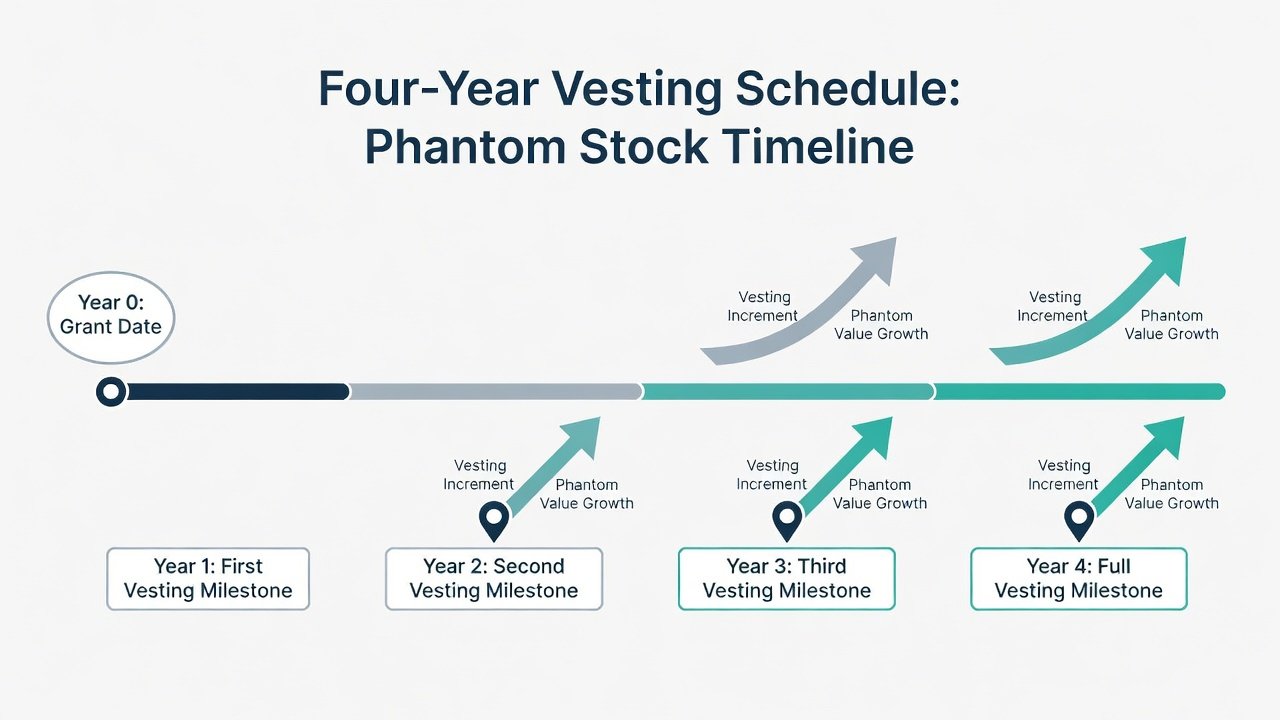
Standard vesting includes four-year schedules with a one-year cliff, followed by monthly or quarterly increments. Acceleration clauses for change of control protect executives during acquisitions by vesting 50-100% of unvested awards. Negotiate for partial acceleration on termination without cause to mitigate risk, typically 12-24 months of additional vesting credit.
Variations include performance-based vesting tied to milestones such as ARR growth exceeding 30% annually or successful product launches. These structures align incentives tightly with company success but require clear, measurable definitions to prevent ambiguity.
Comparing Private Equity to Public Company RSUs
Public RSUs offer transparency through market pricing but expose holders to volatility and immediate tax events. Private alternatives provide customized upside tied to internal milestones yet carry higher illiquidity risk. A risk assessment framework should weigh probability of exit events against potential dilution from future funding rounds, typically modeled over five- to seven-year horizons.
Key differences include liquidity timing, governance rights, and information access. Private executives often receive more detailed financial updates but lack the ability to sell shares freely on an exchange.
Step-by-Step Negotiation Scripts
- Start by anchoring on total compensation: "Based on 2026 benchmarks, equity should represent 40-60% of my package given the company's growth trajectory and comparable offers in the sector."
- Propose specific instruments: "I suggest 20% phantom stock with annual 409A valuation refreshes plus a profit-sharing component capped at 15% of annual profits."
- Address vesting: "Include a 25% acceleration on change of control plus 12 months of severance-linked acceleration for termination without cause to align with market standards."
- Close with protections: "Add clear definitions for performance metrics and an independent appraisal right every two years."
Risk Assessment Framework
- Evaluate company financial health and funding runway using the latest cap table and burn rate data.
- Model multiple exit scenarios using conservative, base, and optimistic projections over five years.
- Assess personal tax exposure, liquidity needs, and opportunity cost versus public market roles.
- Compare against alternative opportunities by calculating expected value under each equity type.
- Factor in dilution risks from future rounds and anti-dilution protections available.
Real-World Examples from Tech and Finance
In tech, a Series B SaaS startup used profit-sharing tied to ARR milestones, delivering payouts equivalent to two times base salary at a successful exit. Finance executives at a private equity-backed firm negotiated phantom units with ratcheted valuations, protecting against down rounds while capturing upside from operational improvements. These examples highlight the importance of tailoring structures to sector dynamics and growth stage.
Leveraging Company Growth Projections
Request detailed financial forecasts during negotiations. Tie awards to verifiable metrics like net revenue retention above 110% or customer acquisition cost payback under 12 months. This approach maximizes upside when projections exceed expectations and provides objective benchmarks for performance discussions.
FAQs on Common Pitfalls
What are the biggest mistakes in private equity negotiations?
Overlooking 409A compliance and failing to negotiate acceleration clauses often lead to disputes. Always secure written valuation reports and define triggering events precisely.
How can growth projections enhance my package?
Structure incentives around stretch targets supported by board-approved forecasts to capture disproportionate rewards upon outperformance while protecting against under-delivery.
Conclusion
Effective 2026 executive equity negotiation in private firms blends strategic instrument selection, rigorous valuation, and protective terms. By focusing on total compensation maximization and using the frameworks above, leaders can secure packages that reward long-term value creation. Reference authoritative sources such as SEC guidance for broader regulatory context when structuring deals.

No comments yet. Be the first!